Goodman 80000 BTU 80% Efficiency Two Stage Gas Furnace | Variable-Speed ECM Upflow / Horizontal | R32 (GRVT800805DN)
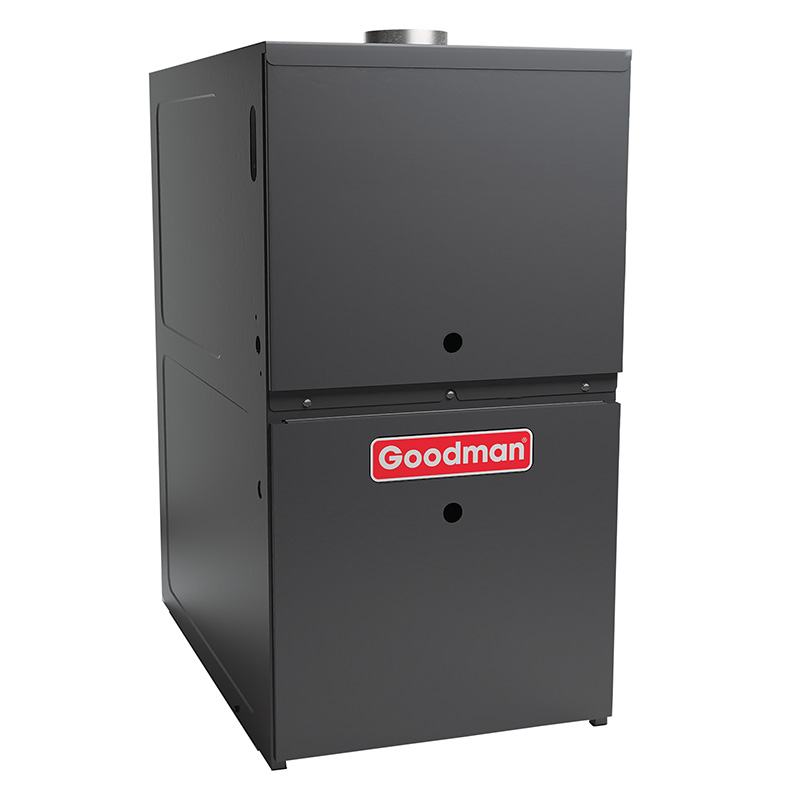
View on AC Direct see your lowest price →Check current price on AC Direct →
Key features
- 80,000 BTU output, 80% AFUE non-condensing two-stage gas furnace
- Variable-speed ECM blower motor for quieter operation and improved airflow efficiency
- Two-stage gas valve runs at reduced capacity on moderate heating days to limit temperature swings
- Upflow and horizontal installation configurations supported
- Compatible with matched Goodman evaporator coils for full system pairing
- Stainless steel primary heat exchanger for corrosion resistance
About this system
The Goodman GRVT800805DN is an 80,000 BTU, 80% AFUE two-stage gas furnace built for upflow or horizontal installation in homes that need solid heating performance without the price tag of a premium brand. The two-stage gas valve lets the furnace run at a lower firing rate on milder days, which reduces temperature swings, cuts short-cycling, and takes some load off the heat exchanger over time. The variable-speed ECM blower motor is the most notable spec here: it ramps airflow gradually, runs quieter than a single-speed motor, and moves more conditioned air per dollar of electricity consumed, making it a meaningful upgrade over a PSC-motor furnace in the same price range.
The 80% AFUE rating means 80 cents of every dollar spent on natural gas becomes usable heat, with the remaining 20% lost through the flue. That is the federal minimum for non-weatherized furnaces in most northern climate zones and sits below the 90%+ condensing tier. For homeowners in mild-to-moderate heating climates, or those replacing a 60% or 70% AFUE unit, the efficiency jump can still be worthwhile. Buyers in cold climates who run their furnace heavily from October through March will generally recover the cost of stepping up to a 96% AFUE condensing unit faster than those further south. The R-32 refrigerant designation in the model number relates to system pairing for matched coil applications rather than the furnace’s direct operation, since furnaces do not use refrigerant themselves.
This unit fits well in a budget-conscious new install or a like-for-like replacement where the existing flue and cabinet space are sized for an 80% unit. It is not the right pick if your utility offers significant rebates only for 95%+ equipment, or if you are in a state with efficiency mandates that require condensing furnaces in new construction. Paired with a matched Goodman coil and a competent installer, the two-stage operation and ECM blower deliver noticeably more comfort than a basic single-stage furnace at a lower upfront cost.
The GRVT800805DN delivers real comfort upgrades over basic single-stage furnaces at a price point that undercuts premium brands by a meaningful margin. The two-stage operation and ECM motor are genuine value adds, not marketing filler. The trade-off is that Goodman's long-term reliability record is below average for premium brands, and getting the most out of this unit depends heavily on proper installation and sizing.
Overall score is the average of the five ratings above.
What we like
- Priced roughly 15 to 25 percent below comparable Trane, Lennox, and Carrier two-stage models
- Variable-speed ECM blower reduces electricity use and noise compared to single-speed PSC motors
- Two-stage firing reduces short-cycling and improves temperature consistency throughout the home
- Upflow and horizontal flexibility makes it usable in a wider range of mechanical room configurations
- Widely stocked by distributors, meaning parts and replacement components are generally available quickly
Trade-offs
- 80% AFUE is the federal minimum efficiency floor, leaving real savings on the table versus 95%+ condensing units in cold climates
- Dual-run capacitors are the most documented failure point across Goodman equipment, typically surfacing after year 5 to 7
- Compressor and component lifespan averages 10 to 14 years across Goodman systems, shorter than premium-brand benchmarks of 15 to 20 years
- Performance is strongly dependent on installer quality, and Goodman's reputation suffers disproportionately from poor installs
What homeowners and pros say about Goodman
Homeowners who research Goodman online quickly find a split picture. On ConsumerAffairs, where the platform’s design attracts frustrated owners more than satisfied ones, Goodman lands around 2.5 out of 5, with the recurring theme being repair costs that climb after roughly year 7. On Google dealer reviews, the picture is less alarming at around 3.8 out of 5, where the most common praise is straightforward: the equipment costs less and it works. For the GRVT800805DN specifically, the variable-speed ECM blower and two-stage operation are the features owners most frequently mention as noticeable improvements over their old single-stage, single-speed units. The complaints that surface most often are not furnace-specific but reflect broader Goodman patterns: dual-run capacitor failures tend to show up after the first few years and are the most commonly reported service call across the product line. They are generally a 300 to 600 dollar fix, not a crisis, but they show up more consistently in Goodman owner experiences than in reviews of Carrier or Trane equipment at the same age.
HVAC technicians who install and service Goodman equipment regularly tend to describe it in practical terms: the equipment is serviceable, parts are easy to find, and the price gap versus premium brands is real. The consistent professional caveat is that Goodman’s performance and longevity lean harder on installation quality than premium brands do. Across Goodman’s lineup, compressors average roughly 10 to 14 years, compared to the 15 to 20 years more commonly cited for Trane, Carrier, and Lennox equipment, and a smaller share of owners report refrigerant-related issues in the first year that experienced techs usually attribute to installation or initial charge problems rather than factory defects. For the GRVT800805DN, the honest professional take is that a skilled installer using this furnace in a properly sized application will get a comfortable, reliable system. The risk rises with a cut-rate install or a unit that is sized wrong for the home.
Sources: ConsumerAffairs Goodman owner reviews, AHRI Directory of Certified Product Performance, U.S. DOE appliance and equipment efficiency standards, Goodman product specification sheets.
How it compares
| Brand | Comparable model | SEER2 | Stage | Price position |
|---|---|---|---|---|
| Goodman | GRVT800805DN | N/A (furnace only) | two-stage | Value pick |
| Carrier | Performance 80 (58TP) | N/A (furnace only) | two-stage | Moderate premium over Goodman, typically 15 to 20 percent higher |
| Trane | S8X2 (XR80 series) | N/A (furnace only) | two-stage | Moderate to significant premium over Goodman, typically 20 to 25 percent higher |
| Lennox | ML180 | N/A (furnace only) | single-stage | Similar to moderate premium over Goodman depending on dealer; Lennox two-stage models step up further in price |
Competitor rows are comparable single-stage units at similar efficiency; price is relative position, not a quote.
Questions about this system
Is 80% AFUE good enough, or should I pay more for a 96% furnace?
In mild-to-moderate heating climates or for replacing a 60-70% AFUE unit, 80% is a meaningful efficiency improvement and the payback period on the upgrade cost is reasonable. In cold northern climates where the furnace runs five or more months per year, the additional fuel savings from a 96% condensing unit typically justify the higher upfront cost within 5 to 8 years. Check your local utility rebates before deciding, since many programs require 95% AFUE or higher to qualify.
What does the variable-speed ECM blower actually do for me day to day?
The ECM motor ramps up and down gradually rather than switching on at full speed, which reduces the initial blast of air you feel from a single-speed furnace and makes the system noticeably quieter at startup. It also uses significantly less electricity during the long low-speed runs that two-stage operation produces, which adds up on your electric bill over a heating season. Better continuous airflow also improves filtration and more even temperatures between rooms.
Goodman has mixed reviews online. How worried should I be about reliability?
Goodman scores around 2.5 out of 5 on ConsumerAffairs, which is a complaint-heavy channel, and around 3.8 out of 5 on Google dealer reviews, where affordability gets consistent praise. The most documented failure points across Goodman equipment are dual-run capacitors, which are generally a low-cost fix in the 300 to 600 dollar range, and shorter average compressor lifespans of 10 to 14 years versus 15 to 20 for premium brands. Many of the worst-rated experiences trace back to installation issues rather than factory defects, so choosing a licensed, experienced installer is arguably the most important reliability decision you make.
What size home is 80,000 BTU right for?
A rough rule of thumb is 30 to 60 BTU per square foot depending on climate, insulation, and ceiling height, which puts 80,000 BTU in the range of a 1,300 to 2,600 square foot home in a moderate climate. That range is wide on purpose: a proper Manual J load calculation by your installer is the only reliable way to confirm the right size for your specific home. Oversizing is a common and costly mistake that causes short-cycling, excess humidity, and premature wear.
Does the GRVT800805DN qualify for federal tax credits?
As of current IRS guidance, the federal 25C tax credit for gas furnaces requires 97% AFUE or higher, so this 80% AFUE unit does not qualify. State and utility rebate programs vary and may have different or lower thresholds, so check with your local utility before purchasing. If tax credit eligibility is a priority, you would need to look at a condensing furnace in the 96 to 98% AFUE range.
Specifications
| Furnace output | 80000 BTU |
| Configuration | Upflow |
| Refrigerant | R-32 |
| Model | GRVT800805DN |