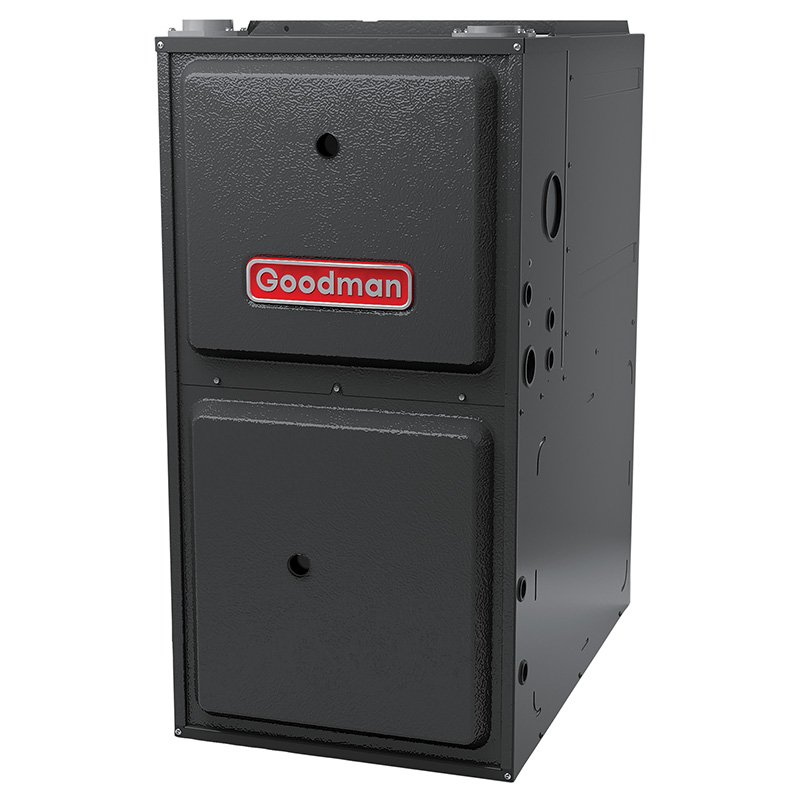
Goodman 100000 BTU Gas Furnace – 2 Stage 96% Efficient Variable Speed ECM Upflow / Horizontal | R32 (GRVT961005DN)
View on AC Direct see your lowest price →Check current price on AC Direct →
Key features
- 100,000 BTU output for larger homes in cold climates
- 96% AFUE efficiency, two-stage burner operation
- Variable-speed ECM blower motor reduces electricity use and noise
- Upflow and horizontal installation configurations supported
- Two-stage gas valve modulates between low- and high-fire modes
- Compatible with Goodman communicating system controls for matched installations
About this system
The Goodman GRVT961005DN is a 100,000 BTU, two-stage, 96% AFUE gas furnace built for upflow or horizontal installations. The 96% efficiency rating means only about four cents of every dollar spent on natural gas escapes as waste heat, placing it solidly in the high-efficiency tier without reaching the premium 98% AFUE ceiling. Two-stage operation gives the burner a low-fire mode for milder days and a high-fire mode for the coldest nights, which smooths out temperature swings and reduces the short-cycling that hammers heat exchangers over time. The variable-speed ECM blower motor is the other meaningful upgrade here: it ramps airflow gradually, cuts electricity consumption compared to single-speed PSC motors, and runs quietly at its most common operating point.
This furnace is best suited to mid-size to larger homes in cold climates where a natural gas heating bill is a real budget concern and where the duct layout calls for upflow discharge or horizontal orientation. The R-32 notation in the model designation is a Goodman internal classification marker and does not mean this furnace uses refrigerant; it is a gas furnace. Homeowners replacing an older 80% AFUE unit should expect a noticeable reduction in heating bills. Those pairing this with a Goodman air handler and coil should confirm the full system is properly matched and commissioned, because the variable-speed ECM communicates with compatible equipment and installer setup quality is the single largest driver of long-term performance on any Goodman product.
The GRVT961005DN delivers genuinely high-efficiency, two-stage heating at a price point that undercuts Trane, Carrier, and Lennox by a meaningful margin. The variable-speed ECM blower is a real comfort and operating-cost advantage, not a marketing claim. The honest trade-off is that Goodman's documented reliability record and shorter average compressor and component lifespan mean you should budget for service costs in years seven and beyond and not skimp on installation quality.
Overall score is the average of the five ratings above.
What we like
- 96% AFUE is high-efficiency territory and cuts heating bills versus 80% units
- Two-stage operation reduces temperature swings and heat-exchanger stress
- Variable-speed ECM motor lowers electricity draw compared to single-speed blowers
- Purchase price runs 15 to 25 percent below comparable Trane, Lennox, and Carrier units
- Upflow and horizontal configurations cover most residential duct layouts
Trade-offs
- Dual-run capacitors are the most commonly reported failure point, typically appearing within the first decade
- Component lifespan (particularly heat exchangers and controls) tends to trail premium-brand equivalents, with repair costs climbing after roughly year 7 per ConsumerAffairs feedback
- Long-term reliability is heavily dependent on installer competence; a poor commissioning job erases the efficiency advantage
- Brand reputation sits below premium competitors, which can matter at resale or when negotiating service contracts
What homeowners and pros say about Goodman
Goodman’s reputation in the HVAC trade is consistent: installers acknowledge it as a functional, affordable product whose lifespan is closely tied to how carefully it is set up. On ConsumerAffairs, Goodman scores approximately 2.5 out of 5, and that channel skews toward people who had a problem worth writing about. The recurring complaint pattern points to repair costs rising after roughly year seven, which tracks with the brand’s documented shorter average component lifespan compared to Trane, Lennox, or Carrier. Google dealer reviews paint a warmer picture at around 3.8 out of 5, where affordability and upfront price savings are the most common reasons buyers say they chose Goodman and were satisfied.
For this specific furnace, the two documented failure modes most relevant to potential owners are dual-run capacitor failures (a real but typically low-cost fix in the 300 to 600 dollar range) and a general pattern of heat-exchanger and controls issues climbing in frequency past the seven-year mark. Evaporator coil leaks and refrigerant issues are more relevant to Goodman air conditioning products than to this gas furnace specifically, but they are worth knowing about if you are building a full matched Goodman system. The honest takeaway is that the GRVT961005DN delivers real high-efficiency performance for less money upfront, and the risk you accept for that savings is a somewhat higher probability of service calls in the back half of a standard 15-year ownership window.
Sources: ConsumerAffairs Goodman owner reviews, AHRI Directory of Certified Product Performance, U.S. DOE appliance and equipment efficiency standards, Goodman product specification sheets.
How it compares
| Brand | Comparable model | SEER2 | Stage | Price position |
|---|---|---|---|---|
| Goodman | GRVT961005DN | N/A (gas furnace) | Two-stage | Value pick |
| Carrier | Performance 96 (59TP6) | N/A (gas furnace) | Two-stage | Roughly 20 to 30 percent more than Goodman |
| Trane | S9X2 (XR96) | N/A (gas furnace) | Two-stage | Roughly 20 to 30 percent more than Goodman |
| Lennox | ML296V | N/A (gas furnace) | Two-stage variable-speed | Roughly 25 to 35 percent more than Goodman |
Competitor rows are comparable single-stage units at similar efficiency; price is relative position, not a quote.
Questions about this system
What does 'two-stage' mean in practice for a 100,000 BTU furnace this size?
Two-stage means the burner runs at a reduced output (typically around 65% of full capacity) on most days and only fires at full 100,000 BTU output on the coldest days. For a large home this translates to fewer short on-off cycles, more even temperatures room to room, and less thermal stress on the heat exchanger over time.
Why does the model number reference R-32 if this is a gas furnace?
The R-32 designation in the GRVT961005DN model string is a Goodman internal product-line classification and does not mean the furnace uses or handles refrigerant. This is a straight gas furnace; it burns natural gas and moves heated air through your ducts.
What repairs should I expect to budget for over a 10-year ownership period?
Dual-run capacitors are the most frequently reported failure on Goodman equipment and typically cost 300 to 600 dollars to diagnose and replace. After year seven, ConsumerAffairs feedback shows a pattern of rising repair frequency. Setting aside a small annual service reserve starting around year five is a practical approach.
Does the variable-speed ECM blower work with any thermostat, or do I need a communicating control?
The ECM motor will function with a standard 24-volt thermostat, but it operates in its most efficient communicating mode when paired with a compatible Goodman or matched-brand control system. Ask your installer to confirm thermostat compatibility during the quote stage, especially if you plan to use a smart thermostat.
How does Goodman's warranty on this furnace compare to Trane or Lennox?
Goodman offers a limited lifetime heat-exchanger warranty and a 10-year parts warranty on registered units, which looks competitive on paper. The practical difference is that premium brands like Trane and Lennox have longer average component lifespans, so the warranty is less likely to be needed on those units in the first place. Registration within the required window after installation is essential to activate full Goodman coverage.
Specifications
| Furnace output | 100000 BTU |
| Configuration | Upflow |
| Refrigerant | R-32 |
| Model | GRVT961005DN |