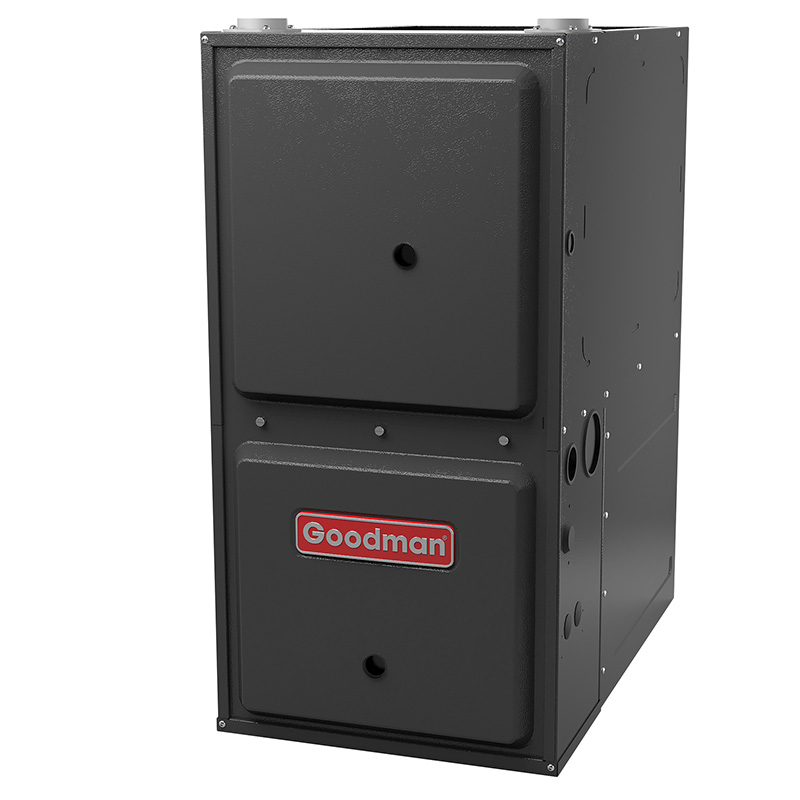
Goodman 120000 BTU Gas Furnace – 2 Stage 96% Efficient Variable Speed ECM Downflow | R32 (GDVT961205DN)
View on AC Direct see your lowest price →Check current price on AC Direct →
Key features
- 120,000 BTU input capacity for large homes in cold climates
- 96% AFUE two-stage operation reduces short-cycling and fuel use
- Variable-speed ECM blower motor lowers electricity draw and minimizes drafts
- Downflow-only cabinet configuration for under-unit duct systems
- Compatible with R-32 refrigerant systems when sold as a matched package
- Stainless steel secondary heat exchanger for added corrosion resistance
About this system
The Goodman GDVT961205DN is a 120,000 BTU downflow gas furnace rated at 96% AFUE, meaning it converts 96 cents of every dollar of natural gas into usable heat. The two-stage gas valve lets the furnace run at a lower fire on mild days and ramp up only when outdoor temperatures demand it, which reduces short-cycling, lowers fuel bills, and keeps indoor temperatures more consistent than a single-stage unit can manage. The variable-speed ECM blower motor adjusts airflow in small increments rather than simply switching between high and low, which cuts electricity consumption at the air handler, reduces drafts near registers, and supports better humidity control when paired with a central air conditioning coil.
The downflow configuration is the critical spec here. This furnace is built specifically for installations where supply air must be discharged downward, most commonly in manufactured homes, homes with crawl-space duct systems accessed from a closet, or certain slab-on-grade builds where the duct plenum sits beneath the unit. If your existing ductwork is configured for upflow or horizontal, this cabinet will not work without a full duct redesign. The R-32 refrigerant designation on this model applies to the system as a whole when sold as part of a matched cooling package, not to the furnace combustion circuit itself. Confirm compatibility with your coil and condensing unit before ordering.
At 120,000 BTU this is a large-capacity furnace suited to homes in the 3,000 to 4,500 square foot range in cold climates, or homes with high heat-loss characteristics such as older construction, high ceilings, or significant window area. Oversizing a furnace produces just as many comfort problems as undersizing, so a Manual J load calculation from your installer is strongly recommended before committing to this capacity.
The GDVT961205DN delivers genuine high-efficiency, two-stage comfort at a price point meaningfully below Carrier, Trane, and Lennox equivalents, which makes it a reasonable choice when budget is a real constraint and the installing contractor is experienced with Goodman equipment. The trade-off is a reliability track record that lags premium brands past the seven-year mark and a documented history of capacitor and coil issues that owners should budget for. The downflow configuration limits this unit to a specific installation context, so confirming it matches your home before purchasing is non-negotiable.
Overall score is the average of the five ratings above.
What we like
- 96% AFUE places it in the upper efficiency tier, reducing annual heating costs versus 80% units
- Two-stage operation improves temperature consistency and reduces noisy on-off cycling
- Variable-speed ECM motor cuts blower electricity use compared to PSC motors
- Purchase price runs 15 to 25 percent below comparable Carrier, Trane, and Lennox models
- Stainless steel secondary heat exchanger resists condensate corrosion better than aluminized alternatives
Trade-offs
- Consumer satisfaction scores average around 2.5 out of 5 on ConsumerAffairs, with repair costs climbing after roughly year seven being the recurring complaint
- Dual-run capacitors are the most commonly reported failure point across Goodman equipment, typically requiring a service call every few years in some installs
- Compressor and major component lifespan averages 10 to 14 years versus 15 to 20 years for premium brands, meaning total cost of ownership closes the gap over time
- Downflow-only cabinet is incompatible with upflow and most horizontal duct configurations, eliminating it from the majority of residential installs without duct modification
What homeowners and pros say about Goodman
On Google dealer review aggregates, Goodman scores around 3.8 out of 5 across locations that carry the brand, and the consistent praise is straightforward: the equipment costs noticeably less upfront than Carrier, Trane, or Lennox, and when it is installed well it performs close to its rated specs. For a 120,000 BTU, 96% AFUE two-stage furnace in a downflow application, that price gap is real and meaningful for homeowners financing a replacement. Contractors who sell Goodman regularly tend to note that installation quality and proper commissioning matter more with this brand than with some premium alternatives, and that owners who skip the annual tune-up are more likely to run into the documented capacitor failures that show up in service histories.
On ConsumerAffairs, Goodman sits at roughly 2.5 out of 5, which is a complaint-heavy channel but still worth noting because the pattern is specific: owners report satisfaction in the early years and growing frustration as repair costs accumulate after year seven or so. For a high-capacity unit like this one, the cost of a heat exchanger or control board repair past the labor warranty window can erode the original price advantage. The documented failure modes to watch for include dual-run capacitors, which are the most commonly reported issue and typically a low-cost fix, evaporator coil leaks when the unit is paired with a cooling system, and a compressor lifespan that tends to run shorter than what premium brands deliver. None of these are reasons to automatically pass on the unit, but they are honest factors to weigh against the upfront savings.
Sources: ConsumerAffairs Goodman owner reviews, AHRI Directory of Certified Product Performance, U.S. DOE appliance and equipment efficiency standards, Goodman product specification sheets.
How it compares
| Brand | Comparable model | SEER2 | Stage | Price position |
|---|---|---|---|---|
| Goodman | GDVT961205DN | N/A (furnace only) | Two-stage | Value pick |
| Carrier | Performance 96 (59TP6) | N/A (furnace only) | Two-stage | Roughly 20 to 30 percent above Goodman |
| Trane | S9V2 (96% two-stage variable speed) | N/A (furnace only) | Two-stage | Roughly 25 to 35 percent above Goodman |
| Lennox | Merit ML196V | N/A (furnace only) | Two-stage | Roughly 20 to 30 percent above Goodman |
Competitor rows are comparable single-stage units at similar efficiency; price is relative position, not a quote.
Questions about this system
Can I use this furnace in a standard upflow or horizontal application?
No. The GDVT961205DN is engineered exclusively for downflow installations where air is discharged downward through the bottom of the cabinet. Using it in an upflow or horizontal position would create combustion and airflow hazards. If your home uses a standard attic or basement upflow setup, you need a different cabinet configuration.
What does the R-32 designation mean on a gas furnace?
The R-32 reference indicates this furnace is matched and sold as part of a system package designed to work with R-32 refrigerant in the connected cooling coil and outdoor condensing unit. The furnace itself burns natural gas and does not contain refrigerant, but the coil it is paired with uses R-32 rather than older R-410A, which affects what replacement parts and coils are compatible.
Is 120,000 BTU likely the right size for my house?
Not without a Manual J load calculation. At 120,000 BTU this is a large-capacity unit that generally suits homes above 3,000 square feet in cold climates, but factors like insulation, ceiling height, window area, and climate zone all affect the correct size. An oversized furnace short-cycles, wears components faster, and delivers poor humidity control, so sizing it from square footage alone is not reliable.
What are the most common repairs I should budget for over the life of this furnace?
Across Goodman gas furnace reviews, dual-run capacitors are the most frequently reported failure, typically a relatively low-cost repair in the few-hundred-dollar range when it occurs. Inducer motor and control board failures are also documented in older units. Setting aside a modest annual service budget and scheduling preventive maintenance helps catch capacitor and igniter wear before they cause a no-heat call in the middle of winter.
How does Goodman's warranty compare to Trane or Carrier on this type of furnace?
Goodman offers a lifetime heat exchanger warranty and a 10-year parts warranty on registered units, which is competitive on paper with what Carrier and Trane offer at the entry and mid-tier level. The practical difference is that warranty coverage requires registration within a set window after installation and does not cover labor, meaning a repair that happens under parts warranty can still cost several hundred dollars in technician time.
Specifications
| Furnace output | 120000 BTU |
| Configuration | Downflow |
| Refrigerant | R-32 |
| Model | GDVT961205DN |