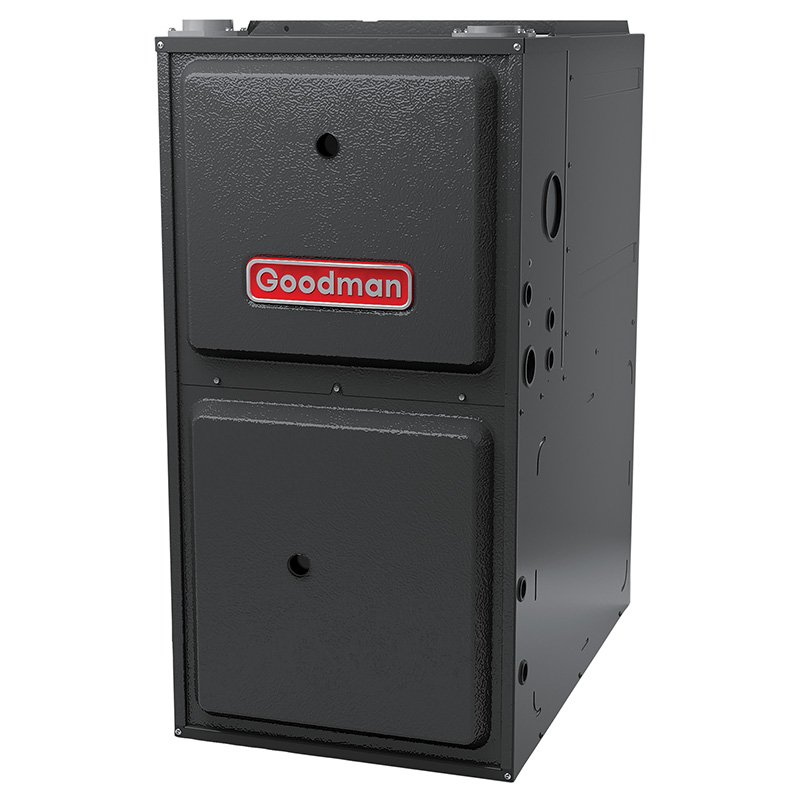
Goodman 120000 BTU Gas Furnace – 2 Stage 96% Efficient Variable Speed ECM Upflow / Horizontal | R32 (GRVT961205DN)
View on AC Direct see your lowest price →Check current price on AC Direct →
Key features
- 96% AFUE two-stage gas furnace rated at 120,000 BTU output
- Variable-speed ECM blower motor reduces electricity use and noise
- Two-stage burner runs low-fire most of the time, full fire only on peak demand days
- Upflow and horizontal installation configurations supported
- Compatible with matched Goodman cooling equipment in R-32 system configurations
- Priced 15 to 25 percent below comparable Trane, Lennox, and Carrier models
About this system
The Goodman GRVT961205DN is a 120,000 BTU, two-stage, 96% AFUE gas furnace built for upflow or horizontal installation. At 96% AFUE, it sits at the upper tier of gas furnace efficiency, meaning roughly 96 cents of every dollar spent on natural gas becomes usable heat. The two-stage burner runs at a lower capacity most of the time and only steps up to full output on the coldest days, which reduces temperature swings, lowers fuel consumption compared to a single-stage unit, and puts less wear on the heat exchanger over time.
The variable-speed ECM blower motor is the other meaningful spec here. ECM motors use significantly less electricity than standard PSC motors, ramp up and down gradually instead of slamming on at full speed, and tend to run quieter during steady-state operation. That gradual airflow also improves humidity distribution and air filtration performance. The R-32 refrigerant designation on a furnace is unusual and likely relates to a matched system pairing rather than the furnace itself, so buyers should confirm the full system configuration with their installer. This unit is sized for large homes, typically 2,800 to 3,500 square feet depending on climate zone, insulation quality, and ceiling height, and it should only be sized by a Manual J load calculation.
Goodman prices this furnace 15 to 25 percent below comparable two-stage, variable-speed units from Trane, Lennox, and Carrier. That gap is real money on a premium-efficiency furnace, and it makes the GRVT961205DN worth serious consideration for buyers who want high-efficiency performance without the premium brand markup, provided they use an experienced installer and understand the brand’s reliability track record going in.
The GRVT961205DN delivers genuine high-efficiency specs at a price that undercuts the major premium brands by a meaningful margin, and the two-stage ECM combination is a legitimate upgrade over entry-level furnaces. The trade-off is a brand reliability record that trails Trane and Lennox, with repair costs that tend to climb after year seven, so long-term ownership cost depends heavily on installer quality and whether you stay current on maintenance.
Overall score is the average of the five ratings above.
What we like
- 96% AFUE puts heating efficiency at the top tier, reducing monthly gas bills versus 80% units
- Variable-speed ECM motor lowers electricity draw and improves comfort compared to single-speed blowers
- Two-stage operation reduces temperature swings and wear on the heat exchanger
- Significantly lower upfront cost than comparable two-stage, variable-speed Trane, Lennox, or Carrier furnaces
- Upflow and horizontal compatibility gives installers flexibility in tight or atypical mechanical spaces
Trade-offs
- Brand reliability ratings are below premium competitors, with ConsumerAffairs averaging around 2.5 out of 5 and complaints clustering around rising repair costs after year seven
- Dual-run capacitors are a documented weak point, though repairs typically run 300 to 600 dollars when they fail
- Compressor and major component lifespan tends to average 10 to 14 years versus 15 to 20 years typical of premium brands
- Performance and longevity are unusually dependent on installer quality, meaning a poor installation can negate the efficiency and reliability gains the specs promise
What homeowners and pros say about Goodman
Homeowners who review Goodman equipment on ConsumerAffairs give the brand roughly 2.5 out of 5, and the pattern in those reviews is consistent: the first several years tend to be uneventful, but repair costs begin climbing around year seven, and a portion of owners feel the long-term cost undercuts the initial savings. Google dealer reviews tell a somewhat different story, averaging around 3.8 out of 5 across hundreds of location reviews, where the most common praise is straightforwardly about price relative to competing brands. The gap between those two numbers is partly explained by the difference in who is writing each type of review, but it is also a real signal about where satisfaction tends to hold and where it erodes.
HVAC technicians who work on Goodman equipment regularly point to dual-run capacitor failures as the most common service call, a repair that typically runs 300 to 600 dollars and is not unique to Goodman but does show up in owner accounts with some frequency. Evaporator coil leaks appear in a meaningful share of reviews, and compressor lifespan on Goodman cooling systems tends to average 10 to 14 years, shorter than the 15 to 20 years more commonly associated with Trane and Carrier equipment. For the GRVT961205DN specifically, which is a furnace rather than a cooling system, the heat exchanger and control board are the components worth watching over the long term. Technicians are consistent on one point: a properly installed and maintained Goodman furnace at this efficiency tier outperforms a poorly installed premium brand, which means vetting your contractor is at least as important as choosing the equipment.
Sources: ConsumerAffairs Goodman owner reviews, AHRI Directory of Certified Product Performance, U.S. DOE appliance and equipment efficiency standards, Goodman product specification sheets.
How it compares
| Brand | Comparable model | SEER2 | Stage | Price position |
|---|---|---|---|---|
| Goodman | GRVT961205DN | N/A (furnace only) | Two-stage | Value pick |
| Carrier | Performance 96 (58TP6) | N/A (furnace only) | Two-stage | Moderately higher than Goodman |
| Trane | S9X2 (XR95) | N/A (furnace only) | Two-stage | Higher than Goodman, mid-premium range |
| Lennox | EL296V | N/A (furnace only) | Two-stage variable-speed | Notably higher than Goodman |
Competitor rows are comparable single-stage units at similar efficiency; price is relative position, not a quote.
Questions about this system
Is 120,000 BTU the right size furnace for my house?
Not necessarily, and this is the most important question to answer before purchasing. Furnace sizing must be based on a Manual J heat load calculation performed by your installer, accounting for square footage, insulation, windows, climate zone, and ceiling height. An oversized 120,000 BTU furnace will short-cycle, reduce comfort, and wear out faster than a correctly sized unit.
What does the two-stage burner actually do in day-to-day operation?
On most winter days the furnace fires at its lower stage, typically around 65 to 70 percent of full capacity, and only steps up to 120,000 BTU on the coldest days. This means longer, quieter, more even heating cycles rather than short blasts of high heat, which most homeowners find more comfortable and which is easier on the heat exchanger over time.
What should I expect to pay for repairs if something goes wrong after the warranty period?
The most commonly reported failure on Goodman furnaces is the dual-run capacitor, which typically costs 300 to 600 dollars to diagnose and replace. More significant failures like heat exchanger cracks or control board issues run considerably higher. Goodman owner feedback on ConsumerAffairs reflects repair costs that become a recurring concern after roughly year seven of ownership.
Why does this furnace spec show R-32 refrigerant if it is a gas furnace?
R-32 on this listing most likely refers to a matched system pairing, where the furnace air handler is paired with an R-32 refrigerant-based cooling system. The furnace itself burns natural gas and does not use refrigerant. Confirm with your installer exactly which cooling equipment this unit is matched with to ensure system compatibility and proper refrigerant handling certifications.
How important is installer choice with a Goodman furnace compared to a premium brand?
Installer quality matters with every brand, but it matters more with Goodman. Technicians consistently cite installation quality as the single biggest factor in how long a Goodman system lasts and how efficiently it runs. Choosing an installer with documented Goodman experience, who pulls permits and performs combustion analysis at startup, is not optional if you want the warranty and efficiency specs to hold up.
Specifications
| Furnace output | 120000 BTU |
| Configuration | Upflow |
| Refrigerant | R-32 |
| Model | GRVT961205DN |