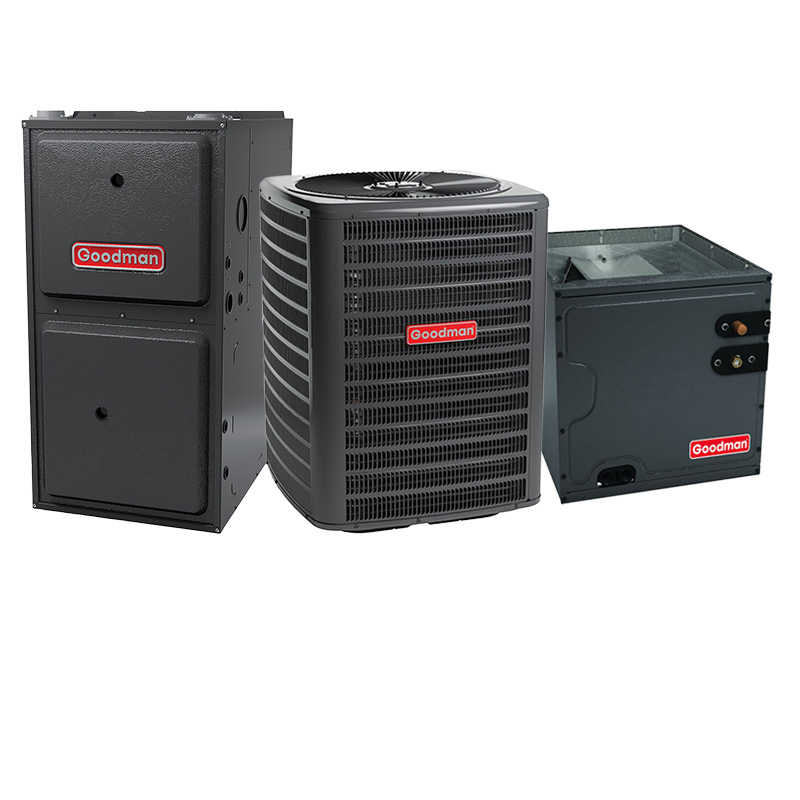
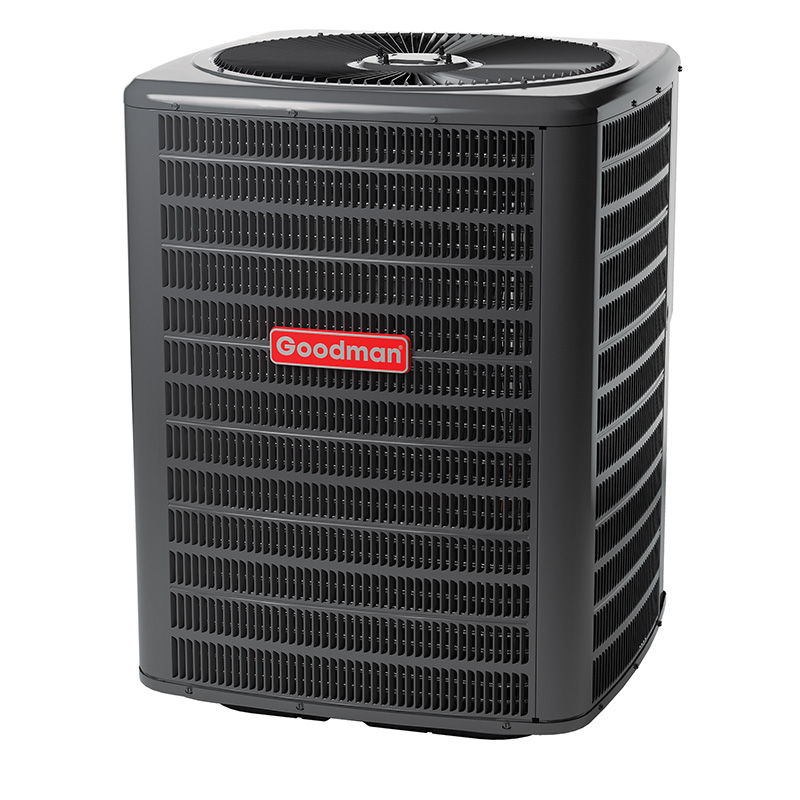
Goodman Air Conditioning And Heating – 1.5 Ton 15.2 SEER2 AC With 60000 BTU 96% AFUE Two Stage Multi-Speed ECM Gas Furnace System – Upflow | R32
View on AC Direct see your lowest price →Check current price on AC Direct →
Key features
- 15.2 SEER2 cooling efficiency, meets and exceeds 2023 federal minimums for most U.S. regions
- 96% AFUE two-stage gas furnace reduces fuel waste and temperature swings versus single-stage units
- Multi-speed ECM blower motor cuts electrical draw and improves airflow consistency
- R-32 refrigerant with lower global warming potential than R-410A, increasingly standard in new installs
- Upflow configuration designed for basement or closet installs where supply air exits the top
- 1.5-ton capacity sized for smaller, well-insulated spaces up to roughly 900 square feet depending on load
About this system
This Goodman bundle pairs a 1.5-ton, 15.2 SEER2 air conditioner with a 60,000 BTU, 96% AFUE two-stage gas furnace in an upflow configuration, making it a compact but capable choice for smaller homes, condos, or well-insulated spaces in the 600 to 900 square foot range depending on climate and load. The 15.2 SEER2 rating clears the federal minimum comfortably and sits in the mid-efficiency tier, which translates to meaningful savings over an older 13 or 14 SEER unit without the premium price of a 18+ SEER2 variable-speed system. R-32 refrigerant is a forward-looking choice: it carries a lower global warming potential than the R-410A it replaces and is becoming the industry standard, so future service calls should not hit any refrigerant availability walls.
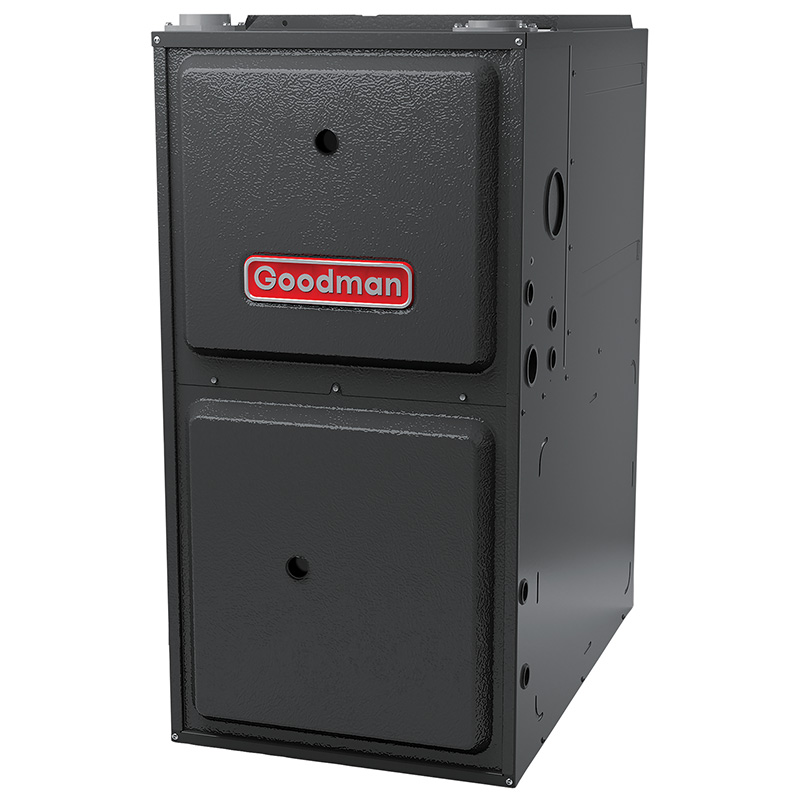
The two-stage furnace is the standout component here. Running at low fire the majority of the time, it cycles less aggressively, holds steadier indoor temperatures, and generally runs quieter than a single-stage unit. The multi-speed ECM blower motor adds to that comfort story by ramping airflow gradually rather than blasting on at full speed, and it draws significantly less electricity than a standard PSC motor during those long low-fire runs. Together, the 96% AFUE rating means roughly 96 cents of every dollar spent on gas becomes heat, which is competitive with most mid-tier condensing furnaces on the market. This system suits budget-conscious buyers in colder climates who want real heating efficiency without paying Trane or Lennox prices for it.
This Goodman bundle delivers genuinely good heating efficiency and two-stage comfort at a price point 15 to 25 percent below comparable Carrier, Trane, and Lennox systems, which is a real advantage if upfront cost is a priority. The trade-off is a brand with a mixed long-term track record: capacitor failures, evaporator coil leaks, and compressor lifespans shorter than premium competitors are documented recurring issues. Buyers who invest in a quality install and sign up for regular maintenance get the most out of this system.
Overall score is the average of the five ratings above.
What we like
- Two-stage furnace with ECM motor delivers steadier temperatures and quieter operation than single-stage alternatives
- 96% AFUE is a strong heating efficiency rating that keeps monthly gas bills competitive
- 15.2 SEER2 cooling efficiency is meaningfully above the federal minimum without the cost of variable-speed equipment
- Priced 15 to 25 percent below comparable Trane, Carrier, and Lennox systems, leaving budget for a quality install or extended warranty
- R-32 refrigerant is a future-ready choice with better environmental profile and growing technician familiarity
Trade-offs
- Dual-run capacitors are the most frequently reported failure point, typically around years 5 to 8, though repairs usually run only 300 to 600 dollars
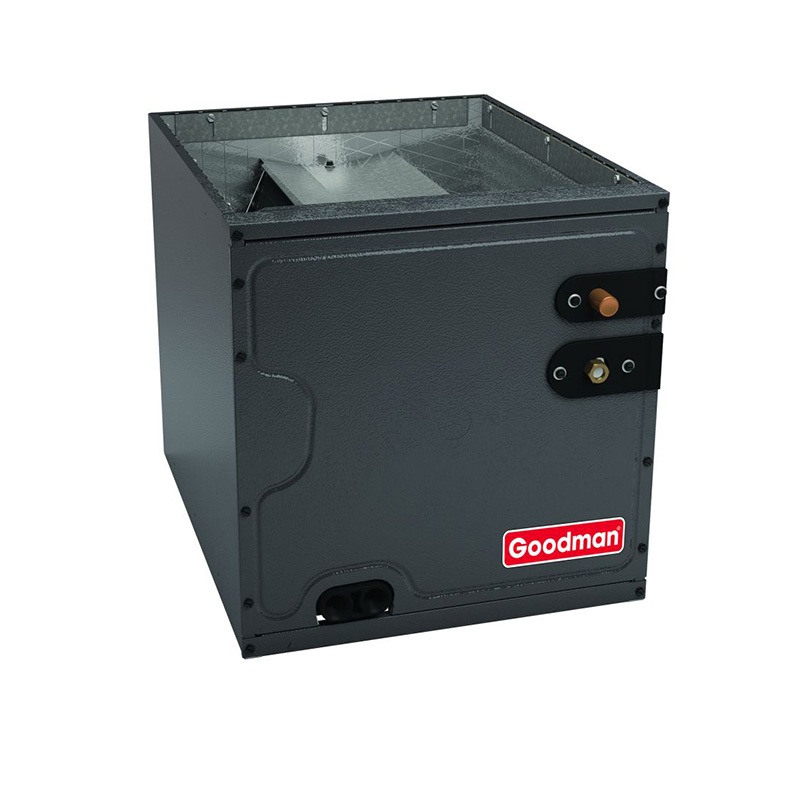
- Evaporator coil leaks appear in a notable share of owner reports and can be costly if the coil needs replacement after the warranty window
- Compressor longevity averages 10 to 14 years versus 15 to 20 years for premium brands, which matters for total cost of ownership over a longer horizon
- ConsumerAffairs rating sits around 2.5 out of 5, with repair costs after year 7 being the most repeated complaint, suggesting long-term ownership costs can climb
What homeowners and pros say about Goodman
Homeowners who choose Goodman most often point to the upfront savings as the deciding factor, and dealer Google ratings clustered around 3.8 out of 5 suggest that a significant share of buyers are satisfied, particularly when they work with an experienced installer. The two-stage furnace in this configuration earns consistent positive feedback for reducing temperature swings and running more quietly than basic single-stage alternatives. Where the picture gets more complicated is the longer-term ownership experience: ConsumerAffairs scores for Goodman sit around 2.5 out of 5, and that platform skews toward people motivated to complain, but the pattern in those complaints is consistent enough to take seriously. Repair costs accelerating after roughly year 7 is the most repeated theme, and the documented failure modes back that up: dual-run capacitors failing in the 5 to 8 year window, evaporator coil leaks showing up in a meaningful share of units, and compressor lifespans averaging 10 to 14 years rather than the 15 to 20 years more typical of Trane, Carrier, and Lennox equipment.
HVAC technicians are generally candid about Goodman occupying a specific market position: it is workable equipment that performs close to spec when installed correctly and maintained regularly, but it does not carry the same component durability margins as premium brands. Technicians frequently flag that the savings gap at purchase narrows over a 15-year ownership window once capacitor replacements, potential coil work, and an earlier-than-ideal compressor replacement are factored in. For this specific 1.5-ton, two-stage bundle, the calculus favors buyers who genuinely need to keep first costs down, have a reliable local contractor willing to do the install properly, and are realistic about building a modest repair fund over the life of the equipment. Buyers expecting set-it-and-forget-it reliability over two decades may find the premium brands a better fit despite the higher entry price.
Sources: ConsumerAffairs Goodman owner reviews, AHRI Directory of Certified Product Performance, U.S. DOE appliance and equipment efficiency standards, Goodman product specification sheets.
What it costs to run
At 15.2 SEER2, cooling this 1.5-ton system for a typical 1200-hour cooling season at the U.S. average electricity rate of $0.17/kWh works out to roughly $242 per year in cooling, about $32 less per year than a minimum-efficiency 13.4 SEER2 unit of the same size. Your real cost depends on your climate and local rate.
Method: (18,000 BTU/hr ÷ 15.2 SEER2) × 1200 hours ÷ 1000 × $0.17/kWh. Rate source: U.S. EIA average; cooling hours: moderate-climate estimate.
How it compares
| Brand | Comparable model | SEER2 | Stage | Price position |
|---|---|---|---|---|
| Goodman | 1.5T 15.2 SEER2 AC + 60K BTU 96% AFUE Two-Stage ECM Furnace (this system) | 15.2 | Two-stage furnace / single-stage AC | Value pick |
| Carrier | Performance 15 (24ACC6) AC + 58CVA Performance Two-Stage Furnace | 15+ | Two-stage furnace / single-stage AC | Typically 15 to 25 percent more than this Goodman bundle |
| Trane | XR15 (4TTR5) AC + S9X2 Two-Stage Furnace | 15+ | Two-stage furnace / single-stage AC | Typically 15 to 25 percent more than this Goodman bundle |
| Lennox | Merit ML15 AC + ML196E Two-Stage Furnace | 15+ | Two-stage furnace / single-stage AC | Typically 15 to 25 percent more than this Goodman bundle |
Competitor rows are comparable single-stage units at similar efficiency; price is relative position, not a quote.
Questions about this system
Is 1.5 tons actually enough cooling for my house, and how do I know?
A 1.5-ton system is generally appropriate for roughly 600 to 900 square feet in moderate climates, but actual sizing depends on insulation quality, ceiling height, window area, local climate, and duct layout. The only reliable way to confirm is a Manual J load calculation from a licensed HVAC contractor before purchase. Oversizing is as problematic as undersizing: it causes short cycling, poor humidity control, and accelerated wear.
What is the Goodman warranty on this system, and what does it actually cover?
Goodman typically offers a 10-year parts limited warranty on registered systems, which covers components including the compressor and heat exchanger, but does not cover labor, refrigerant, or diagnostic costs. Registration must usually be completed within 60 days of installation to qualify for the full 10-year term. Reading the specific warranty document for these model numbers before purchase is worthwhile, since coverage details can vary by component.
How often do Goodman capacitors actually fail, and what does that repair cost?
Dual-run capacitor failure is the most commonly documented issue in Goodman owner reports, with many failures appearing in the 5 to 8 year range. The repair is relatively inexpensive, typically in the 300 to 600 dollar range including a service call, and most HVAC technicians can complete it in under an hour. Keeping a service contract or scheduling annual tune-ups improves the odds of catching a weakening capacitor before it leaves you without cooling on a hot day.
Why does this system use R-32 refrigerant, and will that make future service more expensive?
R-32 is replacing R-410A across the HVAC industry because it has roughly one-third the global warming potential of its predecessor and is slightly more efficient to compress. Technician familiarity is growing quickly as manufacturers shift to it, and current indications suggest it will be widely available and competitively priced for the foreseeable service life of this equipment. Any technician you hire should be EPA 608 certified to handle refrigerants regardless of type.
How important is installer quality with a Goodman system specifically?
Very important, and this is not unique to Goodman. HVAC technicians consistently cite install quality as the single largest factor in how long any system lasts and how efficiently it runs, but Goodman's brand reputation makes this point especially worth emphasizing. The minority of owners who report refrigerant leaks within the first year are most often dealing with a charge or installation issue rather than a product defect. Getting multiple bids from licensed contractors and asking specifically about load calculations and refrigerant charging procedures is time well spent.
Specifications
| Cooling capacity | 1.5 Ton |
| Efficiency | 15.2 SEER2 |
| Furnace output | 60000 BTU |
| Furnace efficiency | 96% AFUE |
| Configuration | Upflow |
| Refrigerant | R-32 |