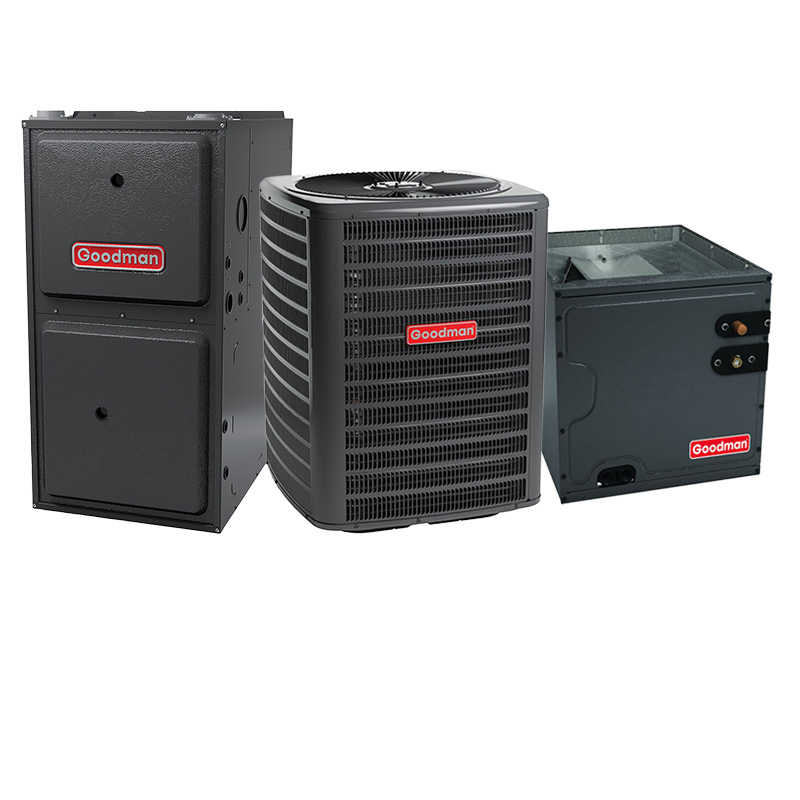
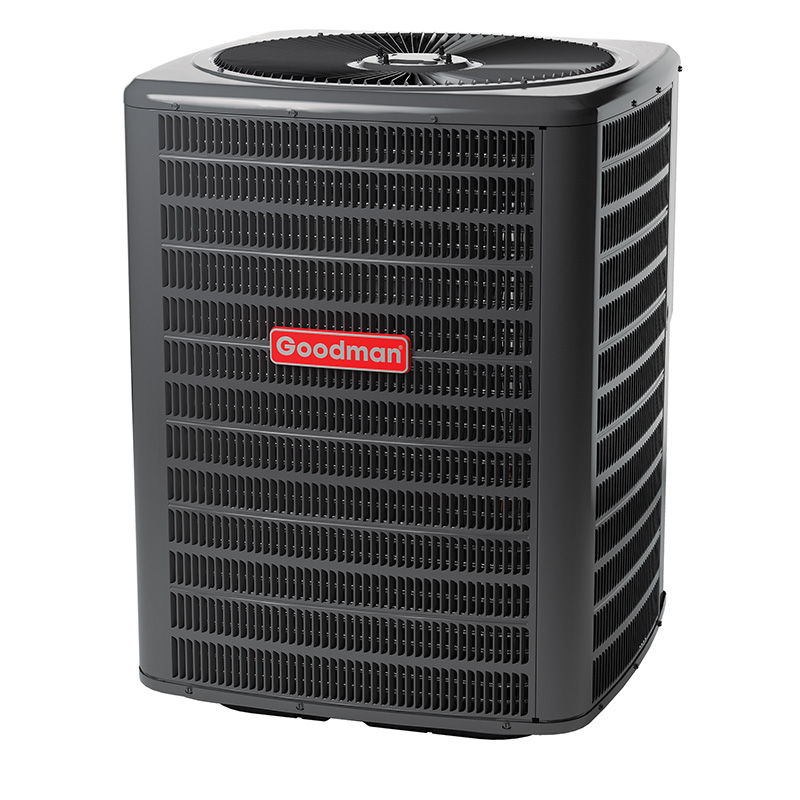
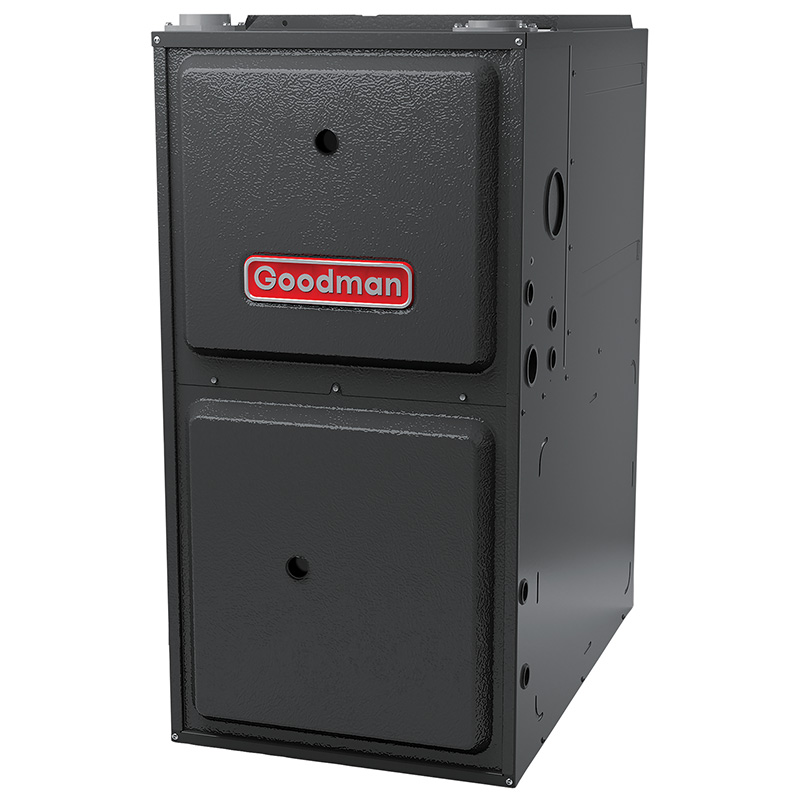
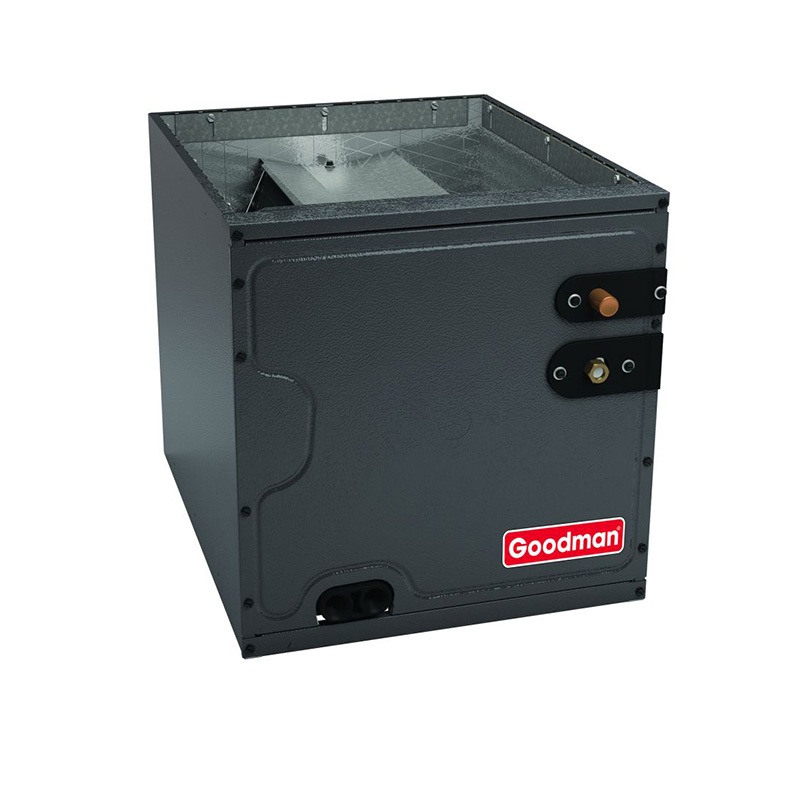
Goodman Air Conditioning And Heating – 4 Ton 15.2 SEER2 AC With 100000 BTU 96% AFUE Two Stage Multi-Speed ECM Gas Furnace System – Upflow | R32
View on AC Direct see your lowest price →Check current price on AC Direct →
Key features
- 4-ton cooling capacity rated at 15.2 SEER2 for mid-tier energy efficiency
- 96% AFUE two-stage gas furnace reduces fuel waste and softens temperature swings
- Multi-speed ECM blower motor cuts electricity use and lowers operating noise
- R-32 refrigerant with lower global warming potential than R-410A
- Upflow configuration suits most residential forced-air duct layouts in basements and closets
- Bundled system pre-matched for compatibility, simplifying contractor selection and equipment sourcing
About this system
This Goodman bundle pairs a 4-ton, 15.2 SEER2 air conditioner with a 100,000 BTU, 96% AFUE two-stage gas furnace in an upflow configuration, making it a practical choice for larger homes in the 2,000 to 2,800 square foot range that need serious heating capacity alongside solid cooling. The R-32 refrigerant is a meaningful step forward compared to older R-410A systems: it carries a lower global warming potential and is increasingly the industry standard as regulations tighten, so this system is reasonably future-proof on the refrigerant front.
The two-stage furnace and multi-speed ECM blower motor are the standout mechanical details here. Two-stage heating means the furnace runs on a lower fire most of the time, cycling up to full output only when outdoor temperatures drop hard. Combined with an ECM (electronically commutated motor) blower, that translates to quieter operation, more consistent temperatures room to room, and measurably lower electricity draw on the air handler side compared to a single-stage, PSC-motor furnace. The 96% AFUE rating means roughly 96 cents of every dollar spent on gas goes to usable heat, which puts it in the high-efficiency tier without the complexity or cost of a modulating unit.
Goodman positions this as a value-first system, and the price reflects that. It suits homeowners who want real efficiency gains over a builder-grade system without paying Trane or Lennox prices, and who either have a trusted installer or are willing to invest in a quality contractor. Installation quality is not a minor footnote with Goodman equipment; technicians consistently identify it as the largest single variable in how long the system performs and how few repair calls it generates in the first decade.
This Goodman system delivers genuine two-stage efficiency and a low purchase price, making it a reasonable choice for budget-conscious buyers who can secure a skilled installer. The trade-off is a reliability ceiling that sits below premium brands, with documented weak points around capacitors, evaporator coil integrity, and compressor longevity past the ten-year mark. It earns its place in the market as a value pick, not a premium one.
Overall score is the average of the five ratings above.
What we like
- Purchase price runs roughly 15 to 25 percent below comparable Trane, Carrier, and Lennox systems
- Two-stage furnace operation delivers quieter, more even heating than single-stage alternatives
- 96% AFUE places the furnace in the high-efficiency tier, reducing annual gas bills meaningfully
- ECM blower motor reduces electricity consumption on the air handler compared to PSC motors
- R-32 refrigerant is lower-impact and increasingly supported by equipment manufacturers going forward
Trade-offs
- Compressor lifespan averages 10 to 14 years versus 15 to 20 years for premium-brand compressors
- Dual-run capacitor failures are the most commonly reported repair, typically appearing after year 5 to 7
- A minority of owners report refrigerant leaks within the first year, most often tied to install or initial charge issues
- Evaporator coil leaks appear in a meaningful share of owner reviews and can be costly to address out of warranty
What homeowners and pros say about Goodman
Homeowners who review Goodman equipment tend to sort into two camps, and this system will likely follow the same pattern. Those who had the unit professionally installed by an experienced contractor and kept up with annual maintenance report years of unremarkable, trouble-free operation and frequently point to the lower purchase price as the main reason they went with Goodman in the first place. This lines up with Google dealer review scores that cluster around 3.8 out of 5, where affordability is the praise that shows up most consistently. The other camp, represented more heavily in ConsumerAffairs data where the brand scores around 2.5 out of 5, tends to be homeowners dealing with repair costs that mount after roughly year seven. The documented failure points are specific: dual-run capacitor replacements are the most common call, a relatively inexpensive fix in the 300 to 600 dollar range but annoying when it repeats. Evaporator coil leaks are a harder conversation since coil replacement is labor-intensive and costly. Compressor longevity is the longer-term concern, with Goodman compressors averaging 10 to 14 years compared to 15 to 20 years for premium brands.
HVAC technicians who work on Goodman equipment regularly tend to say much the same thing: the equipment is not badly built for the price, but its performance ceiling is heavily tied to how it was put in and how consistently it is maintained. Refrigerant leaks showing up in the first year are almost always flagged by pros as an installation or charge issue rather than a manufacturing defect, which underscores why contractor selection matters as much as equipment selection with this brand. For this specific system, the two-stage furnace and ECM motor are genuine upgrades over entry-level Goodman configurations, which means buyers are getting more mechanical sophistication than a base-tier system. Whether that sophistication holds up over 15-plus years at Goodman’s price point is the honest uncertainty a buyer should carry into the decision.
Sources: ConsumerAffairs Goodman owner reviews, AHRI Directory of Certified Product Performance, U.S. DOE appliance and equipment efficiency standards, Goodman product specification sheets.
What it costs to run
At 15.2 SEER2, cooling this 4-ton system for a typical 1200-hour cooling season at the U.S. average electricity rate of $0.17/kWh works out to roughly $644 per year in cooling, about $87 less per year than a minimum-efficiency 13.4 SEER2 unit of the same size. Your real cost depends on your climate and local rate.
Method: (48,000 BTU/hr ÷ 15.2 SEER2) × 1200 hours ÷ 1000 × $0.17/kWh. Rate source: U.S. EIA average; cooling hours: moderate-climate estimate.
How it compares
| Brand | Comparable model | SEER2 | Stage | Price position |
|---|---|---|---|---|
| Goodman | 4-Ton 15.2 SEER2 AC / 96% AFUE Two-Stage ECM Furnace Bundle | 15.2 | Two-stage | Value pick |
| Carrier | Performance 15 Series (24ACC6) | 15+ | Single-stage | Typically 15 to 25 percent more than this Goodman bundle |
| Trane | XR15 Series | 15+ | Single-stage | Typically 15 to 25 percent more than this Goodman bundle |
| Lennox | Merit 14ACX / ML180 Series bundle | 15+ | Single-stage | Typically 15 to 25 percent more than this Goodman bundle |
Competitor rows are comparable single-stage units at similar efficiency; price is relative position, not a quote.
Questions about this system
Is 15.2 SEER2 good enough to qualify for federal energy efficiency tax credits?
For split systems in most northern climate zones, the federal 25C tax credit threshold for central air conditioning is 15.2 SEER2 or higher, and this unit meets that floor. Always confirm your specific region's requirements with a tax professional before purchase, since climate zone rules vary for heating-dominant areas.
What does the two-stage furnace actually do differently from a standard single-stage unit?
A two-stage furnace has a low-fire setting that handles roughly 65 to 70 percent of full output, which is sufficient for most winter days. It only kicks up to full 100,000 BTU output during the coldest stretches. This means longer, steadier burner cycles rather than frequent full-blast on-and-off cycles, which reduces temperature swings, lowers noise, and can cut gas use on moderate days.
The specs mention R-32 refrigerant. Will my current contractor be able to work on it?
R-32 requires technicians to have specific training and compatible recovery equipment since it is mildly flammable under certain conditions, unlike R-410A. Most established HVAC contractors are already equipped or in the process of certifying for R-32 as it becomes the industry standard, but it is worth confirming with your contractor before scheduling service.
What is the most likely repair I should budget for in the first ten years?
Dual-run capacitor failure is the most commonly documented issue on Goodman condensing units and typically costs between 300 and 600 dollars to repair, including a service call. It is not a catastrophic failure, but planning for at least one such repair in the first decade is prudent. Evaporator coil leaks and refrigerant issues represent higher-cost scenarios that appear less frequently but are worth monitoring.
Is 100,000 BTU too much furnace for a 4-ton cooling system in most homes?
Furnace sizing and cooling sizing follow different load calculations, so a mismatch in nominal numbers does not necessarily mean the system is wrong for your home. A 4-ton AC typically suits homes in the 2,000 to 2,800 square foot range, while 100,000 BTU furnaces are often selected for larger or poorly insulated homes in colder climates. A Manual J load calculation from your contractor is the only reliable way to confirm both components are sized correctly for your specific house.
Specifications
| Cooling capacity | 4 Ton |
| Efficiency | 15.2 SEER2 |
| Furnace output | 100000 BTU |
| Furnace efficiency | 96% AFUE |
| Configuration | Upflow |
| Refrigerant | R-32 |