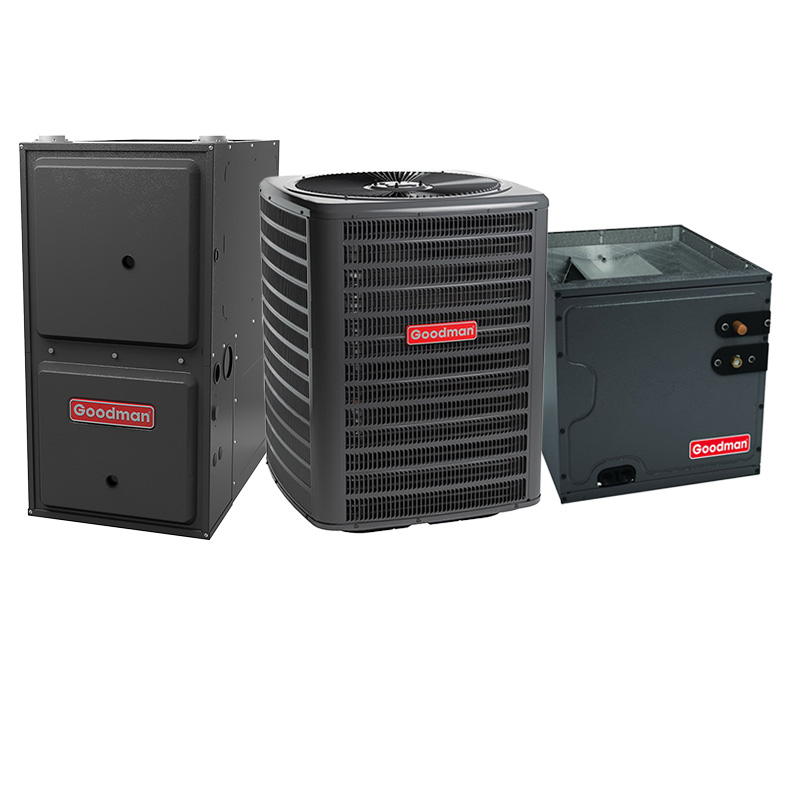
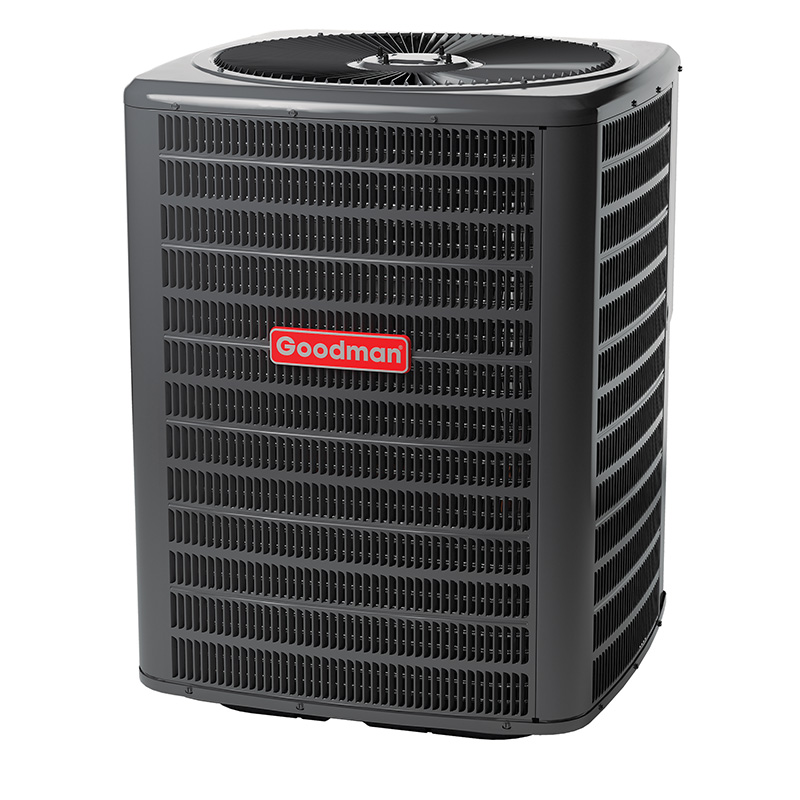
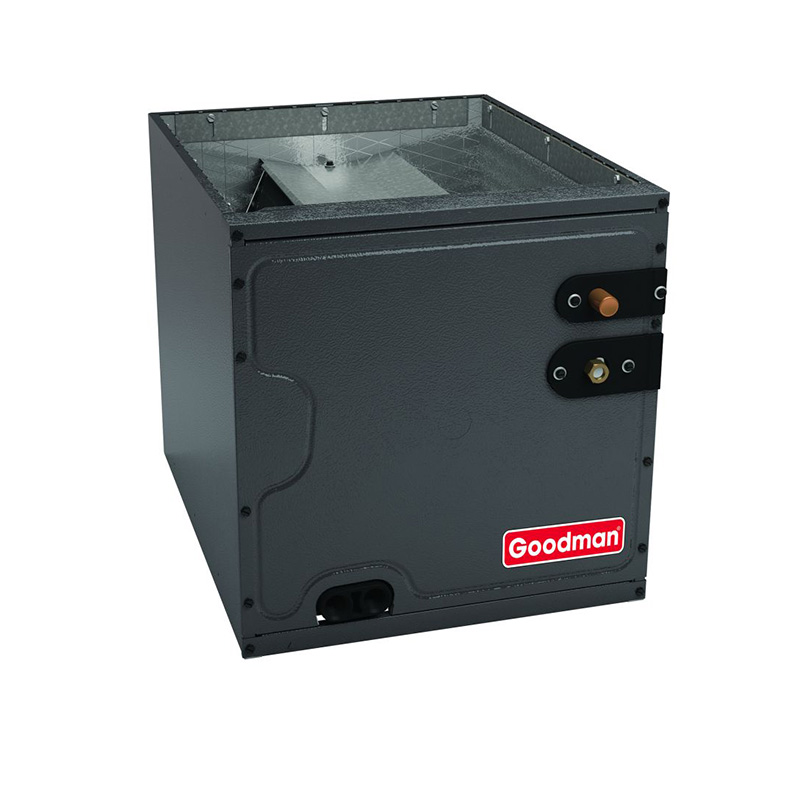
Goodman Furnace AC – 2.5 Ton 14.5 SEER2 AC With 60000 BTU 96% AFUE Multi-Speed ECM Gas Furnace System – Downflow | R32
View on AC Direct see your lowest price →Check current price on AC Direct →
Key features
- 2.5-ton cooling capacity with 14.5 SEER2 efficiency rating
- 60,000 BTU gas furnace at 96% AFUE for high-efficiency heating
- Downflow configuration for closet, platform, or above-floor installations
- Multi-speed ECM blower motor for reduced electricity use and improved humidity control
- R-32 refrigerant: lower global warming potential and better long-term serviceability than R-410A
- Factory-matched system designed to meet current DOE regional efficiency standards
About this system
This Goodman system pairs a 2.5-ton, 14.5 SEER2 central air conditioner with a 60,000 BTU, 96% AFUE multi-speed ECM gas furnace in a downflow configuration, making it a practical choice for homes where the air handler sits in a closet, alcove, or platform and delivers conditioned air downward into the ductwork below. The R-32 refrigerant charge is a forward-looking detail: R-32 has a lower global warming potential than the R-410A it replaces and is increasingly the industry standard, so future service calls should not be complicated by refrigerant availability issues.
The 96% AFUE rating means roughly 96 cents of every dollar spent on gas goes directly to heat, placing this furnace in the high-efficiency tier and making it eligible for some utility rebate programs depending on your location. The multi-speed ECM blower motor runs at lower speeds during partial-load conditions, which reduces electricity consumption compared to a single-speed PSC motor and tends to improve humidity control and air distribution comfort. At 14.5 SEER2, the cooling side meets the current federal minimum for northern climates and sits just above it for most southern regions, delivering honest entry-level efficiency rather than a premium tier result. Homeowners replacing an older 8 to 10 SEER system will still see a noticeable reduction in summer cooling bills.
This bundle is best suited to budget-conscious homeowners in mild to moderate climates, rental property owners, or anyone replacing aging equipment who wants a full system on a defined budget. It is not aimed at buyers prioritizing whisper-quiet operation, top-tier long-run reliability, or the lowest possible utility bills over a 20-year horizon. Think of it as a solid, no-frills workhorse that delivers real performance when it is installed correctly and maintained on schedule.
This Goodman bundle delivers genuine high-efficiency heating and entry-level efficient cooling at a price point that undercuts Carrier, Trane, and Lennox by a meaningful margin. The trade-off is a shorter expected compressor lifespan, some documented component vulnerability, and performance that is heavily dependent on the quality of the installation. For buyers who prioritize upfront cost and are comfortable budgeting for potential mid-life repairs, it represents fair value.
Overall score is the average of the five ratings above.
What we like
- 96% AFUE furnace is in the high-efficiency tier and may qualify for local utility rebates
- ECM multi-speed blower improves comfort and lowers blower operating costs versus single-speed motors
- R-32 refrigerant is future-ready and easier to source as R-410A is phased out
- Priced 15 to 25 percent below comparable Carrier, Trane, and Lennox systems
- Factory-matched components reduce compatibility guesswork and simplify warranty claims
Trade-offs
- Compressor lifespan averages 10 to 14 years, notably shorter than the 15 to 20 years typical of premium brands
- Dual-run capacitors are the most commonly reported failure point, typically requiring a repair within the first 7 to 10 years
- A meaningful share of owner reviews report evaporator coil leaks, which are more costly to address than capacitor swaps
- A minority of owners have reported refrigerant leaks in the first year, generally traced to install or charge issues rather than the unit itself
What homeowners and pros say about Goodman
Homeowners who share experiences with Goodman equipment online tell a fairly consistent story. On Google dealer review pages, where ratings average around 3.8 out of 5, the most common praise centers on affordability: buyers felt they received a functional, complete system without paying the premium that Carrier or Trane command. Complaints on those same pages tend to focus on installer responsiveness rather than the equipment itself, which echoes what HVAC technicians say privately: a Goodman unit installed carefully, with correct refrigerant charge and properly sealed ductwork, tends to run without drama in its first several years. The equipment is straightforward to work on, parts are widely stocked, and experienced technicians generally do not regard it as difficult to service.
The harder picture emerges on ConsumerAffairs, where Goodman scores roughly 2.5 out of 5 and the reviews skew heavily toward frustrated owners. The recurring pattern is not early catastrophic failure but rather repair costs that begin accumulating after roughly year seven. The dual-run capacitor is the most frequently named culprit, a genuinely low-cost fix, but owners who then face an evaporator coil leak or a compressor replacement in the same general window can feel the original savings erode quickly. Compressor longevity is the other documented concern: independent technician assessments put Goodman compressor averages at 10 to 14 years, compared to 15 to 20 years for premium brands. For a rental property or a home you plan to sell within a decade, that gap may matter less than the upfront savings. For a forever home, it is worth factoring into the total cost of ownership before signing off on the purchase.
Sources: ConsumerAffairs Goodman owner reviews, AHRI Directory of Certified Product Performance, U.S. DOE appliance and equipment efficiency standards, Goodman product specification sheets.
What it costs to run
At 14.5 SEER2, cooling this 2.5-ton system for a typical 1200-hour cooling season at the U.S. average electricity rate of $0.17/kWh works out to roughly $422 per year in cooling, about $35 less per year than a minimum-efficiency 13.4 SEER2 unit of the same size. Your real cost depends on your climate and local rate.
Method: (30,000 BTU/hr ÷ 14.5 SEER2) × 1200 hours ÷ 1000 × $0.17/kWh. Rate source: U.S. EIA average; cooling hours: moderate-climate estimate.
How it compares
| Brand | Comparable model | SEER2 | Stage | Price position |
|---|---|---|---|---|
| Goodman | This system (2.5T 14.5 SEER2 / 96% AFUE Downflow ECM) | 14.5 | Single-stage cooling / Multi-speed heating | Value pick |
| Carrier | Comfort Series (24ACC636 / 59SC2) | 14.5-15 | Single-stage | Typically 15 to 25 percent more than this Goodman system |
| Trane | XR14 / XC14 with S8X1 furnace | 14.5-15 | Single-stage | Typically 15 to 25 percent more than this Goodman system |
| Lennox | Merit Series ML14XC1 with ML196E furnace | 14.5-15 | Single-stage | Typically 15 to 25 percent more than this Goodman system |
Competitor rows are comparable single-stage units at similar efficiency; price is relative position, not a quote.
Questions about this system
Is a downflow furnace the right configuration for my home, or do I need upflow?
Downflow furnaces discharge heated or cooled air through the bottom of the unit into ductwork below, which suits installations in a main-floor closet, a raised platform, or a space where ductwork runs under the floor. If your ducts run through an attic or the furnace sits in a basement blowing up into the living space, you need an upflow model instead. Confirm your existing duct connection location before ordering.
Will R-32 refrigerant cause any problems finding a technician for future service?
R-32 is now widely used in mini-split systems and is gaining ground in central equipment, so most licensed HVAC technicians are familiar with it. It does require slightly different handling procedures than R-410A because it is mildly flammable, but it is not a specialty refrigerant, and supply availability is strong and growing as the industry moves away from R-410A.
What does the 96% AFUE rating actually mean for my heating bill?
AFUE measures how much of the fuel burned becomes usable heat. At 96%, only about 4% of the gas you pay for is lost through the flue, compared to roughly 20% with an older 80% AFUE furnace. In practical terms, replacing an 80% unit with this furnace could reduce your gas heating costs by roughly 15 to 20 percent, though actual savings depend on your local gas rates, climate, and home insulation.
How worried should I be about the capacitor and coil failure reports?
Dual-run capacitor failures on Goodman equipment are well-documented and worth knowing about, but they are also one of the least expensive HVAC repairs, typically costing between 300 and 600 dollars including labor. Evaporator coil leaks are more serious and can cost significantly more to fix. Enrolling in annual maintenance visits and asking your technician to inspect the coil and capacitor during each visit is the most practical way to catch problems early.
Does the ECM blower motor make a noticeable difference compared to a standard motor?
Yes, in two practical ways. First, it uses significantly less electricity at lower speeds, which reduces your overall operating costs across the cooling and heating seasons. Second, because it can ramp down to a gentle, sustained airflow rather than cycling fully on and off, most homeowners notice quieter operation and more even temperature distribution throughout the house.
Specifications
| Cooling capacity | 2.5 Ton |
| Efficiency | 14.5 SEER2 |
| Furnace output | 60000 BTU |
| Furnace efficiency | 96% AFUE |
| Configuration | Downflow |
| Refrigerant | R-32 |