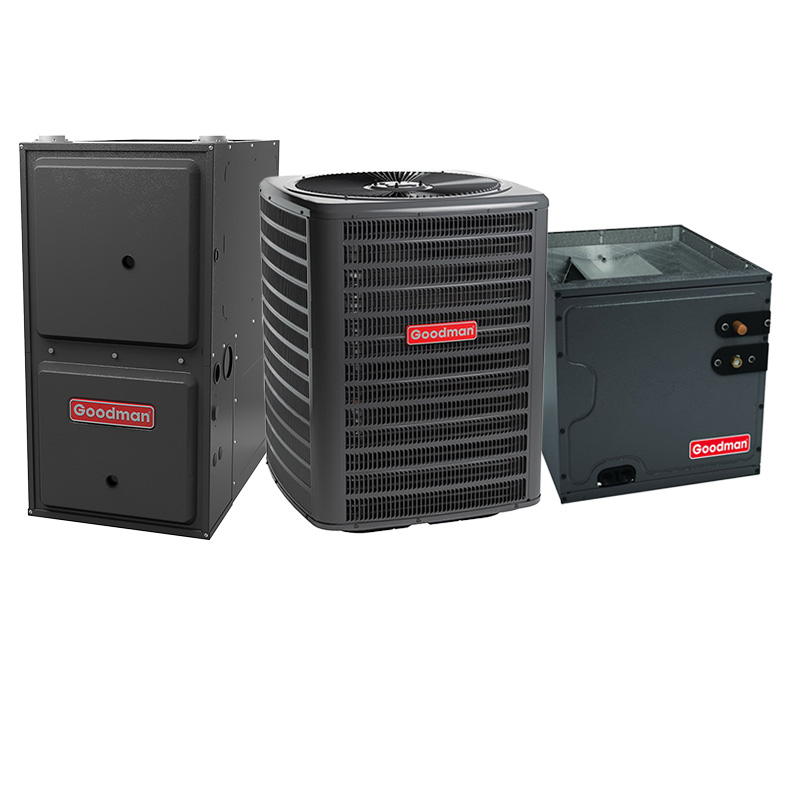
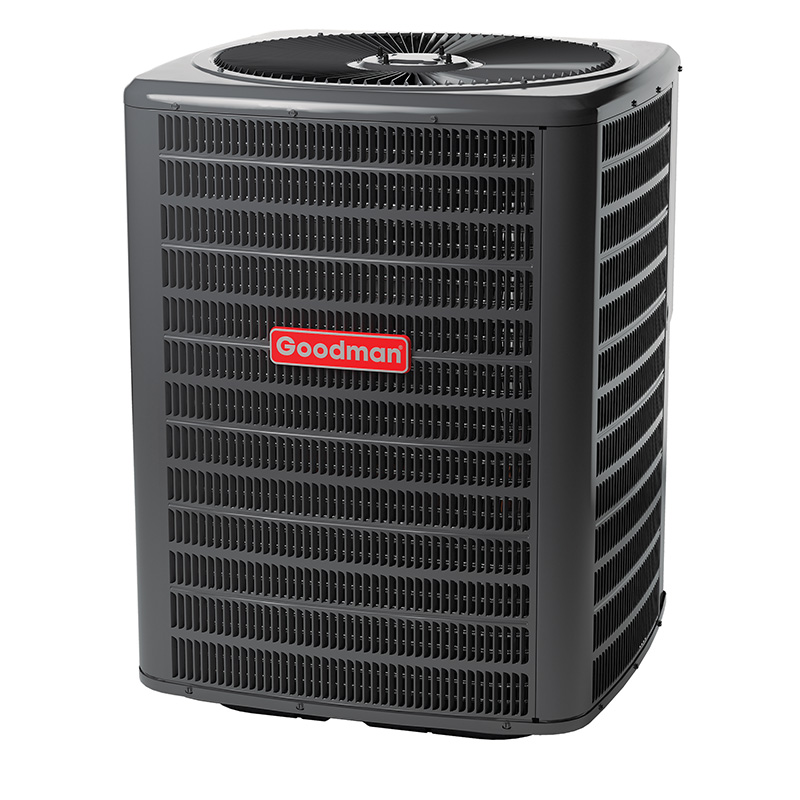
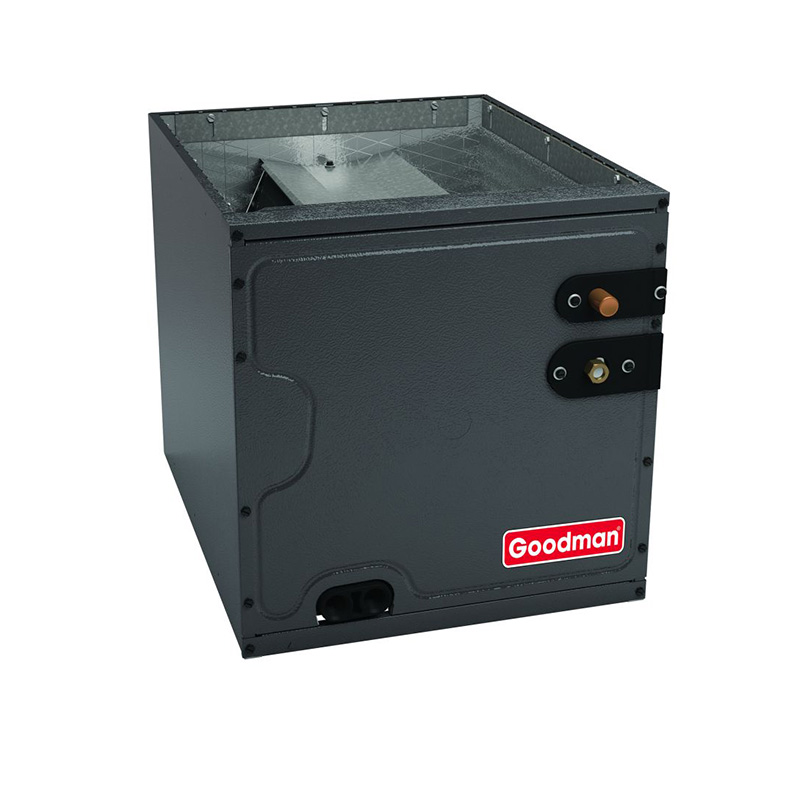
Goodman Furnace AC – 2 Ton 14.5 SEER2 AC With 60000 BTU 96% AFUE Multi-Speed ECM Gas Furnace System – Downflow | R32
View on AC Direct see your lowest price →Check current price on AC Direct →
Key features
- 14.5 SEER2 cooling efficiency meets current federal minimum standards for most U.S. regions
- 96% AFUE multi-speed ECM gas furnace reduces fuel waste and blower electricity draw
- Downflow configuration designed for below-unit duct systems in crawl-space and manufactured homes
- R-32 refrigerant with lower global warming potential than R-410A
- 60,000 BTU heating capacity suited to approximately 900 to 1,400 square feet (load calc required)
- Goodman factory warranty covers parts; 10-year registered parts warranty available with timely registration
About this system
This Goodman downflow system pairs a 2-ton, 14.5 SEER2 central air conditioner with a 60,000 BTU, 96% AFUE multi-speed ECM gas furnace. The downflow configuration sends conditioned air downward through the supply plenum, making it the right choice for homes with ductwork routed beneath the unit, a common setup in crawl-space homes, manufactured housing, and some split-level builds. The R-32 refrigerant charge is a forward-looking choice: R-32 has a lower global warming potential than the R-410A it replaces and is increasingly the industry standard, so servicing costs should remain reasonable as the market shifts.
The 96% AFUE furnace rating means only about four cents of every fuel dollar escapes as exhaust, which puts this unit in the high-efficiency tier without the added cost or venting complexity of a 98% modulating system. The multi-speed ECM blower motor adjusts airflow to match demand rather than running at a single fixed speed, which improves dehumidification, reduces temperature swings, and cuts blower electricity use compared to a standard PSC motor. At 2 tons and 60,000 BTU, this system is sized for roughly 900 to 1,400 square feet of well-insulated space, though a proper Manual J load calculation by your installer is the only reliable way to confirm fit for your home.
Goodman positions this as a value-oriented system, typically priced 15 to 25 percent below comparable equipment from Trane, Lennox, and Carrier. That gap is real, and so are the trade-offs. Performance and longevity depend heavily on installation quality, and the brand’s ownership history shows more repair activity after year seven than premium competitors tend to see. For budget-conscious homeowners who vet their installer carefully and want a high-efficiency furnace with a modern refrigerant, this bundle makes a credible case. For those who prize the lowest possible lifetime cost and premium brand support, the price gap to premium brands may be worth closing.
This Goodman downflow bundle delivers a legitimate 96% AFUE furnace and entry-level 14.5 SEER2 cooling at a price that undercuts major brands by a notable margin. The ECM blower and R-32 refrigerant are genuine upgrades over baseline equipment, but the brand's track record points to above-average repair frequency past year seven and a compressor lifespan that trails premium competitors. It is a reasonable buy for cost-focused homeowners who hire an experienced, licensed installer and keep up with maintenance.
Overall score is the average of the five ratings above.
What we like
- 96% AFUE furnace is a high-efficiency rating that meaningfully reduces monthly gas bills
- ECM multi-speed blower improves comfort and cuts electrical consumption versus single-speed PSC motors
- R-32 refrigerant is lower-GWP and increasingly serviceable as market supply grows
- System price typically runs 15 to 25 percent below Trane, Carrier, and Lennox equivalents
- Downflow design fits a specific duct layout that many competing bundle kits do not address
Trade-offs
- Dual-run capacitors are the most frequently reported failure, typically appearing after several years of use and costing $300 to $600 to repair
- Evaporator coil leaks appear in a meaningful share of owner reports, which can mean refrigerant loss and costly service calls
- Compressor lifespan averages 10 to 14 years versus 15 to 20 years for premium-brand compressors
- ConsumerAffairs rating sits around 2.5 out of 5, with recurring complaints about escalating repair costs after roughly year seven
What homeowners and pros say about Goodman
Homeowners who share feedback on Goodman equipment tend to split along a clear line. Those who had a careful installation and kept up with annual maintenance often report years of uneventful service and point to affordability as the reason they chose the brand. Google dealer reviews across Goodman installers average around 3.8 out of 5, with budget-friendly pricing the most common point of praise. The picture on ConsumerAffairs is harder, with a score of about 2.5 out of 5 on a channel that tends to attract owners with complaints rather than satisfied customers. The recurring theme there is repair bills that start to climb somewhere around year seven, which aligns with the brand’s documented component history.
HVAC technicians who work on Goodman equipment regularly point to two failure modes worth knowing before you buy. First, dual-run capacitors are the most commonly replaced part, and while the repair is usually straightforward and costs $300 to $600, it can be an early signal of broader electrical stress on the system. Second, evaporator coil leaks appear in a meaningful number of owner reports, and a leaking coil in an R-32 system means both refrigerant loss and a service call that goes beyond a simple capacitor swap. On the furnace side, a 96% AFUE ECM unit from Goodman draws little criticism from the field. Technicians note that the multi-speed blower logic and heat exchanger quality at this price point are competitive, and that the compressor, not the furnace, is where the brand’s shorter average lifespan of 10 to 14 years versus 15 to 20 for premium brands shows up most clearly.
Sources: ConsumerAffairs Goodman owner reviews, AHRI Directory of Certified Product Performance, U.S. DOE appliance and equipment efficiency standards, Goodman product specification sheets.
What it costs to run
At 14.5 SEER2, cooling this 2-ton system for a typical 1200-hour cooling season at the U.S. average electricity rate of $0.17/kWh works out to roughly $338 per year in cooling, about $27 less per year than a minimum-efficiency 13.4 SEER2 unit of the same size. Your real cost depends on your climate and local rate.
Method: (24,000 BTU/hr ÷ 14.5 SEER2) × 1200 hours ÷ 1000 × $0.17/kWh. Rate source: U.S. EIA average; cooling hours: moderate-climate estimate.
How it compares
| Brand | Comparable model | SEER2 | Stage | Price position |
|---|---|---|---|---|
| Goodman | This downflow R-32 bundle (2T 14.5 SEER2 / 96% AFUE ECM) | 14.5 | Single-stage cooling, multi-speed ECM heat | Value pick |
| Carrier | Comfort Series (24ACC6 AC + 59SC5 furnace) | 14.5-15 | Single-stage | Typically 15 to 25 percent more than this Goodman bundle |
| Trane | S-Series (AC S4AC2 + furnace S9X2) | 14.5-15 | Single-stage | Typically 15 to 25 percent more than this Goodman bundle |
| Lennox | Merit Series (14ACX AC + ML196 furnace) | 14.5-15 | Single-stage | Typically 15 to 25 percent more than this Goodman bundle |
Competitor rows are comparable single-stage units at similar efficiency; price is relative position, not a quote.
Questions about this system
Why does this system use a downflow configuration instead of upflow, and how do I know which one my home needs?
Downflow means the furnace pulls return air in from the top and pushes conditioned air downward into the supply plenum below it. This suits homes where ductwork runs beneath the unit, such as crawl-space or manufactured homes. Upflow is the reverse and is common in basements. Check where your existing supply and return ducts connect to your current air handler or furnace before ordering, or have your installer confirm the correct orientation.
What does R-32 refrigerant mean for me compared to the older R-410A systems?
R-32 has a lower global warming potential than R-410A and is quickly becoming the new industry standard as R-410A is phased down under federal regulations. For you as an owner, this means parts and refrigerant should remain available and competitively priced over the life of the system. R-32 systems do require technicians certified to handle it, but most licensed HVAC professionals are already familiar with it.
What are the most common repairs I should budget for with a Goodman system?
The most frequently reported failure point is the dual-run capacitor, a relatively inexpensive repair that typically runs $300 to $600. Evaporator coil leaks also show up in a meaningful share of Goodman owner reports and are more costly to address. Budgeting for a maintenance contract or setting aside a repair fund after year five is a practical approach with this brand.
Do I need to register the product to get the full warranty, and what does the warranty actually cover?
Yes, Goodman requires product registration within a specific window after installation (typically 60 days) to unlock the 10-year registered parts warranty. Without registration, the warranty period is shorter. The parts warranty covers covered components but generally does not include labor costs, so verify what your installer's labor warranty adds on top of Goodman's coverage.
Is a 2-ton, 60,000 BTU system the right size for my home?
Roughly speaking, 2 tons of cooling is a starting point for homes around 900 to 1,400 square feet, but ceiling height, insulation levels, window area, climate zone, and duct condition all affect the correct size. Oversizing or undersizing both cause real problems, including comfort issues and shortened equipment life. A licensed installer should perform a Manual J load calculation before any equipment is purchased or installed.
Specifications
| Cooling capacity | 2 Ton |
| Efficiency | 14.5 SEER2 |
| Furnace output | 60000 BTU |
| Furnace efficiency | 96% AFUE |
| Configuration | Downflow |
| Refrigerant | R-32 |