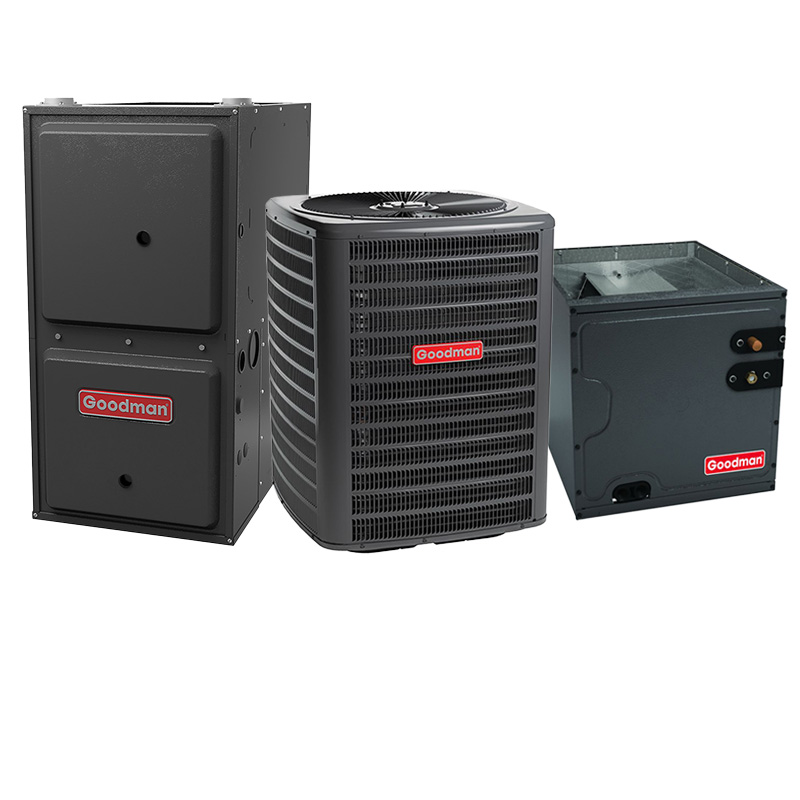
Goodman Furnace AC Combo – 4 Ton 13.5 SEER2 AC With 100000 BTU 97% AFUE Modulating Variable-Speed ECM Gas Furnace System – Downflow | R32
View on AC Direct see your lowest price →Check current price on AC Direct →
Key features
- 97% AFUE modulating gas furnace keeps heating bills near the practical ceiling for gas equipment
- Variable-speed ECM blower motor reduces energy use and noise compared to single-speed motors
- 13.5 SEER2 AC meets current federal minimum efficiency standards for most U.S. climate zones
- Downflow configuration designed for installations where conditioned air is delivered from above the living space
- R-32 refrigerant with lower global warming potential and growing technician availability
- 4-ton capacity suited to larger homes, typically 1,800 to 2,400 square feet depending on load factors
About this system
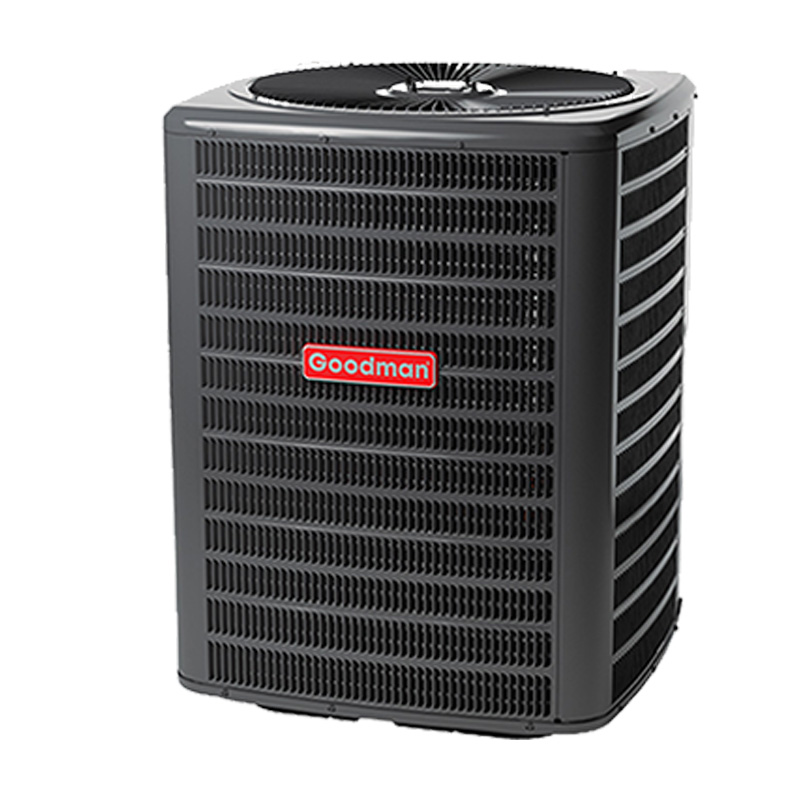
This Goodman combo pairs a 4-ton, 13.5 SEER2 air conditioner with a 100,000 BTU, 97% AFUE modulating gas furnace in a downflow configuration, making it a strong candidate for homes where the air handler sits in an upper-level closet or attic and supply air flows downward. The R-32 refrigerant charge is a forward-looking choice: R-32 has a lower global warming potential than the R-410A it replaces and is increasingly the industry standard, so future service and recharge costs should remain accessible as the refrigerant becomes more widely stocked. At 4 tons, this system is sized for roughly 1,800 to 2,400 square feet depending on climate, insulation, and window load, though a proper Manual J load calculation by your installer is the only reliable way to confirm fit.
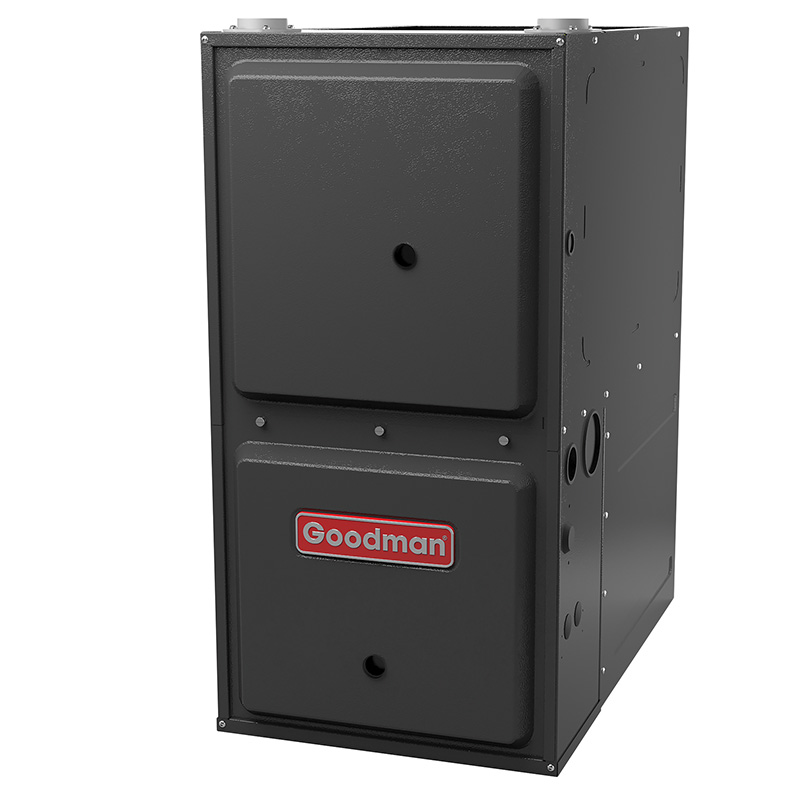
The furnace side is where this bundle stands out. A 97% AFUE rating means only 3% of combustion energy exits as flue gas, which is about as efficient as a gas furnace gets. The modulating burner adjusts heat output in small increments rather than cycling fully on and off, and the variable-speed ECM blower motor ramps airflow up and down to match demand. That combination delivers steadier indoor temperatures, quieter operation, and measurably lower heating bills versus a single-stage unit. The AC side, at 13.5 SEER2, meets the new federal minimum efficiency standards for most U.S. regions but sits at the lower end of the efficiency range rather than the top. Buyers prioritizing low operating costs on the cooling side may want to weigh a higher-SEER2 option, but for climates where heating dominates the annual energy bill, the furnace efficiency is the bigger lever.
This combo delivers genuinely high furnace efficiency and comfort-oriented modulating technology at a price point well below comparable Trane, Carrier, or Lennox bundles. The trade-off is a cooling efficiency that is merely code-minimum and a brand reliability record that trails premium competitors, particularly after the seven-year mark. For budget-conscious buyers in heating-dominated climates who plan to invest in quality installation, it offers solid value.
Overall score is the average of the five ratings above.
What we like
- 97% AFUE furnace is among the most efficient gas heating options available
- Modulating burner and variable-speed ECM blower improve comfort and reduce temperature swings
- R-32 refrigerant is more environmentally responsible and increasingly well-supported by technicians
- Priced 15 to 25 percent below comparable Carrier, Trane, and Lennox systems, freeing budget for a quality install
- Downflow design suits attic and upper-closet applications that are otherwise difficult to configure
Trade-offs
- 13.5 SEER2 is code-minimum cooling efficiency; operating costs will be higher than mid- or high-efficiency AC options over time
- Compressor longevity averages 10 to 14 years versus 15 to 20 years for premium brands, meaning earlier replacement risk on a 4-ton unit
- Dual-run capacitors and evaporator coil leaks are documented recurring failure points that can add repair costs after year seven
- A minority of owners report refrigerant leaks in the first year, which points to sensitivity to installation quality and charge accuracy
What homeowners and pros say about Goodman
Owners and technicians tend to agree on two things about Goodman equipment: the price-to-feature ratio is hard to beat at purchase time, and what happens afterward depends heavily on who installed it. On ConsumerAffairs, Goodman scores around 2.5 out of 5, a channel skewed toward unhappy owners, where the most consistent complaint is repair costs rising after roughly year seven. Google dealer reviews tell a different story, averaging around 3.8 out of 5 across hundreds of location-level reviews, where affordability is the praise that comes up most often. The gap between those two scores reflects the gap between buyers who got a careful installation and those who did not.
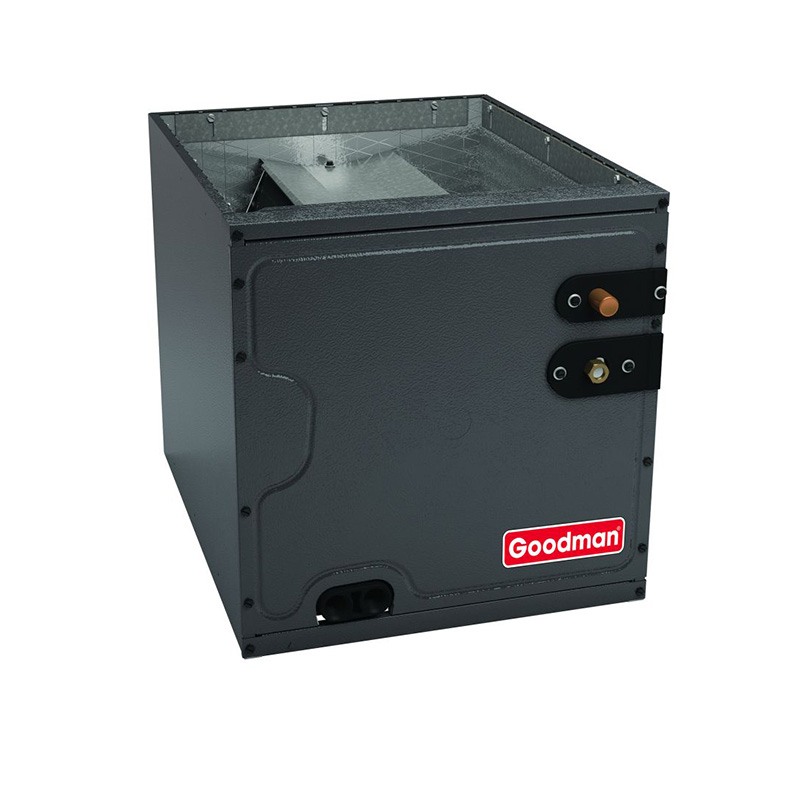
Among the specific failure modes that come up in real-world reports, dual-run capacitor failures are the most common and generally the least alarming: a $300 to $600 repair that an experienced technician can handle in under an hour. More consequential are evaporator coil leaks, which appear in a meaningful share of owner accounts and can be costly depending on when they occur in the system’s life. Compressor longevity is the other honest concern: Goodman compressors tend to run 10 to 14 years on average, shorter than the 15 to 20-year track record associated with premium brands, which matters more on a larger 4-ton unit where replacement costs are higher. A small percentage of owners also report refrigerant leaks within the first year, an issue that typically traces back to installation or initial charge rather than the equipment itself.
Sources: ConsumerAffairs Goodman owner reviews, AHRI Directory of Certified Product Performance, U.S. DOE appliance and equipment efficiency standards, Goodman product specification sheets.
What it costs to run
At 13.5 SEER2, cooling this 4-ton system for a typical 1200-hour cooling season at the U.S. average electricity rate of $0.17/kWh works out to roughly $725 per year in cooling, about $6 less per year than a minimum-efficiency 13.4 SEER2 unit of the same size. Your real cost depends on your climate and local rate.
Method: (48,000 BTU/hr ÷ 13.5 SEER2) × 1200 hours ÷ 1000 × $0.17/kWh. Rate source: U.S. EIA average; cooling hours: moderate-climate estimate.
How it compares
| Brand | Comparable model | SEER2 | Stage | Price position |
|---|---|---|---|---|
| Goodman | GMVC97 / GSXH504810 (this system) | 13.5 | Modulating / Variable-speed | Value pick |
| Carrier | Comfort 14 (24ACC4) with 59MN7 Gas Furnace | 13.8 | Single-stage / Two-stage | Roughly 20 to 25 percent more than this system |
| Trane | XR14c with S9V2 Gas Furnace | 14.0 | Single-stage / Variable-speed | Roughly 25 to 30 percent more than this system |
| Lennox | Merit 14ACX with ML296V Gas Furnace | 13.8 | Single-stage / Variable-speed | Roughly 20 to 30 percent more than this system |
Competitor rows are comparable single-stage units at similar efficiency; price is relative position, not a quote.
Questions about this system
Why does this furnace have a 97% AFUE rating and what does that actually save me?
A 97% AFUE furnace converts 97 cents of every dollar of gas into usable heat, compared to roughly 80 cents for a standard-efficiency unit. On a typical U.S. heating bill that difference can represent hundreds of dollars per year in savings, though exact amounts depend on your local gas rate, climate, and how well the system is sized and sealed. The modulating burner also helps by running at lower capacity most of the time rather than cycling on at full blast.
Is a downflow furnace harder to install than a standard upflow unit?
Downflow furnaces require the supply plenum and ductwork to connect below the unit, which limits where they can be installed and adds complexity if your existing duct layout was designed for upflow. They are a correct and common choice for attic or upper-closet installations, but you should confirm with your installer that your home's duct configuration matches before purchasing. Mismatches here are a known source of callbacks and extra labor costs.
What are the most common repair issues I should budget for with Goodman equipment?
The most frequently reported failure point is the dual-run capacitor, which typically costs between $300 and $600 to diagnose and replace and is generally a straightforward fix. Evaporator coil leaks appear in a meaningful portion of owner reports and are more expensive to address. Compressors on Goodman units tend to average 10 to 14 years of service life, so budgeting for a possible compressor repair or replacement in the second decade of ownership is reasonable.
Is R-32 refrigerant easy to find and service compared to R-410A?
R-32 availability has grown substantially as manufacturers shift away from R-410A, and most HVAC distributors and service contractors now stock it or can order it quickly. It does require technicians to use compatible recovery equipment and follow specific handling procedures due to its mildly flammable classification, so confirming your service technician is R-32 certified before scheduling any refrigerant work is a good practice.
Will 4 tons actually be the right size for my house, or should I get a load calculation done?
A Manual J load calculation is the only reliable way to size this system correctly for your home. Rules of thumb like 400 to 600 square feet per ton are a rough starting point but ignore insulation levels, ceiling height, window area, local climate, and infiltration. Oversizing a modulating system like this one partially offsets the efficiency penalty through part-load operation, but it still shortens equipment life and increases humidity problems. Ask your installer for a documented load calculation before signing off on 4 tons.
Specifications
| Cooling capacity | 4 Ton |
| Efficiency | 13.5 SEER2 |
| Furnace output | 100000 BTU |
| Furnace efficiency | 97% AFUE |
| Configuration | Downflow |
| Refrigerant | R-32 |