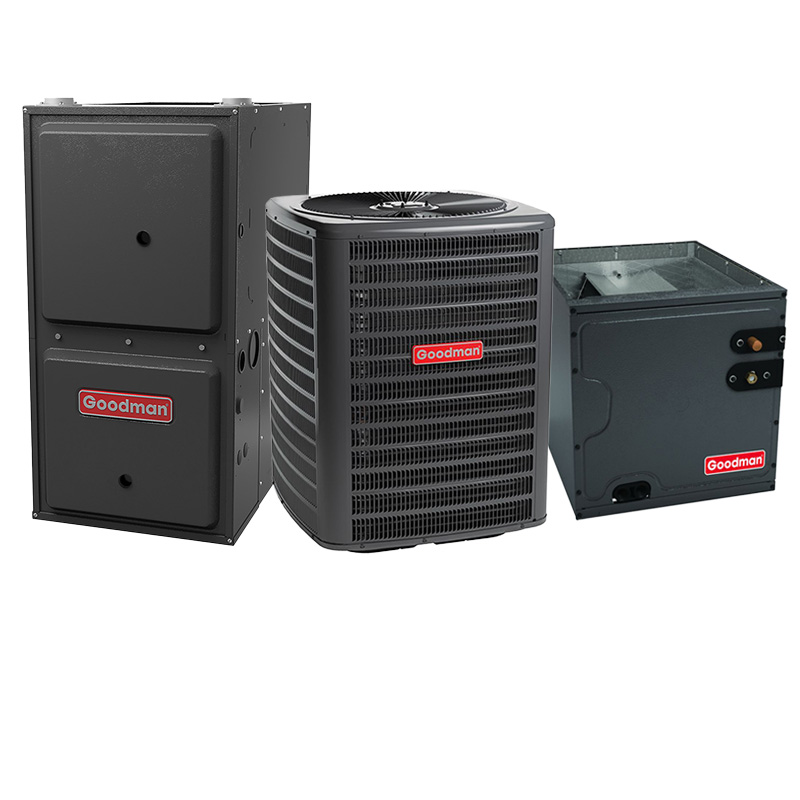
Goodman Furnace AC Combo – 5 Ton 13.6 SEER2 AC With 100000 BTU 97% AFUE Modulating Variable-Speed ECM Gas Furnace System – Downflow | R32
View on AC Direct see your lowest price →Check current price on AC Direct →
Key features
- 5-ton cooling capacity suited for larger homes in the 2,500 to 3,500 sq ft range
- 97% AFUE modulating gas furnace with incremental burner output for consistent comfort
- Variable-speed ECM blower motor reduces electricity use and improves dehumidification
- 13.6 SEER2 cooling efficiency meets current federal minimums for most U.S. regions
- Downflow configuration designed for above-space installations with downward duct runs
- R-32 refrigerant with lower global warming potential and good long-term parts availability
About this system
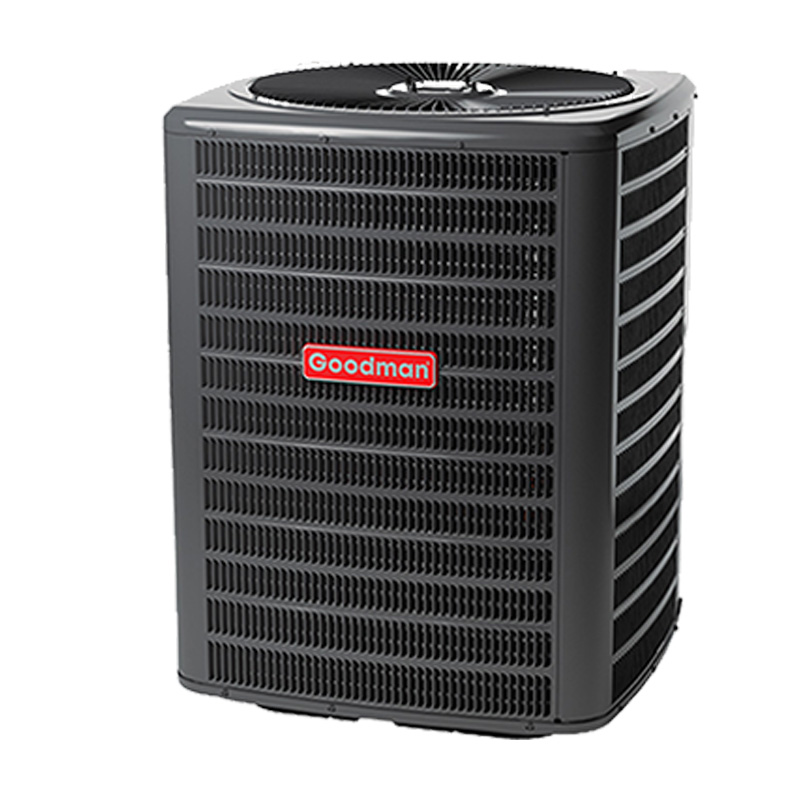
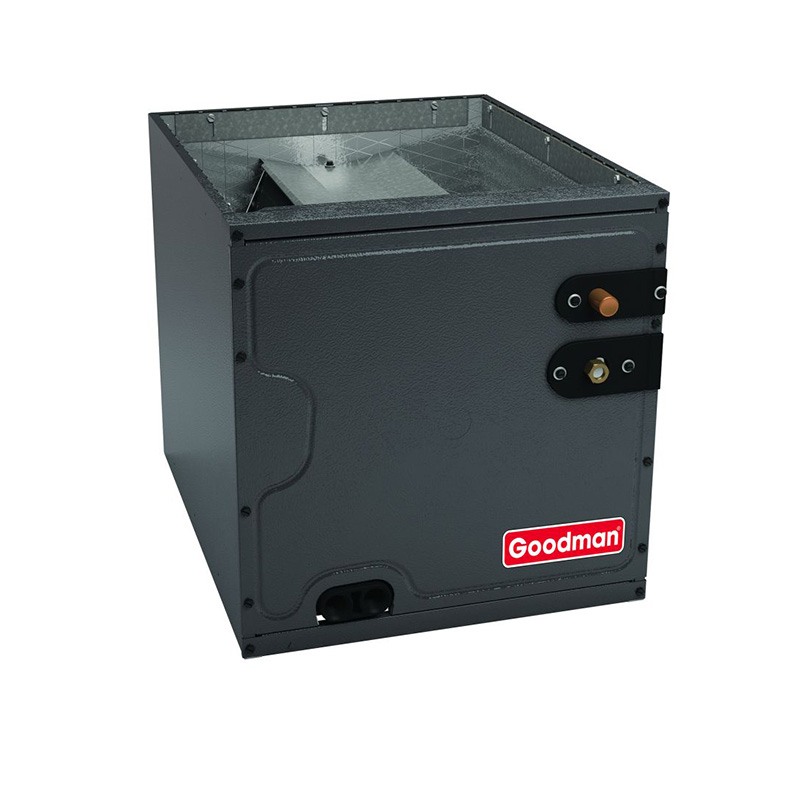
This Goodman combo pairs a 5-ton, 13.6 SEER2 central air conditioner with a 100,000 BTU, 97% AFUE modulating gas furnace in a downflow configuration, making it sized for larger homes typically in the 2,500 to 3,500 square foot range depending on climate and insulation. The downflow orientation means the air handler sits above the conditioned space and delivers air downward, a layout common in homes with basement or closet mechanical rooms where supply ducts run beneath the unit. The system uses R-32 refrigerant, a lower global-warming-potential option that is becoming the new standard as R-410A is phased out, so parts and refrigerant availability should remain strong for the foreseeable future.
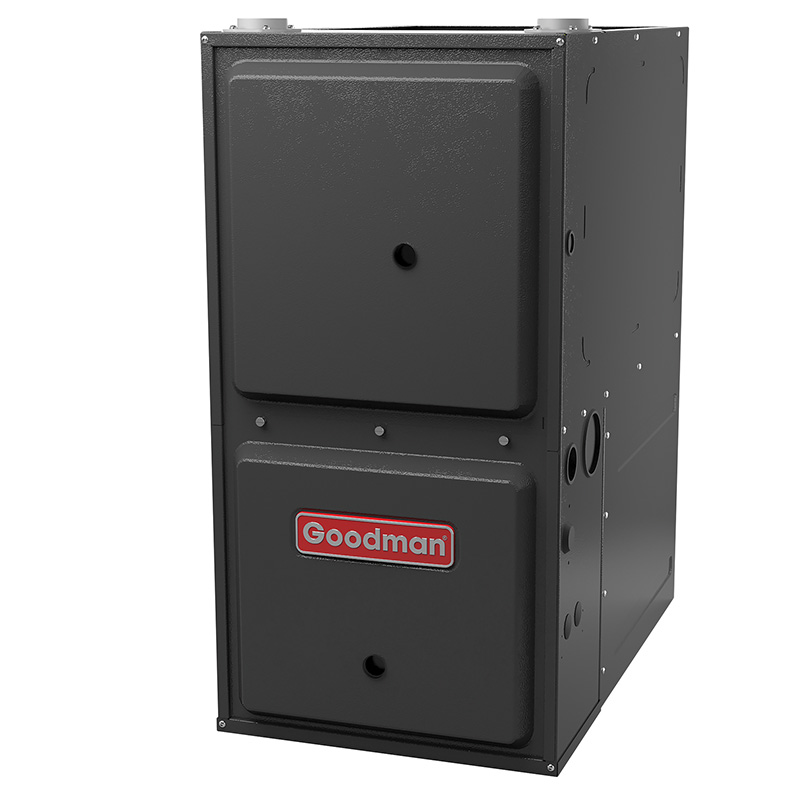
The furnace side is where this package stands out most. A 97% AFUE modulating furnace with a variable-speed ECM blower motor is genuinely high-performance heating technology. Modulating means the burner adjusts output in small increments rather than cycling fully on and off, which holds indoor temperatures more consistently and reduces cold-start temperature swings. The ECM motor ramps fan speed to match demand, cutting electricity consumption compared to a standard PSC blower and improving dehumidification in cooling mode by moving air more slowly across the coil. The 13.6 SEER2 AC rating is entry-level under current Department of Energy standards, competitive for the budget tier but not exceptional if running costs are a primary concern in hot southern climates.
This system delivers genuinely premium heating technology, specifically the modulating furnace and ECM blower, at a price point well below Carrier, Trane, or Lennox equivalents. The 13.6 SEER2 cooling side is competent but not a strength, and long-term ownership costs will depend heavily on install quality and how the documented Goodman failure points play out over time. Buyers who want high-efficiency heating without paying a premium brand price will find real value here, provided they use a skilled installer.
Overall score is the average of the five ratings above.
What we like
- 97% AFUE modulating furnace is top-tier heating efficiency and typically adds hundreds in annual gas savings in cold climates
- Variable-speed ECM blower significantly reduces fan electricity costs compared to single-speed alternatives
- R-32 refrigerant is future-proof as R-410A is phased out industry-wide
- Goodman pricing runs 15 to 25 percent below comparable Trane, Lennox, and Carrier systems
- Modulating burner and ECM combination produces more even temperatures and better humidity control than single-stage setups
Trade-offs
- 13.6 SEER2 is the low end of current efficiency standards; high-cooling-demand regions will see meaningfully lower savings than a 16 or 18 SEER2 system
- Dual-run capacitor failures are a well-documented Goodman weak point, and compressors average 10 to 14 years versus 15 to 20 for premium brands
- Evaporator coil leaks appear in a notable share of owner reports and can be costly to address out of warranty
- A minority of owners report refrigerant leaks within the first year, typically traced to charge or install errors rather than the equipment itself, which underscores the heavy reliance on installer quality
What homeowners and pros say about Goodman
Homeowners who have lived with Goodman equipment generally divide into two camps, and the split closely tracks install quality. On Google dealer reviews, Goodman systems average around 3.8 out of 5 stars across hundreds of reviews per location, with affordability cited most often as the reason buyers chose the brand. On ConsumerAffairs, a channel that skews heavily toward people motivated enough to file a complaint, the score drops to roughly 2.5 out of 5, and the recurring pattern is repair costs accelerating after about year seven. Neither number tells the whole story, but together they suggest a brand that performs acceptably when set up right and shows its budget origins when it does not.
Among the failure modes HVAC technicians and owners report most often, dual-run capacitor failures are the most common on Goodman equipment and are generally a low-cost fix in the 300 to 600 dollar range. More concerning are evaporator coil leaks, which appear in a notable share of owner reviews and represent a more significant repair. Compressor lifespan runs an estimated 10 to 14 years on Goodman systems, noticeably shorter than the 15 to 20 years frequently cited for Trane, Carrier, and Lennox compressors. A smaller group of owners has also reported refrigerant leaks in the first year, a problem technicians typically attribute to charge or installation errors rather than a factory defect. For this specific system, the modulating furnace and ECM blower add mechanical complexity that rewards having a highly skilled installer who understands variable-capacity commissioning.
Sources: ConsumerAffairs Goodman owner reviews, AHRI Directory of Certified Product Performance, U.S. DOE appliance and equipment efficiency standards, Goodman product specification sheets.
What it costs to run
At 13.6 SEER2, cooling this 5-ton system for a typical 1200-hour cooling season at the U.S. average electricity rate of $0.17/kWh works out to roughly $900 per year in cooling, about $13 less per year than a minimum-efficiency 13.4 SEER2 unit of the same size. Your real cost depends on your climate and local rate.
Method: (60,000 BTU/hr ÷ 13.6 SEER2) × 1200 hours ÷ 1000 × $0.17/kWh. Rate source: U.S. EIA average; cooling hours: moderate-climate estimate.
How it compares
| Brand | Comparable model | SEER2 | Stage | Price position |
|---|---|---|---|---|
| Goodman | GMVC97 / GSXH5 Series | 13.6 | Modulating / Variable-speed | Value pick |
| Carrier | Infinity 96 / Performance 13 Series | 13.8 | Modulating / Variable-speed | 20 to 25 percent higher than this system |
| Trane | XV95 / XR13B Series | 14.0 | Modulating / Variable-speed | 20 to 30 percent higher than this system |
| Lennox | SLP98V / ML14XC1 Series | 14.3 | Modulating / Variable-speed | 25 to 35 percent higher than this system |
Competitor rows are comparable single-stage units at similar efficiency; price is relative position, not a quote.
Questions about this system
Is 5 tons the right size for my house, and can I just go bigger to be safe?
Sizing should come from a Manual J load calculation, not square footage alone. An oversized 5-ton unit in a house that needs 3.5 tons will short-cycle, leaving humidity high and wearing components faster. Have your installer run the calculation before ordering.
What does downflow mean, and how do I know if my home needs it?
Downflow means the furnace pulls return air in at the top and discharges heated or cooled air downward into the duct system below. It is the correct choice when your air handler sits in a main-floor closet or utility room with supply ducts in a basement or crawl space beneath it. Your existing ductwork layout determines this, not personal preference.
The furnace is 97% AFUE and modulating, but the AC is only 13.6 SEER2. Is that a mismatch?
The furnace and AC are separate pieces of equipment with independent efficiency ratings, so there is no technical mismatch. It does mean the heating side is exceptional while the cooling side is entry-level, which is a reasonable trade-off if your winters are long and summers are mild, but less ideal in climates where you run the AC heavily for six or more months.
What are the most likely repair costs I should budget for owning a Goodman over 10 years?
The dual-run capacitor is the most commonly reported failure and runs roughly 300 to 600 dollars to replace, including labor. Evaporator coil leaks are a more serious and more expensive repair that show up in a meaningful share of Goodman owner reports. Compressor lifespan averages 10 to 14 years on Goodman equipment, so budgeting for a potential compressor replacement or system replacement in that window is prudent.
Does R-32 refrigerant require any special handling or certification from my HVAC technician?
Yes. R-32 is mildly flammable and classified A2L, which means technicians need proper certification and equipment to handle it safely. Most licensed HVAC professionals are already trained or in the process of being certified for A2L refrigerants as R-32 and R-454B become standard. Confirm your installer is current before scheduling service.
Specifications
| Cooling capacity | 5 Ton |
| Efficiency | 13.6 SEER2 |
| Furnace output | 100000 BTU |
| Furnace efficiency | 97% AFUE |
| Configuration | Downflow |
| Refrigerant | R-32 |