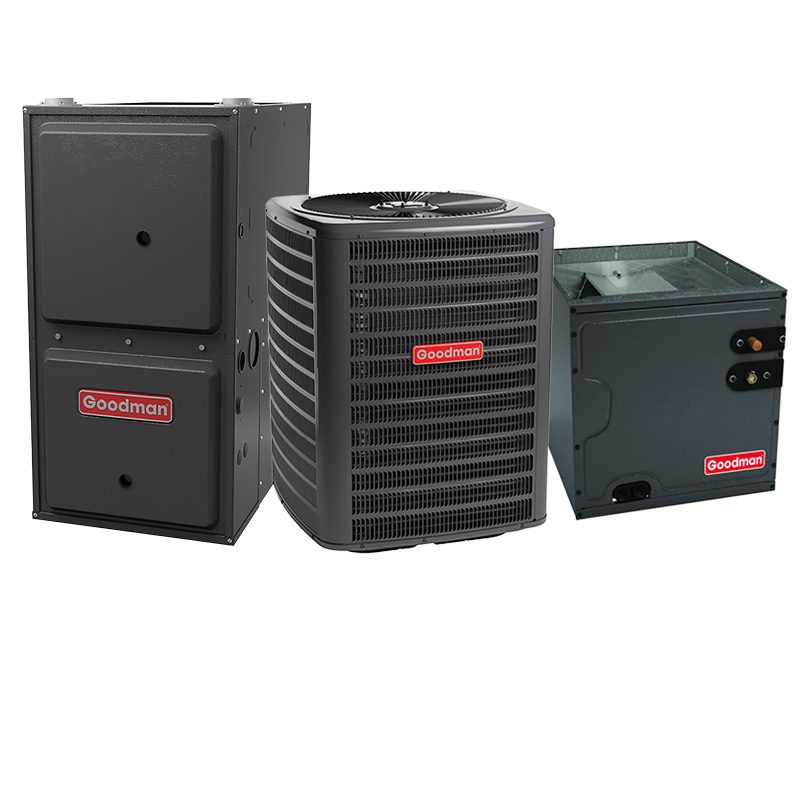
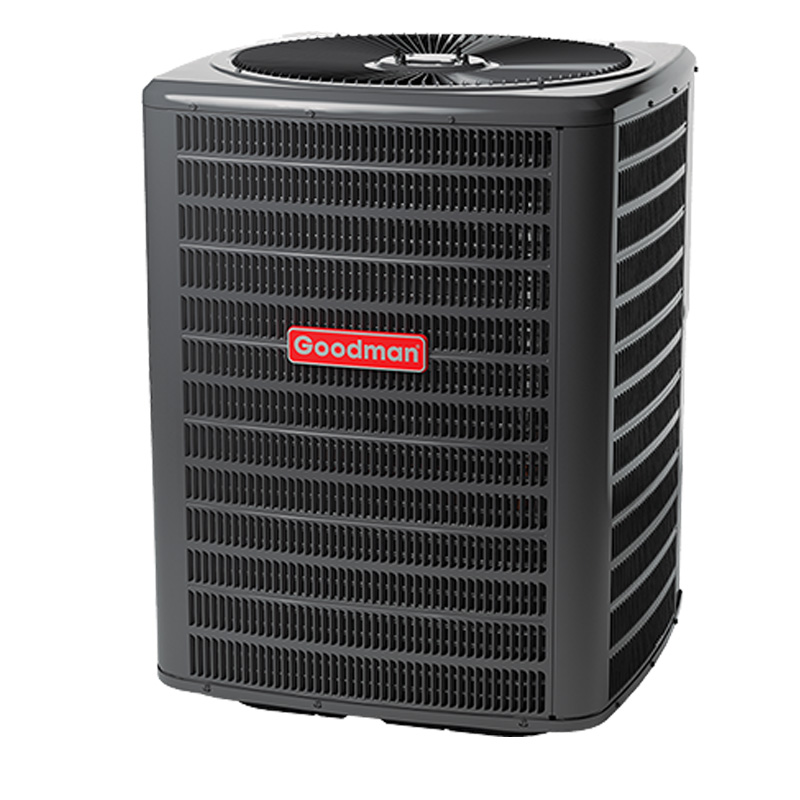
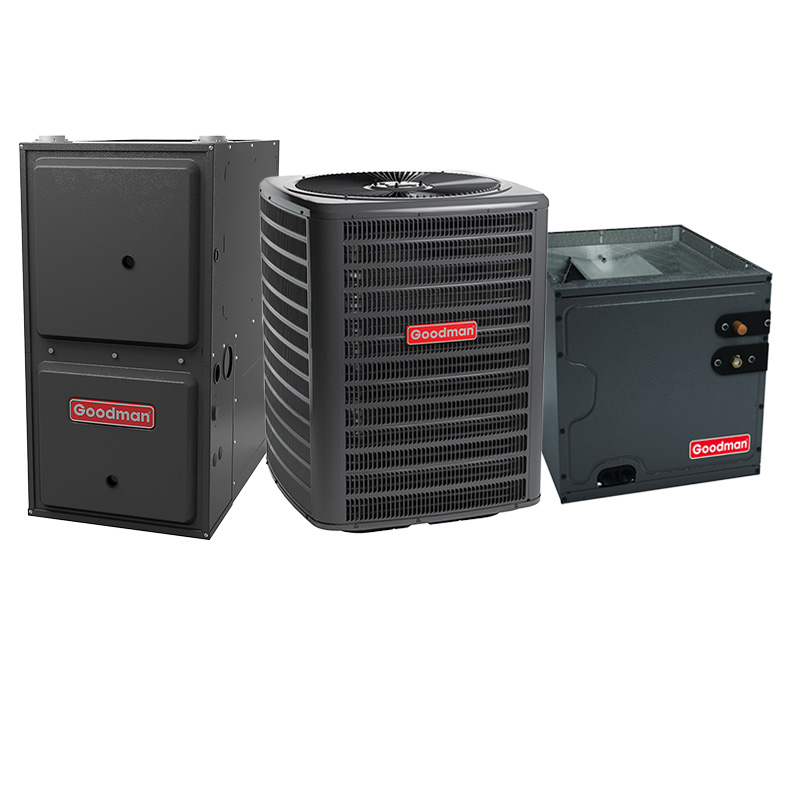
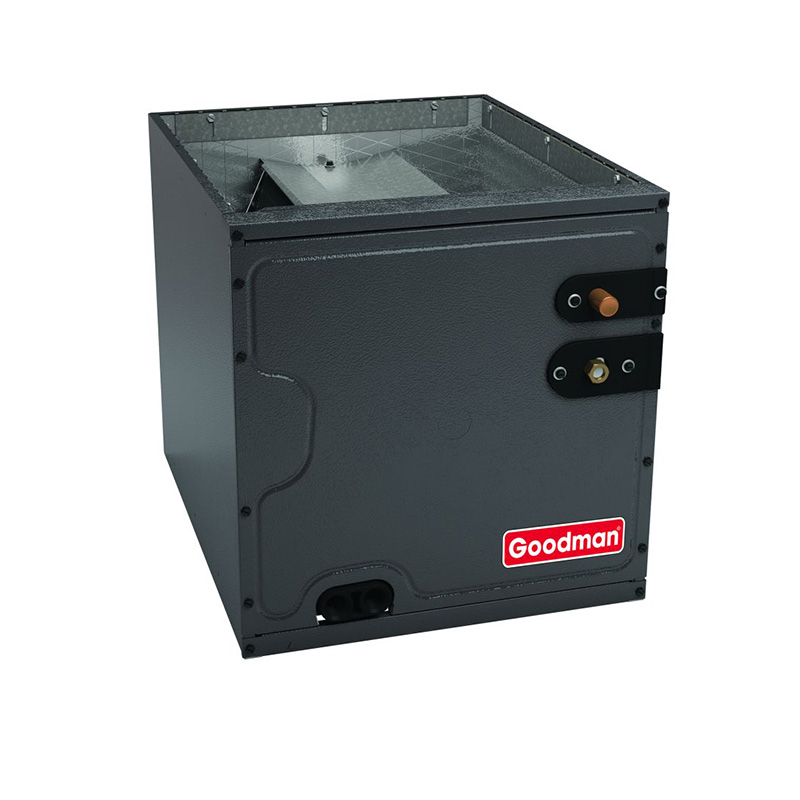
Goodman Furnace And Air Conditioner 2.5 Ton 14.5 SEER2 AC With 80000 BTU 96% AFUE Multi-Speed ECM Gas Furnace System – Downflow | R32
View on AC Direct see your lowest price →Check current price on AC Direct →
Key features
- 14.5 SEER2 air conditioner rated for 2.5 tons of cooling capacity
- 96% AFUE gas furnace with 80,000 BTU output in downflow configuration
- Multi-speed ECM blower motor for reduced electricity use and steadier airflow
- R-32 refrigerant with lower global-warming potential than R-410A
- Downflow airflow orientation suits slab homes and floor-duct systems
- Priced roughly 15 to 25 percent below comparable Carrier, Trane, and Lennox systems
About this system
This Goodman bundle pairs a 2.5-ton, 14.5 SEER2 central air conditioner with an 80,000 BTU, 96% AFUE multi-speed ECM gas furnace in a downflow configuration, and it runs on R-32 refrigerant. The package is sized for homes roughly in the 1,200 to 1,800 square foot range, though actual sizing depends on insulation, climate zone, and duct layout. Downflow units discharge conditioned air downward through floor ducts, making them a practical fit for homes built on slabs or with ductwork routed beneath the floor rather than through an attic.
The 96% AFUE rating places the furnace in the high-efficiency tier, meaning nearly all of the gas consumed becomes usable heat. The ECM blower motor adjusts speed in steps rather than running at a single fixed rate, which reduces electricity use during heating and fan-only modes and can improve comfort by maintaining steadier airflow. The 14.5 SEER2 rating on the air conditioner clears the current federal minimum in most U.S. regions, though it sits at the lower end of efficiency rather than the mid or premium tier. R-32 refrigerant carries a lower global-warming potential than the R-410A it is replacing across the industry and is increasingly standard on new residential equipment.
This Goodman system offers a genuine high-efficiency furnace and a code-compliant air conditioner at a price point that is hard to match from premium brands, making it a reasonable choice for budget-conscious buyers who can secure a skilled installer. The long-term ownership picture is more mixed, with documented failure modes around capacitors, evaporator coil leaks, and a compressor lifespan that tends to run shorter than premium-brand equivalents. It is a solid value buy, not a set-it-and-forget-it premium product.
Overall score is the average of the five ratings above.
What we like
- 96% AFUE furnace delivers meaningful gas savings over 80% AFUE equipment
- ECM blower motor lowers electricity consumption compared to single-speed PSC motors
- R-32 refrigerant is the current industry standard and supports future serviceability
- Entry price is substantially lower than Carrier, Trane, or Lennox systems with similar specs
- Downflow configuration is well-suited to slab construction and under-floor duct layouts
Trade-offs
- Dual-run capacitors are the most frequently reported failure point, typically around year 5 to 9
- Evaporator coil leaks appear in a meaningful share of owner reports over the equipment's lifetime
- Compressor lifespan averages 10 to 14 years versus 15 to 20 years commonly seen on premium brands
- 14.5 SEER2 cooling efficiency is entry-level and will not qualify for most federal or utility efficiency incentives
What homeowners and pros say about Goodman
Homeowners discussing this Goodman system on review platforms reflect a split picture that matches the brand’s broader ratings: a Google dealer score of around 3.8 out of 5 where affordability is the most common reason buyers are satisfied, and a ConsumerAffairs rating of roughly 2.5 out of 5 driven largely by owners who encountered repair costs after the first seven or so years. The recurring early complaints involve refrigerant leaks shortly after installation, which technicians generally attribute to charge issues or connection quality rather than the equipment itself. After that break-in period, dual-run capacitor failures and evaporator coil leaks are the specific failure modes that show up most in owner accounts, and compressor longevity in the 10 to 14 year range is consistently shorter than what buyers report from premium-brand equipment.
HVAC professionals who work on Goodman equipment regularly tend to have a more nuanced view. Many note that the furnace side of a bundle like this, particularly a 96% AFUE unit with an ECM motor, performs competitively against higher-priced alternatives when it is installed correctly and maintained. The consistent professional critique is that Goodman’s tolerances are tighter to the minimum acceptable standard, so a careless refrigerant charge or an unbalanced duct system shows up as a problem faster than it might on a Trane or Carrier unit. The consensus among both owners and technicians is that this system rewards buyers who invest in a skilled installer and budget for routine maintenance, and it underperforms for those who treat an HVAC purchase as entirely hands-off after the first day of operation.
Sources: ConsumerAffairs Goodman owner reviews, AHRI Directory of Certified Product Performance, U.S. DOE appliance and equipment efficiency standards, Goodman product specification sheets.
What it costs to run
At 14.5 SEER2, cooling this 2.5-ton system for a typical 1200-hour cooling season at the U.S. average electricity rate of $0.17/kWh works out to roughly $422 per year in cooling, about $35 less per year than a minimum-efficiency 13.4 SEER2 unit of the same size. Your real cost depends on your climate and local rate.
Method: (30,000 BTU/hr ÷ 14.5 SEER2) × 1200 hours ÷ 1000 × $0.17/kWh. Rate source: U.S. EIA average; cooling hours: moderate-climate estimate.
How it compares
| Brand | Comparable model | SEER2 | Stage | Price position |
|---|---|---|---|---|
| Goodman | This system (2.5 Ton 14.5 SEER2 AC / 96% AFUE ECM Furnace, Downflow, R-32) | 14.5 | Single-stage | Value pick |
| Carrier | Comfort Series (24ACC6 condenser / 58SB0 furnace bundle) | 14.3 to 15.2 | Single-stage | Typically 15 to 25 percent more than Goodman |
| Trane | XR Series (XR14c condenser / S9X1 furnace bundle) | 14.3 to 15.0 | Single-stage | Typically 15 to 25 percent more than Goodman |
| Lennox | Merit Series (ML14XC1 condenser / ML196E furnace bundle) | 14.3 to 15.0 | Single-stage | Typically 15 to 25 percent more than Goodman |
Competitor rows are comparable single-stage units at similar efficiency; price is relative position, not a quote.
Questions about this system
Is a downflow furnace the right configuration for my home?
Downflow furnaces push heated and cooled air downward, so they work best when your supply ducts run under the floor or in a crawlspace rather than through an attic. If your ducts are overhead, you need an upflow or horizontal unit instead. Confirm your duct layout with your installer before ordering.
Does this system qualify for the federal energy efficiency tax credit?
As of current IRS guidance, the 25C tax credit for central air conditioners requires a minimum of 16 SEER2 in most regions, so the 14.5 SEER2 condenser in this bundle does not qualify on the cooling side. The 96% AFUE furnace does meet the heating efficiency threshold for the credit, so check with your tax advisor about claiming the furnace portion separately.
What should I expect if a technician says R-32 is hard to source locally?
R-32 is increasingly common and stocked by most regional HVAC distributors as manufacturers shift away from R-410A, but availability can still vary in rural areas. Ask your installer to confirm local R-32 access before installation, since a refrigerant charge issue after startup is one of the documented early failure modes with this brand.
How serious is the capacitor failure issue, and what does it cost to fix?
Dual-run capacitor failure is the most commonly reported repair on Goodman equipment and is well-documented in owner feedback. The part itself is inexpensive and the repair typically runs in the $300 to $600 range including a service call, so it is not a catastrophic failure. Keeping a basic service contract in place after the warranty period can make this kind of repair feel less disruptive.
How important is installer quality for a Goodman system specifically?
HVAC technicians consistently cite installation quality as the single largest factor in how long Goodman equipment lasts, more so than with premium brands that have tighter factory tolerances. Proper refrigerant charge, correct airflow calibration, and tight duct connections are all critical. Spending more on a licensed, experienced installer is one of the highest-return decisions you can make with this product.
Specifications
| Cooling capacity | 2.5 Ton |
| Efficiency | 14.5 SEER2 |
| Furnace output | 80000 BTU |
| Furnace efficiency | 96% AFUE |
| Configuration | Downflow |
| Refrigerant | R-32 |