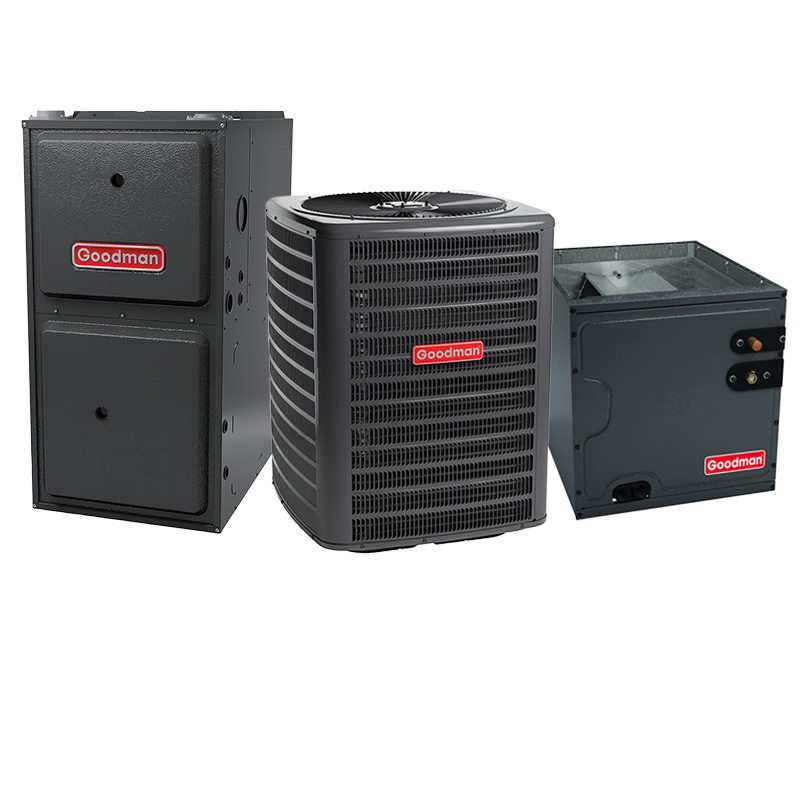
Goodman Furnace And Air Conditioner 2.5 Ton 16 SEER2 AC With 80000 BTU 80% AFUE Two Stage Multi-Speed ECM Gas Furnace System – Upflow | R32
View on AC Direct see your lowest price →Check current price on AC Direct →
Key features
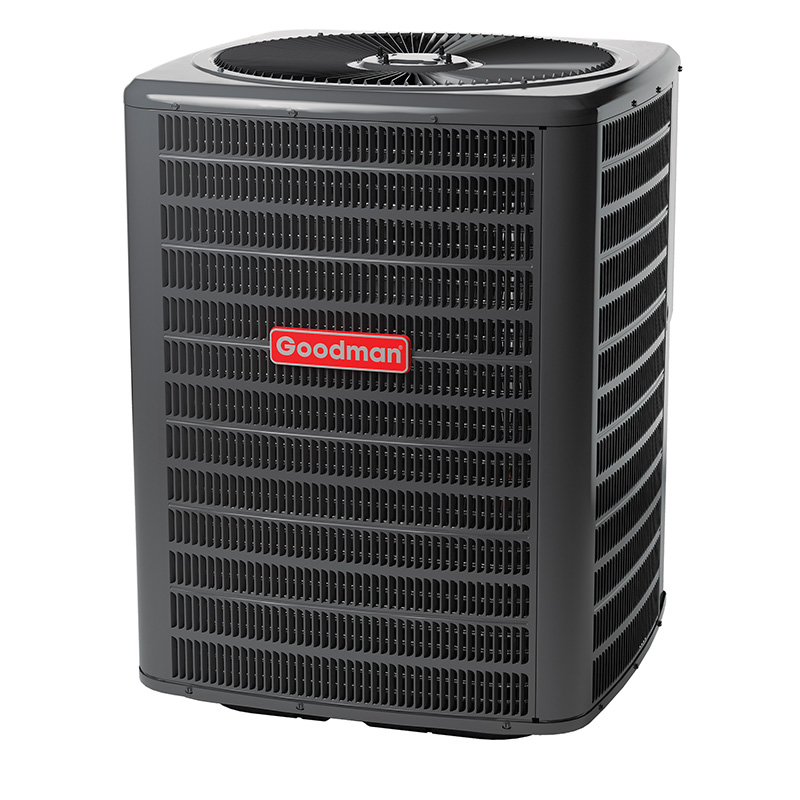
- 2.5-ton, 16 SEER2 central air conditioner charged with lower-GWP R-32 refrigerant
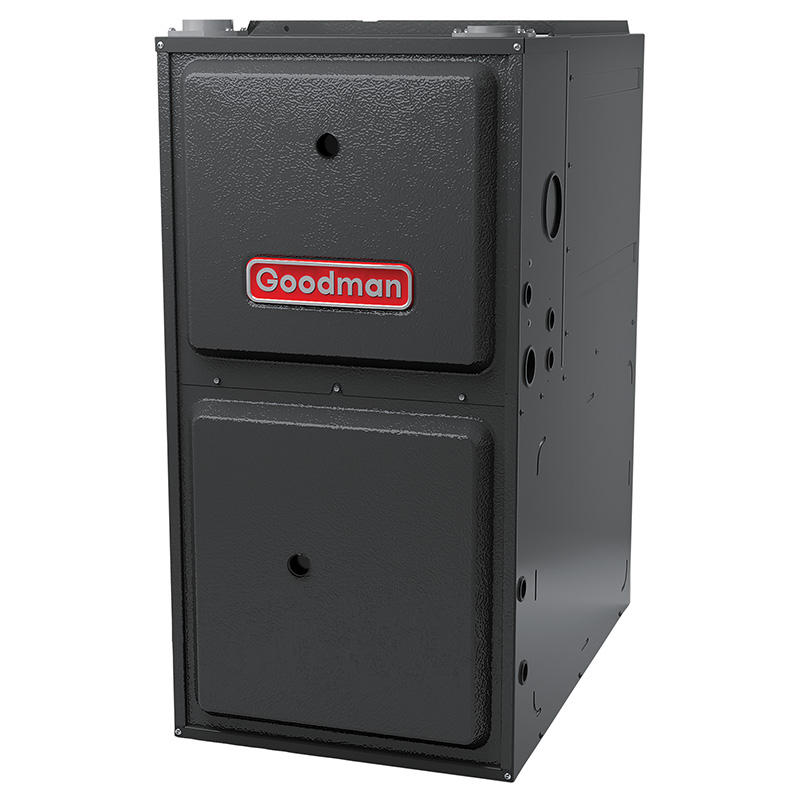
- 80,000 BTU two-stage gas furnace runs at low fire most of the time for steadier temperatures
- Multi-speed ECM blower motor reduces electricity draw compared to standard PSC motors
- 80% AFUE combustion efficiency meets federal minimums; suitable for moderate heating climates
- Upflow configuration designed for basement or crawlspace installs with overhead duct runs
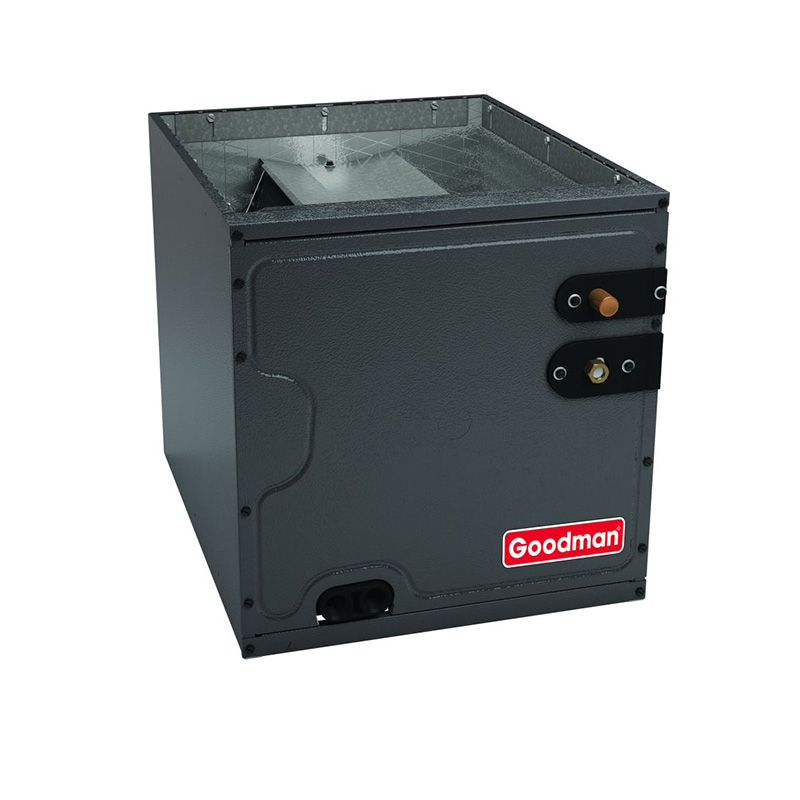
- Factory-matched coil and condensing unit sold as a system, simplifying equipment selection
About this system
This Goodman bundle pairs a 2.5-ton, 16 SEER2 air conditioner with an 80,000 BTU, 80% AFUE two-stage gas furnace in an upflow configuration, making it a practical match for homes roughly 1,200 to 1,800 square feet depending on climate and insulation. The R-32 refrigerant charge is a forward-looking choice: R-32 has a lower global-warming potential than the R-410A it replaces, and it is the direction the industry is heading, so future service technicians will be well-equipped to handle it. At 16 SEER2, this system clears the federal minimum for most regions with a modest efficiency buffer, though it stops well short of the premium 18-plus SEER2 tier.
The two-stage furnace is the standout spec in this bundle. Running at low fire the majority of the time, it cycles less aggressively than a single-stage unit, which improves humidity control, reduces temperature swings, and keeps the multi-speed ECM blower motor running at quieter, lower speeds most of the day. That ECM motor also draws meaningfully less electricity than a standard PSC blower, trimming operating costs over time. The 80% AFUE rating means one fifth of combustion energy exits through the flue; homeowners in cold climates who log long heating seasons should weigh whether a 96% AFUE two-stage unit would recoup its higher upfront cost through gas savings.
Upflow configuration directs conditioned air upward into supply ducts above the unit, the standard layout for basement and crawlspace installations with overhead duct runs. Buyers should confirm this orientation matches their existing duct system before ordering, since swapping configurations after the fact adds labor cost. As with any Goodman system, the quality of the installing contractor matters enormously: technicians consistently flag install quality as the primary driver of how long and how reliably this equipment performs.
This Goodman bundle delivers a capable two-stage, ECM-equipped system at a price point that undercuts Carrier, Trane, and Lennox by a meaningful margin, making it a reasonable choice for budget-conscious buyers who hire a skilled installer. The 16 SEER2 efficiency and 80% AFUE ratings are functional rather than exceptional, and the brand's documented reliability record means buyers should budget for potential repair costs in years seven and beyond. It earns its place as a value pick, not a premium one.
Overall score is the average of the five ratings above.
What we like
- Two-stage furnace operation improves comfort and humidity control compared to single-stage units
- ECM blower motor lowers ongoing electricity consumption
- R-32 refrigerant is forward-compatible with the industry's regulatory direction
- Factory-matched system reduces compatibility guesswork for installers
- Priced roughly 15 to 25 percent below comparable Carrier, Trane, and Lennox equipment
Trade-offs
- Dual-run capacitors are the most frequently reported failure point and typically require service around or after year five
- Evaporator coil leaks appear in a notable share of owner reviews, which can be a costly repair
- Compressor lifespan averages 10 to 14 years versus 15 to 20 years seen on premium brands
- 80% AFUE leaves money on the table for homeowners in cold climates with long heating seasons
What homeowners and pros say about Goodman
Homeowners who have lived with Goodman equipment share a divided experience that tracks closely with the brand’s documented ratings. On ConsumerAffairs, Goodman scores around 2.5 out of 5, a channel that skews toward frustrated owners rather than satisfied ones, and the recurring theme is repair costs that start climbing after roughly year seven. The specific failure modes that come up most often are not mysteries: dual-run capacitors fail and usually cost between 300 and 600 dollars to address, evaporator coil leaks show up in a meaningful share of reviews and carry steeper repair bills, and a smaller number of first-year owners report refrigerant leaks that almost always trace back to installation or initial charge issues rather than a defect in the equipment itself. Compressor longevity is the longer-term concern, with Goodman units averaging 10 to 14 years compared to the 15 to 20 years commonly reported on Trane, Carrier, and Lennox compressors.
HVAC technicians tend to give Goodman a more measured assessment than frustrated online reviewers do. Google dealer reviews average around 3.8 out of 5 across locations, and affordability is consistently the most cited reason contractors recommend it to price-sensitive customers. Technicians are quick to add, however, that the brand’s performance is heavily installation-dependent: a Goodman put in by a careful, experienced crew often outlasts the statistical average, while one rushed through a poor installation can generate callbacks within months. For this particular bundle, the two-stage furnace and ECM blower earn genuine respect from installers who note those features are less common at this price point. The consensus is that this is a reasonable system for the right buyer at the right price, not a shortcut to the reliability ceiling that premium brands advertise.
Sources: ConsumerAffairs Goodman owner reviews, AHRI Directory of Certified Product Performance, U.S. DOE appliance and equipment efficiency standards, Goodman product specification sheets.
What it costs to run
At 16 SEER2, cooling this 2.5-ton system for a typical 1200-hour cooling season at the U.S. average electricity rate of $0.17/kWh works out to roughly $382 per year in cooling, about $75 less per year than a minimum-efficiency 13.4 SEER2 unit of the same size. Your real cost depends on your climate and local rate.
Method: (30,000 BTU/hr ÷ 16 SEER2) × 1200 hours ÷ 1000 × $0.17/kWh. Rate source: U.S. EIA average; cooling hours: moderate-climate estimate.
How it compares
| Brand | Comparable model | SEER2 | Stage | Price position |
|---|---|---|---|---|
| Goodman | This system (2.5T 16 SEER2 / 80K BTU 80% AFUE Two-Stage ECM) | 16 | Two-stage furnace / standard AC | Value pick |
| Carrier | Performance 16 (24PAC636) with 58TP 80% AFUE furnace | 16 | Two-stage furnace / single-stage AC | Typically 15 to 25 percent more than this Goodman bundle |
| Trane | XR16c with S9X2 80% AFUE two-stage furnace | 16 | Two-stage furnace / single-stage AC | Typically 15 to 25 percent more than this Goodman bundle |
| Lennox | Merit ML16XC1 with ML196E 80% AFUE two-stage furnace | 16 | Two-stage furnace / single-stage AC | Typically 15 to 25 percent more than this Goodman bundle |
Competitor rows are comparable single-stage units at similar efficiency; price is relative position, not a quote.
Questions about this system
Will this system work with my existing R-410A line set?
R-32 requires a clean, dry line set, and many technicians recommend replacing or thoroughly flushing existing R-410A copper lines because residual oil from R-410A systems is not compatible with R-32. Confirm this with your installer before reusing old line sets, as contamination can damage the compressor.
Is 16 SEER2 efficient enough to qualify for federal tax credits?
For split systems, the 25C tax credit requires at least 16 SEER2 combined with a minimum 12 EER2; confirm the specific coil and air handler combination meets both thresholds and check the AHRI certificate for the matched system. Tax credit eligibility rules can change, so verify current IRS guidance or consult your tax professional before purchasing.
What does two-stage actually mean for comfort in my home?
The furnace has two heat outputs: a lower stage used on most calls and a higher stage reserved for the coldest days. Running at low fire most of the time means longer, gentler cycles that distribute heat more evenly and help the ECM blower manage humidity, reducing the hot-and-cold swings common with single-stage units.
How serious are the reported evaporator coil leaks, and what do they cost to fix?
Coil leaks are among the more expensive common repairs, often running into the hundreds to over a thousand dollars depending on labor rates and refrigerant costs, and they can void a warranty if a non-certified technician does the work. They show up in a meaningful share of Goodman owner reviews, so it is worth asking your installer about coil inspection protocols during annual maintenance visits.
Does upflow mean I cannot use this in a garage or utility closet installation?
Upflow means the blower pulls air in from the bottom or sides of the furnace cabinet and discharges it upward into overhead supply ducts, which is the standard layout for basements and some utility rooms with duct runs above. If your duct system draws from above and discharges downward, you would need a downflow unit; confirm your duct configuration before ordering.
Specifications
| Cooling capacity | 2.5 Ton |
| Efficiency | 16 SEER2 |
| Furnace output | 80000 BTU |
| Furnace efficiency | 80% AFUE |
| Configuration | Upflow |
| Refrigerant | R-32 |