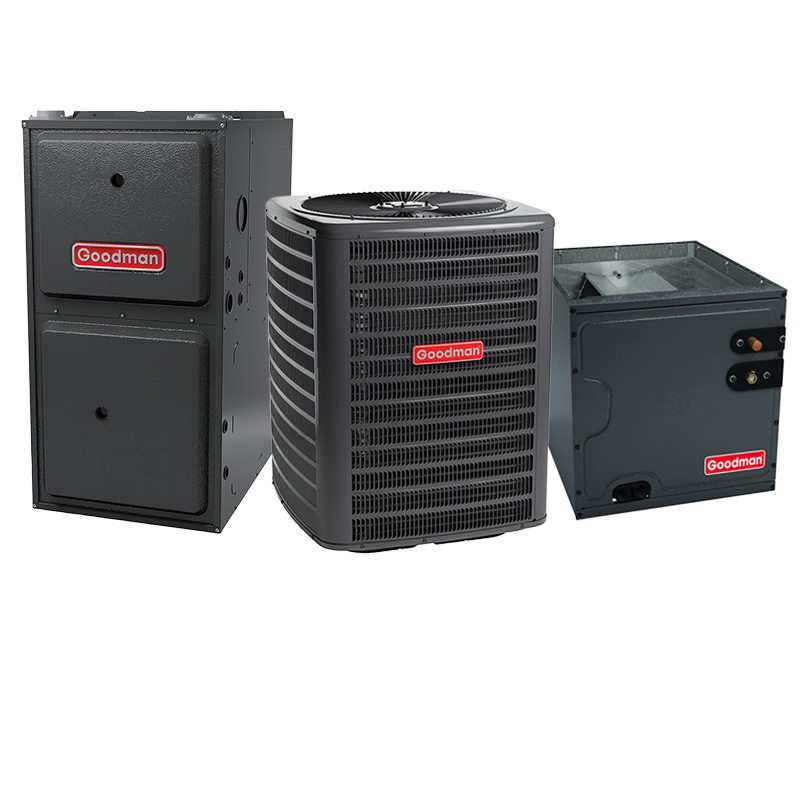
Goodman Furnace And Air Conditioner 2 Ton 16 SEER2 AC With 60000 BTU 80% AFUE Two Stage Multi-Speed ECM Gas Furnace System – Upflow | R32
View on AC Direct see your lowest price →Check current price on AC Direct →
Key features
- 16 SEER2 cooling efficiency, meeting federal minimums for northern U.S. regions
- Two-stage gas furnace operates on low fire for most of the season, reducing temperature swings
- Multi-speed ECM blower motor adjusts airflow gradually for quieter, more even comfort
- R-32 refrigerant with lower global warming potential than legacy R-410A
- 80% AFUE heating efficiency, converting four out of every five BTUs of gas into usable heat
- Upflow configuration designed for basement or utility-closet installs with overhead ductwork
About this system
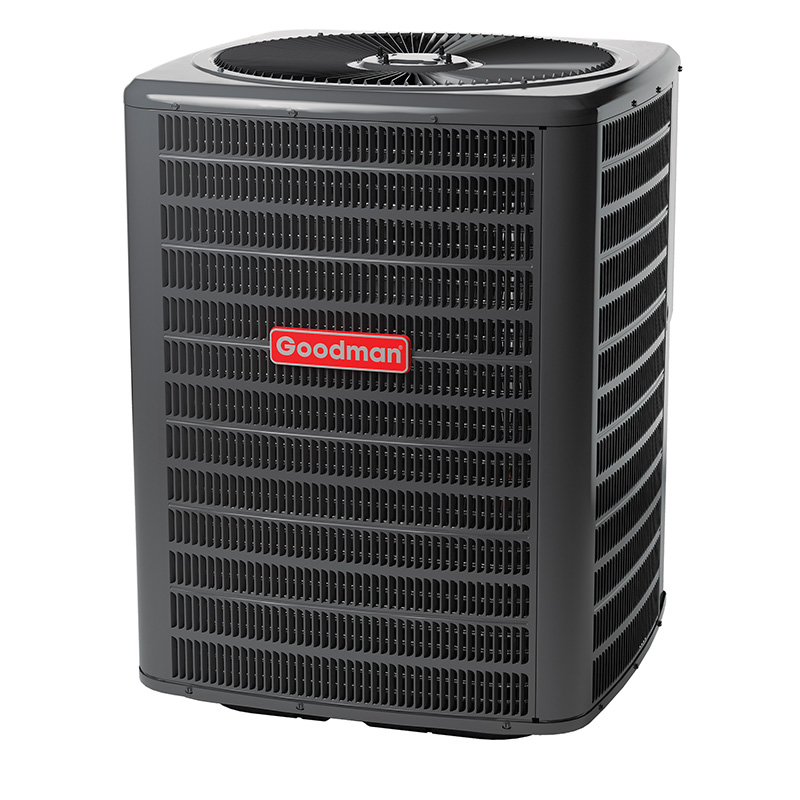
This Goodman bundle pairs a 2-ton, 16 SEER2 air conditioner with a 60,000 BTU, 80% AFUE two-stage gas furnace in an upflow configuration, making it a practical fit for smaller to mid-size homes in the 800 to 1,400 square foot range that have ductwork routed upward from a basement or utility closet. The R-32 refrigerant charge is a forward-looking choice: R-32 carries a lower global warming potential than the R-410A it replaces and is increasingly common in new residential equipment, though it does require technicians to be R-32 certified for future service calls.
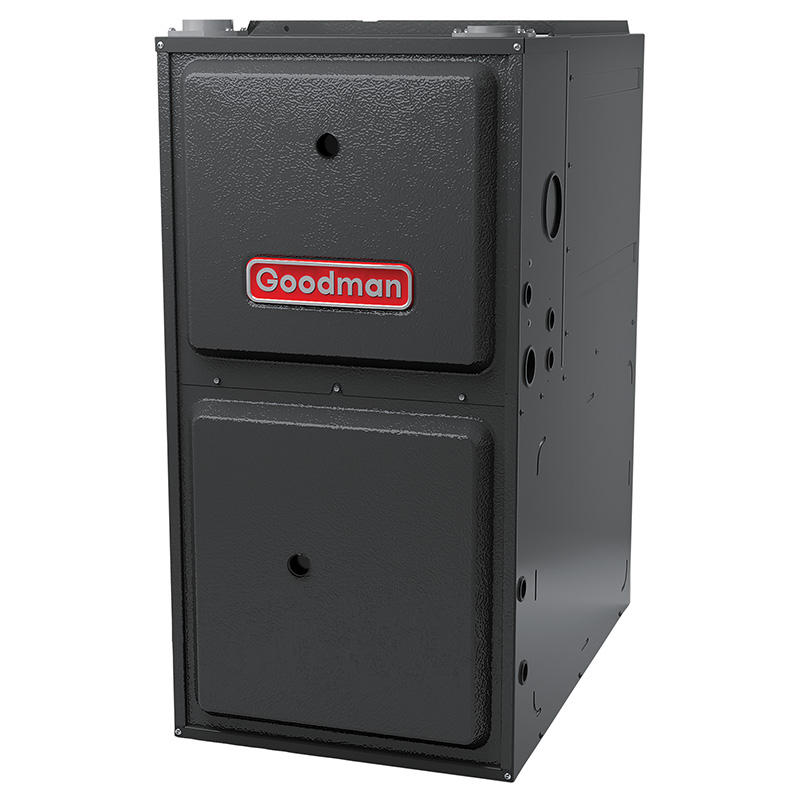
The two-stage furnace is the standout spec here. Running on low fire for most of the heating season, it cycles less abruptly than a single-stage unit, which translates to more even room temperatures and quieter operation. The multi-speed ECM blower motor reinforces that by ramping airflow gradually rather than slamming on at full speed. On the cooling side, 16 SEER2 clears the federal minimum for most northern U.S. climate zones and sits at a solid mid-tier efficiency level, though it will not dramatically cut utility bills compared to a 15 SEER2 unit. The 80% AFUE furnace is the base efficiency tier; homeowners in cold climates should weigh whether stepping up to a 96% or higher unit makes financial sense given local gas rates and heating degree days.
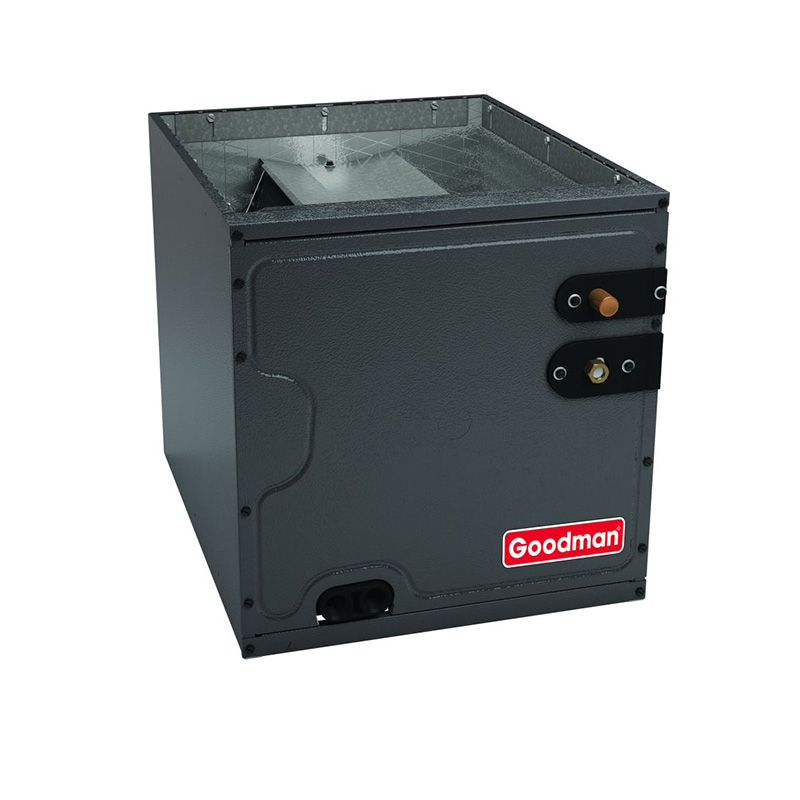
This Goodman bundle delivers a legitimate mid-tier spec sheet at a price point that undercuts Carrier, Trane, and Lennox by a meaningful margin, and the two-stage furnace with ECM motor is a genuine comfort upgrade over single-stage equipment at this price. The honest trade-off is that long-term ownership costs can close the gap with premium brands, particularly if a compressor or evaporator coil needs attention after year seven or eight.
Overall score is the average of the five ratings above.
What we like
- Purchase price is typically 15 to 25 percent below comparable Carrier, Trane, and Lennox systems
- Two-stage furnace and ECM blower provide noticeably smoother heating versus single-stage alternatives at this price tier
- R-32 refrigerant is a future-ready choice with lower environmental impact
- 16 SEER2 meets or exceeds federal minimums across most U.S. climate regions
- Dual-run capacitor failures, the most common documented issue, are a relatively inexpensive repair in the $300 to $600 range
Trade-offs
- Compressor longevity averages 10 to 14 years, shorter than the 15 to 20 years seen more often in premium brands
- Evaporator coil leaks appear in a meaningful share of owner reports, a potential mid-life repair cost
- 80% AFUE is the lowest efficiency tier; homeowners in cold climates may see better long-term economics from a 96%+ furnace
- A minority of owners report refrigerant leaks in the first year, typically traced to install or initial charge quality rather than the equipment itself
What homeowners and pros say about Goodman
Homeowners who share feedback on Goodman equipment tend to split into two camps. Those with straightforward installs and attentive contractors report years of reliable, unspectacular service and consistently praise the lower purchase price. Those who ran into problems often point to repairs that arrived earlier than expected, which is reflected in Goodman’s ConsumerAffairs score of roughly 2.5 out of 5, a channel where dissatisfied owners are overrepresented but where the recurring complaint about rising repair costs after year seven is a real pattern worth taking seriously. Google dealer reviews, which capture a broader cross-section of buyers, land around 3.8 out of 5, and affordability is the praise that shows up most often in that pool.
On the pro side of the industry, experienced HVAC technicians tend to describe Goodman as a competent mid-range brand whose longevity is unusually sensitive to how well the system was set up on day one. The documented failure modes they see most often on Goodman cooling equipment are dual-run capacitor failures, which are common, inexpensive, and not a reason to avoid the brand, and evaporator coil leaks, which are more costly and show up in a meaningful share of long-term owner accounts. Compressor lifespan is the other honest concern: Goodman compressors tend to average 10 to 14 years in real-world use, which is a shorter window than the 15 to 20 years more commonly seen on Trane, Carrier, or Lennox equipment. For this specific two-stage, ECM system, pros note that the more sophisticated furnace staging adds real comfort value at this price point, while reminding buyers that proper R-32 certification and a verified refrigerant charge at startup are non-negotiable steps for getting full life out of the system.
Sources: ConsumerAffairs Goodman owner reviews, AHRI Directory of Certified Product Performance, U.S. DOE appliance and equipment efficiency standards, Goodman product specification sheets.
What it costs to run
At 16 SEER2, cooling this 2-ton system for a typical 1200-hour cooling season at the U.S. average electricity rate of $0.17/kWh works out to roughly $306 per year in cooling, about $59 less per year than a minimum-efficiency 13.4 SEER2 unit of the same size. Your real cost depends on your climate and local rate.
Method: (24,000 BTU/hr ÷ 16 SEER2) × 1200 hours ÷ 1000 × $0.17/kWh. Rate source: U.S. EIA average; cooling hours: moderate-climate estimate.
How it compares
| Brand | Comparable model | SEER2 | Stage | Price position |
|---|---|---|---|---|
| Goodman | GSX2 / GMVC8 Series (this system) | 16 | two-stage | Value pick |
| Carrier | Performance 16 / 58TP Series | 16 | single-stage | Typically 15 to 25 percent more than this Goodman bundle |
| Trane | XR16 / S8X1 Series | 16 | single-stage | Typically 15 to 25 percent more than this Goodman bundle |
| Lennox | Merit ML16XC1 / ML180 Series | 16 | single-stage | Typically 15 to 25 percent more than this Goodman bundle |
Competitor rows are comparable single-stage units at similar efficiency; price is relative position, not a quote.
Questions about this system
Does my HVAC technician need special certification to work with R-32 refrigerant?
Yes. R-32 is an A2L refrigerant, meaning it is mildly flammable and requires technicians to have specific R-32 handling certification and compatible recovery equipment. This is worth confirming with your installer before the job and with any service company you call in the future, as not all shops have updated their tools yet.
Is 80% AFUE worth it, or should I upgrade to a higher-efficiency furnace?
For homeowners in mild to moderate climates with short heating seasons, the payback period on a 96% or 97% AFUE unit can stretch to ten years or more, making 80% a reasonable economic choice. In colder northern states where the furnace runs heavily from October through April, the annual gas savings from a high-efficiency unit often justify the upfront premium within five to eight years.
What is the most common repair issue I should budget for on this system?
Dual-run capacitor failure is the most frequently reported issue on Goodman AC units and is generally a straightforward, low-cost repair in the $300 to $600 range. Evaporator coil leaks and compressor wear are documented concerns after roughly seven or more years of use, and those repairs carry significantly higher costs.
What size home is a 2-ton, 60,000 BTU system appropriate for?
As a rough starting point, a 2-ton unit suits approximately 800 to 1,200 square feet in warmer climates and up to around 1,400 square feet in cooler ones, though ceiling height, insulation quality, window area, and local climate all affect the real number. A Manual J load calculation from your installer is the only reliable way to confirm this system is correctly sized for your home.
How much does installation quality actually matter on a Goodman system?
It matters more than with some premium brands. HVAC technicians consistently point to install quality as the single biggest driver of how long a Goodman system lasts and how efficiently it runs, and the first-year refrigerant leak reports that show up in owner reviews are almost always traced to charging or installation errors rather than defective equipment. Choosing an experienced, licensed installer and having the refrigerant charge verified is not optional on this unit.
Specifications
| Cooling capacity | 2 Ton |
| Efficiency | 16 SEER2 |
| Furnace output | 60000 BTU |
| Furnace efficiency | 80% AFUE |
| Configuration | Upflow |
| Refrigerant | R-32 |