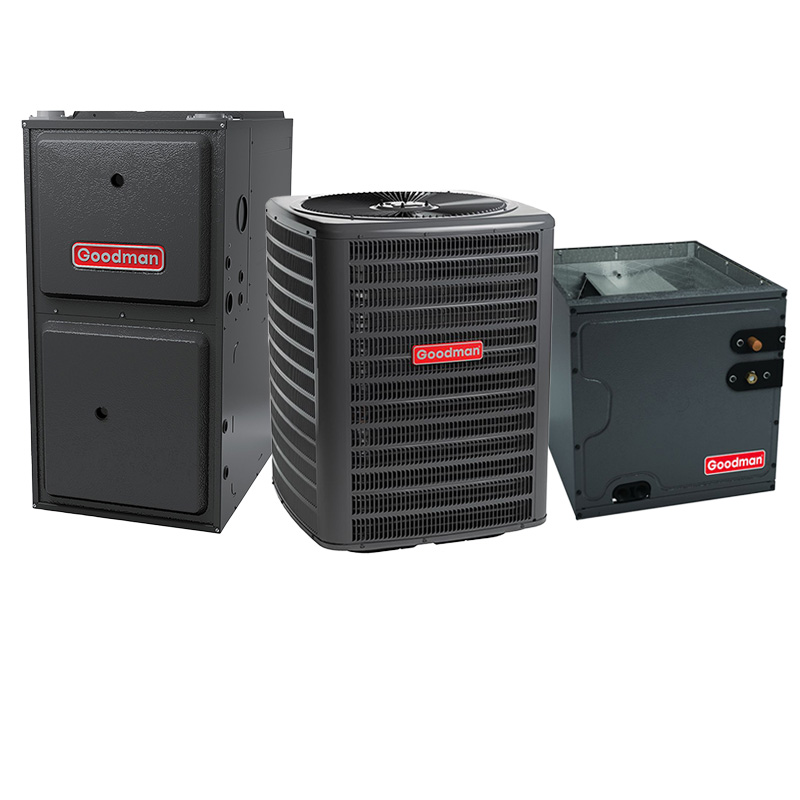
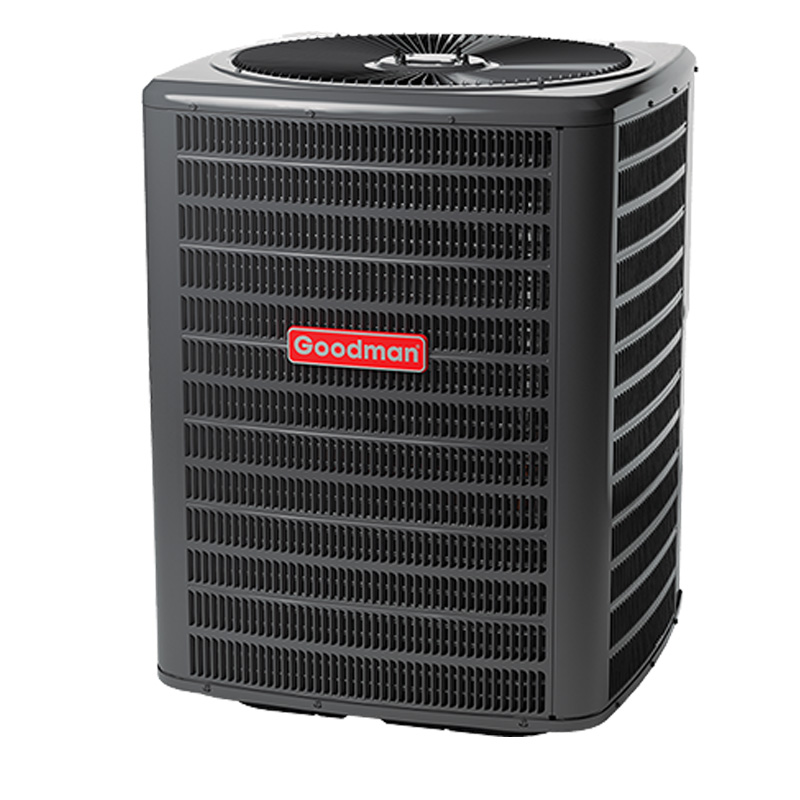
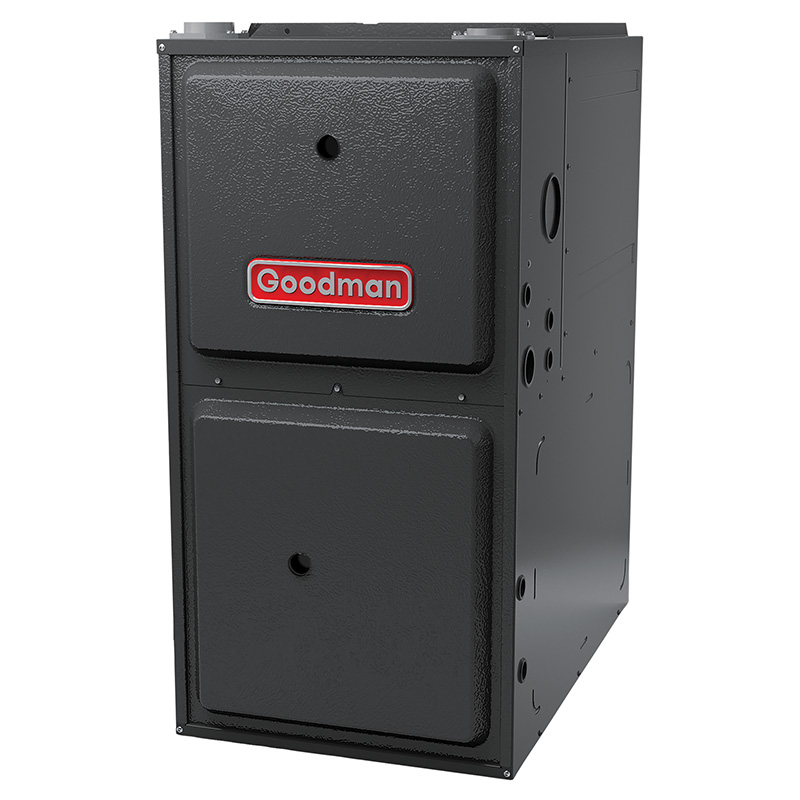
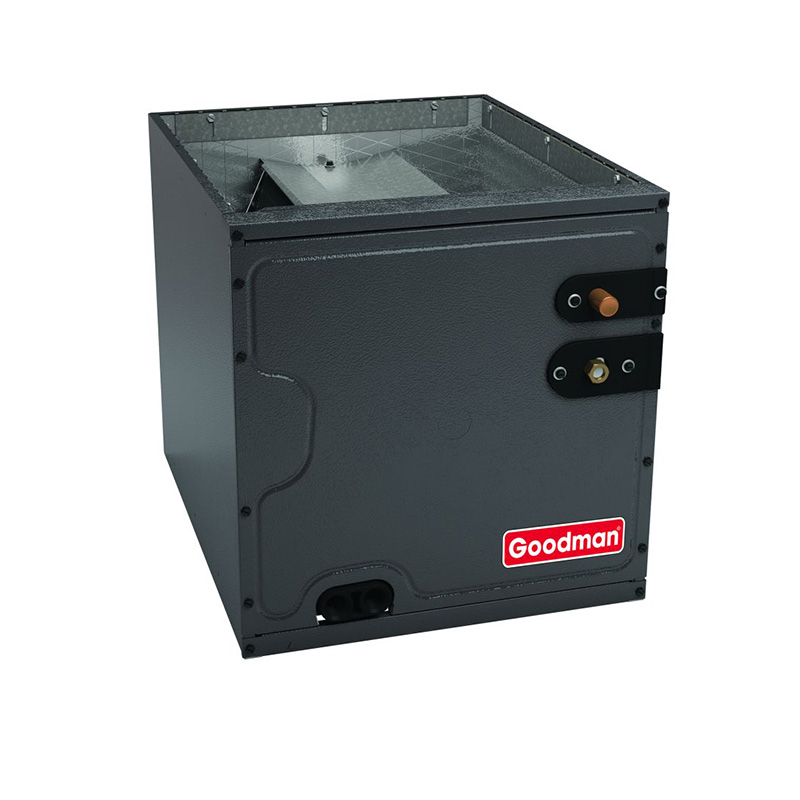
Goodman Furnace And Air Conditioner 5 Ton 14 SEER2 AC With 120000 BTU 96% AFUE Multi-Speed ECM Gas Furnace System – Upflow | R32
View on AC Direct see your lowest price →Check current price on AC Direct →
Key features
- 5-ton single-stage cooling at 14 SEER2, meeting current federal minimum efficiency standards
- 120,000 BTU gas furnace rated at 96% AFUE for high-efficiency heat output
- Multi-speed ECM blower motor for quieter operation and reduced blower electricity use
- Upflow configuration suits basement and ground-level closet installations
- R-32 refrigerant with lower global warming potential than R-410A and lower recharge costs
- Bundled system ensures refrigerant circuit and airflow components are matched from the factory
About this system
This Goodman bundle pairs a 5-ton, 14 SEER2 single-stage air conditioner with a 120,000 BTU, 96% AFUE multi-speed ECM gas furnace in an upflow configuration. The combination is aimed at larger homes, typically in the 2,500 to 3,500 square-foot range depending on climate and insulation, where both serious heating capacity and a full five tons of cooling are genuinely needed. The 96% AFUE rating means the furnace converts 96 cents of every fuel dollar into usable heat, placing it in the high-efficiency tier and making it eligible for federal tax credits under the Inflation Reduction Act’s efficiency thresholds. The multi-speed ECM blower motor adjusts airflow in steps rather than running at full blast constantly, which improves comfort, reduces temperature swings, and lowers blower electricity costs compared with a single-speed PSC motor.
The 14 SEER2 efficiency rating for the cooling side sits at the current federal minimum for most U.S. climate regions, so buyers expecting utility-bill savings over an older 10 or 12 SEER system will see a real improvement, but those upgrading from a 16 SEER unit will notice little difference. R-32 refrigerant is a modern, lower-global-warming-potential alternative to R-410A; it is less expensive to recharge if a leak occurs and is becoming the industry standard, which is a practical long-term advantage. The upflow configuration is the most common furnace orientation and works in basement or ground-level closet installations where supply air exits the top of the unit and travels upward into the duct system. As with all Goodman equipment, installation quality is the dominant variable in how this system performs and how long it lasts.
This Goodman bundle delivers genuine high-efficiency heating and code-compliant cooling at a price point that is difficult to match from premium brands, making it a defensible choice for budget-conscious buyers who can secure a skilled installer. The trade-off is a documented history of mid-cycle repairs, particularly capacitors and evaporator coil issues, and a compressor lifespan that tends to run shorter than what premium competitors deliver. Buyers who plan to stay in the home for 15 or more years should factor likely repair costs into the total ownership calculation before committing.
Overall score is the average of the five ratings above.
What we like
- Price typically 15 to 25 percent below comparable Trane, Carrier, and Lennox systems
- 96% AFUE furnace qualifies for federal tax credits and meaningfully cuts heating costs versus mid-efficiency units
- Multi-speed ECM motor improves comfort and lowers blower operating costs compared with single-speed alternatives
- R-32 refrigerant is more serviceable and environmentally favorable than legacy R-410A
- Matched bundle reduces risk of mismatched components and simplifies warranty coverage
Trade-offs
- Single-stage compressor cycles on at full capacity every time, which can cause humidity and temperature swings in larger homes
- Compressor lifespan averages 10 to 14 years versus 15 to 20 years for premium-brand compressors, according to owner and technician reports
- Dual-run capacitor failures are the most commonly reported repair, typically appearing after year 7 and costing 300 to 600 dollars per occurrence
- Evaporator coil leaks appear in a meaningful share of owner reviews, and a minority of owners report refrigerant leaks within the first year that are usually tied to install or initial charge issues
What homeowners and pros say about Goodman
Homeowners who leave reviews of Goodman equipment on ConsumerAffairs give the brand roughly 2.5 out of 5 stars, a score worth understanding in context: that platform draws a disproportionate share of frustrated owners, and the recurring complaints center on repair costs that climb after year 7 rather than catastrophic early failures. Google dealer reviews tell a somewhat different story, averaging around 3.8 out of 5 across many locations, where the most common praise is straightforward: the system does what it should and the price was right. For a 5-ton, 96% AFUE system, that affordability gap compared with Trane, Carrier, and Lennox is real and can be meaningful to a buyer fitting a large home on a fixed budget.
HVAC technicians tend to have a measured view of Goodman. They consistently point to install quality as the single biggest factor in how any Goodman system ages, more so than with premium brands that have tighter manufacturing tolerances. In the field, the dual-run capacitor is the repair call they associate most often with Goodman equipment, a low-cost fix but one that tends to recur. Evaporator coil leaks show up in a meaningful share of owner accounts, and technicians note that compressors on Goodman systems average roughly 10 to 14 years of service life compared with 15 to 20 years on premium-brand compressors. A minority of owners also report refrigerant issues in the first year, which technicians typically attribute to installation error or an improper initial charge rather than a manufacturing defect. The honest takeaway for this specific system is that the heating side, with its 96% AFUE rating and ECM motor, is genuinely strong for the price; the cooling side performs as specified but carries the reliability caveats that follow Goodman across its product line.
Sources: ConsumerAffairs Goodman owner reviews, AHRI Directory of Certified Product Performance, U.S. DOE appliance and equipment efficiency standards, Goodman product specification sheets.
What it costs to run
At 14 SEER2, cooling this 5-ton system for a typical 1200-hour cooling season at the U.S. average electricity rate of $0.17/kWh works out to roughly $874 per year in cooling, about $39 less per year than a minimum-efficiency 13.4 SEER2 unit of the same size. Your real cost depends on your climate and local rate.
Method: (60,000 BTU/hr ÷ 14 SEER2) × 1200 hours ÷ 1000 × $0.17/kWh. Rate source: U.S. EIA average; cooling hours: moderate-climate estimate.
How it compares
| Brand | Comparable model | SEER2 | Stage | Price position |
|---|---|---|---|---|
| Goodman | 5-Ton 14 SEER2 AC with 120,000 BTU 96% AFUE Multi-Speed ECM Furnace (this system) | 14 | Single-stage | Value pick |
| Carrier | Comfort Series (24ACC6 / 58TP0) | 14-15 | Single-stage | Typically 15 to 25 percent more than this Goodman bundle |
| Trane | XR14c / S9X2 series | 14 | Single-stage | Typically 15 to 25 percent more than this Goodman bundle |
| Lennox | Merit Series (ML14XC1 / ML196E) | 14 | Single-stage | Typically 15 to 25 percent more than this Goodman bundle |
Competitor rows are comparable single-stage units at similar efficiency; price is relative position, not a quote.
Questions about this system
Is 14 SEER2 enough, or should I pay more for a higher-efficiency air conditioner at 5 tons?
14 SEER2 meets the current federal minimum and will reduce cooling costs compared with any system rated below that, but the efficiency gains from stepping up to 16 or 18 SEER2 become harder to recoup at a 5-ton size because the premium on high-SEER large-tonnage equipment is substantial. If your cooling season is long and electricity rates are high, a higher SEER2 unit earns back the cost difference faster; in shorter cooling seasons, 14 SEER2 is often the more practical choice.
What does single-stage cooling mean for a home this size, and is it a problem?
Single-stage means the compressor operates at one fixed capacity, full output, whenever it runs. In a 5-ton application, that can cause the unit to cool the space quickly and shut off before fully wringing humidity out of the air, which can feel clammy in hot, humid climates. Homeowners in drier regions or those with well-zoned duct systems typically notice this less, but buyers in the Southeast or Gulf Coast often find that two-stage or variable-capacity equipment handles comfort better at this size.
How likely is a capacitor failure, and what does it cost to fix?
Dual-run capacitor failure is the most commonly reported repair issue across Goodman equipment, and it tends to surface after roughly year 7 of operation. The good news is that it is one of the least expensive HVAC repairs, typically ranging from 300 to 600 dollars including labor, and most technicians can complete it in under an hour. Keeping a service agreement that includes annual inspections can catch a weakening capacitor before it causes a full system shutdown.
What does the R-32 refrigerant mean for me as an owner, compared with R-410A?
R-32 has a lower global warming potential than R-410A and is typically less expensive to purchase, which translates to lower recharge costs if you ever need a refrigerant top-off after a leak. It does require technicians to have specific R-32 certification and compatible tools, so confirm that your service provider is equipped to handle it before signing a maintenance contract. Availability is growing rapidly as the industry transitions away from R-410A.
Does installing this as a bundle actually affect the warranty, or is it just a marketing angle?
Installing matched Goodman components as a complete system does matter for warranty purposes. Goodman's registered warranty on matched systems typically covers the compressor and heat exchanger for longer periods than a standalone component would receive, and it simplifies any future warranty claim by removing questions about whether a mismatched coil or air handler contributed to a failure. Registration with Goodman within the required window after installation is required to activate the full warranty terms, so confirm your installer handles that step.
Specifications
| Cooling capacity | 5 Ton |
| Efficiency | 14 SEER2 |
| Furnace output | 120000 BTU |
| Furnace efficiency | 96% AFUE |
| Configuration | Upflow |
| Refrigerant | R-32 |