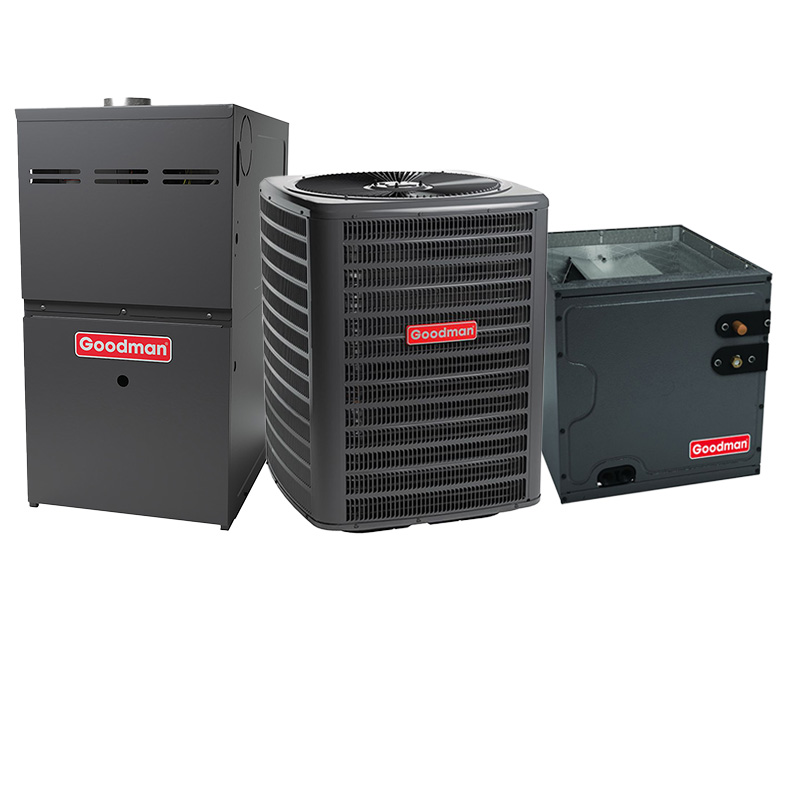
Goodman Furnace And Air Conditioner 5 Ton 16 SEER2 AC With 80000 BTU 80% AFUE Multi-Speed ECM Gas Furnace System – Upflow | R32
View on AC Direct see your lowest price →Check current price on AC Direct →
Key features
- 5-ton / 16 SEER2 central air conditioner using R-32 refrigerant
- 80,000 BTU gas furnace rated at 80% AFUE for code-minimum heating efficiency
- Multi-speed ECM blower motor for staged airflow and improved humidity control
- Upflow cabinet configuration for basement or ground-level air handler installations
- Matched system design allows for efficiency rating verification and single-source warranty
- R-32 refrigerant with lower global warming potential than legacy R-410A systems
About this system
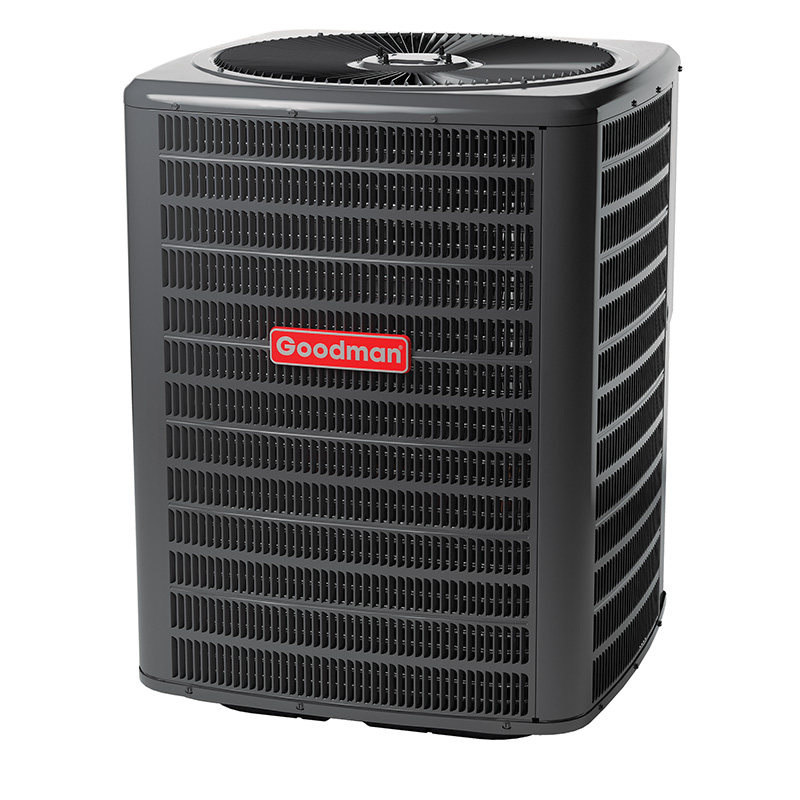
This Goodman bundle pairs a 5-ton, 16 SEER2 central air conditioner with an 80,000 BTU, 80% AFUE multi-speed ECM gas furnace in an upflow configuration. The combination is sized for larger homes, typically in the 2,200 to 2,800 square foot range depending on climate zone, insulation quality, and ceiling height. The 16 SEER2 rating clears the federal minimum for most U.S. regions and lands in the entry-to-mid efficiency tier, meaning operating costs will be lower than older or minimum-efficiency equipment but will not match a 18+ SEER2 two-stage or variable system. R-32 refrigerant is a newer, lower-global-warming-potential alternative to the R-410A it replaces, and it is now the standard across most new residential equipment.
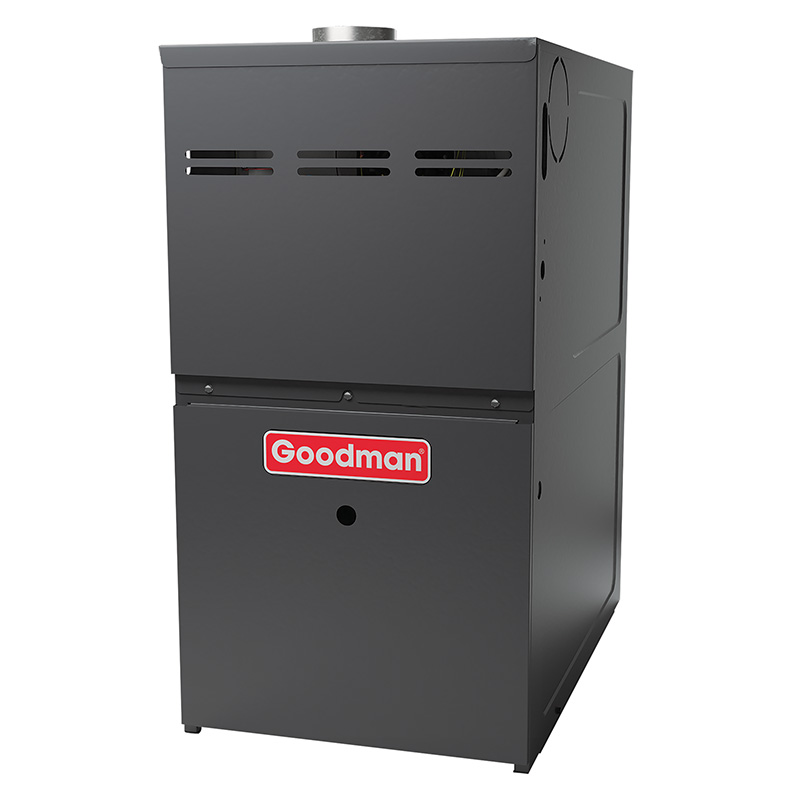
The multi-speed ECM blower motor is a genuine practical advantage over a basic single-speed motor. It ramps airflow up or down in stages, which improves humidity control, reduces temperature swings, and is quieter during low-demand operation compared with a motor that simply runs at full blast or not at all. The 80% AFUE rating means 80 cents of every dollar of gas burned becomes usable heat, which is the code-minimum tier in most climates. Homeowners in cold northern states should weigh whether a 96% AFUE furnace would recover the cost difference through fuel savings. This system suits budget-conscious buyers in moderate climates who want a code-compliant, functional system without the premium cost of a top-tier brand.
This Goodman bundle delivers code-compliant cooling and heating at a price point that typically runs 15 to 25 percent below comparable Carrier, Trane, or Lennox equipment, making it a credible choice for budget-focused buyers who understand the trade-offs. The ECM motor and R-32 refrigerant are genuinely modern features, but the 80% AFUE furnace and documented brand reliability concerns mean buyers should factor in the long-term picture before assuming upfront savings translate to lowest total cost of ownership.
Overall score is the average of the five ratings above.
What we like
- Purchase price typically 15 to 25 percent below equivalent equipment from premium brands
- Multi-speed ECM motor improves comfort and humidity management versus single-speed alternatives
- R-32 refrigerant is current-generation and widely serviceable by certified technicians
- Matched system bundle simplifies permitting, commissioning, and warranty documentation
- Widely available replacement parts through Goodman's broad U.S. dealer and distributor network
Trade-offs
- 80% AFUE is the code-minimum heating efficiency tier and will cost more to operate than a 96% AFUE alternative, particularly in cold climates
- Compressor lifespan averages 10 to 14 years per documented owner experience, shorter than the 15 to 20 years more common in premium brands
- Dual-run capacitors are the most frequently reported failure point, and evaporator coil leaks appear in a meaningful share of owner reviews
- Long-term performance is heavily dependent on installation quality, so a cut-rate install can quickly erode the savings from the lower purchase price
What homeowners and pros say about Goodman
Homeowners who share their experiences with Goodman equipment online tend to sort into two camps. Those who had a skilled installer and used the system within its design limits often report years of trouble-free operation and consistently point to the lower purchase price as the reason they chose the brand. Goodman earns around 3.8 out of 5 stars across Google dealer reviews, where affordability is the most frequently cited reason for satisfaction. The picture on ConsumerAffairs is rougher, with Goodman sitting at roughly 2.5 out of 5, a score shaped in part by the fact that complaint-driven review channels over-represent owners who have had problems. The recurring theme on that platform is repair costs climbing noticeably after year seven, which lines up with the documented compressor lifespan of 10 to 14 years versus the 15 to 20 years more typical of premium brands.
HVAC technicians who service Goodman equipment regularly flag a few specific patterns worth knowing before you buy this system. Dual-run capacitors are the most commonly cited failure point, and the good news is that a capacitor swap is usually a straightforward, relatively low-cost repair in the 300 to 600 dollar range. Evaporator coil leaks appear in a notable share of owner reports and are a more involved fix. A smaller share of owners have reported refrigerant leaks within the first year, which technicians typically attribute to installation or initial charge issues rather than a manufacturing defect, reinforcing the consistent professional advice that Goodman’s long-term performance is strongly tied to the quality of the original install. Choosing an experienced, licensed contractor matters with any brand, but it matters more here than it would with equipment that carries a stronger built-in reliability buffer.
Sources: ConsumerAffairs Goodman owner reviews, AHRI Directory of Certified Product Performance, U.S. DOE appliance and equipment efficiency standards, Goodman product specification sheets.
What it costs to run
At 16 SEER2, cooling this 5-ton system for a typical 1200-hour cooling season at the U.S. average electricity rate of $0.17/kWh works out to roughly $765 per year in cooling, about $148 less per year than a minimum-efficiency 13.4 SEER2 unit of the same size. Your real cost depends on your climate and local rate.
Method: (60,000 BTU/hr ÷ 16 SEER2) × 1200 hours ÷ 1000 × $0.17/kWh. Rate source: U.S. EIA average; cooling hours: moderate-climate estimate.
How it compares
| Brand | Comparable model | SEER2 | Stage | Price position |
|---|---|---|---|---|
| Goodman | GSX16 / GMVC8 Series Bundle | 16 | Single-stage AC / Multi-speed furnace | Value pick |
| Carrier | Comfort 16 (24ACC6) Series | 16 | Single-stage | Typically 15 to 25 percent more than this Goodman bundle |
| Trane | XR16 Series | 16 | Single-stage | Typically 15 to 25 percent more than this Goodman bundle |
| Lennox | Merit 16ACX Series | 16 | Single-stage | Typically 15 to 25 percent more than this Goodman bundle |
Competitor rows are comparable single-stage units at similar efficiency; price is relative position, not a quote.
Questions about this system
Is 16 SEER2 enough, or should I spend more to get a higher-efficiency air conditioner?
16 SEER2 meets or exceeds the federal minimum for most U.S. regions and will deliver a real efficiency gain over equipment from 10 or more years ago. Unless you are in an extremely hot climate with very long cooling seasons, the payback period on a significantly higher SEER2 unit often stretches to eight or more years, so 16 SEER2 is a reasonable stopping point for moderate climates. In the Sun Belt, running the numbers on an 18 or 19 SEER2 option is worth the time.
Will my technician be able to service R-32 refrigerant, or is it hard to find?
R-32 requires a Section 608 EPA certification, which any licensed HVAC technician should already hold. The refrigerant itself is increasingly stocked by major distributors, so availability is generally not a problem in urban and suburban markets. In very rural areas, confirm your service provider is already set up for R-32 before purchasing.
The 80% AFUE furnace is cheaper, but how much more will I spend on gas compared to a 96% AFUE unit?
The gap depends on your local gas rates and how many heating degree days your climate sees. As a rough benchmark, a household spending 1,200 dollars per year on gas heat at 80% AFUE would spend roughly 200 to 250 dollars less per year at 96% AFUE. In mild climates with short heating seasons, payback on the price premium for a higher-AFUE furnace can take a decade or longer. In cold northern climates with heavy heating loads, the upgrade often pays back in five to seven years.
What is the most common repair I should budget for on a Goodman system?
Dual-run capacitors are the most frequently documented failure point across Goodman owner reviews, and a capacitor replacement typically costs 300 to 600 dollars including labor. Evaporator coil leaks show up in a meaningful share of reviews as well, which is a more expensive repair. Having a service agreement in place after year five is a reasonable precaution given these documented patterns.
Does the upflow configuration work with a side-discharge or horizontal install, or is it strictly vertical?
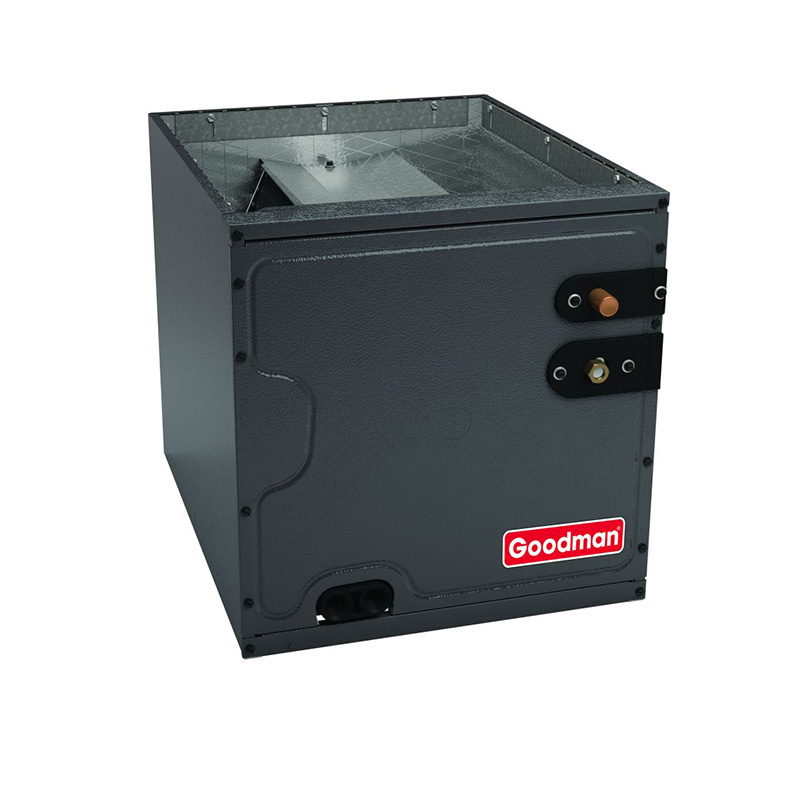
Upflow means the blower draws air in from the bottom and discharges conditioned air upward through the supply plenum, which is the standard orientation for basement and ground-level closet installations. This cabinet is not configured for horizontal or counterflow use. If your ductwork enters from above the air handler or you need a horizontal attic installation, you would need a different cabinet orientation.
Specifications
| Cooling capacity | 5 Ton |
| Efficiency | 16 SEER2 |
| Furnace output | 80000 BTU |
| Furnace efficiency | 80% AFUE |
| Configuration | Upflow |
| Refrigerant | R-32 |