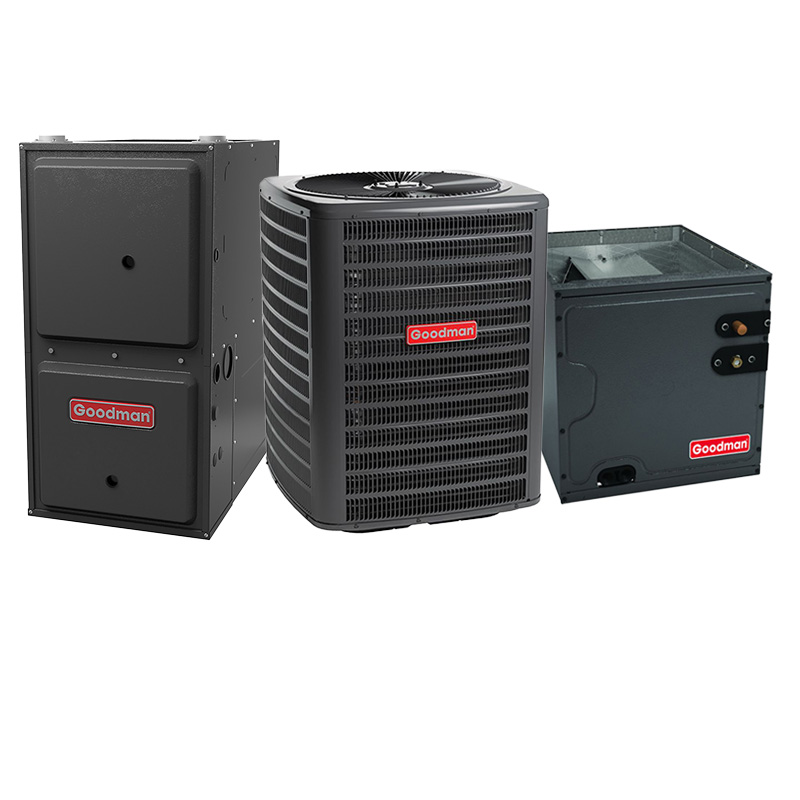
Goodman 3.5 Ton 13.4 SEER2 80000 BTU 96% AFUE Multi-Speed ECM Gas Furnace System – Downflow | R32
View on AC Direct see your lowest price →Check current price on AC Direct →
Key features
- 3.5-ton cooling capacity with 13.4 SEER2 efficiency rating
- 80,000 BTU, 96% AFUE two-stage gas furnace for high-efficiency heating
- Downflow configuration for homes with floor-level duct systems
- Multi-speed ECM blower motor for quieter, more efficient airflow
- R-32 refrigerant charge with lower global-warming potential than R-410A
- Goodman 10-year parts warranty when registered within 60 days of install
About this system
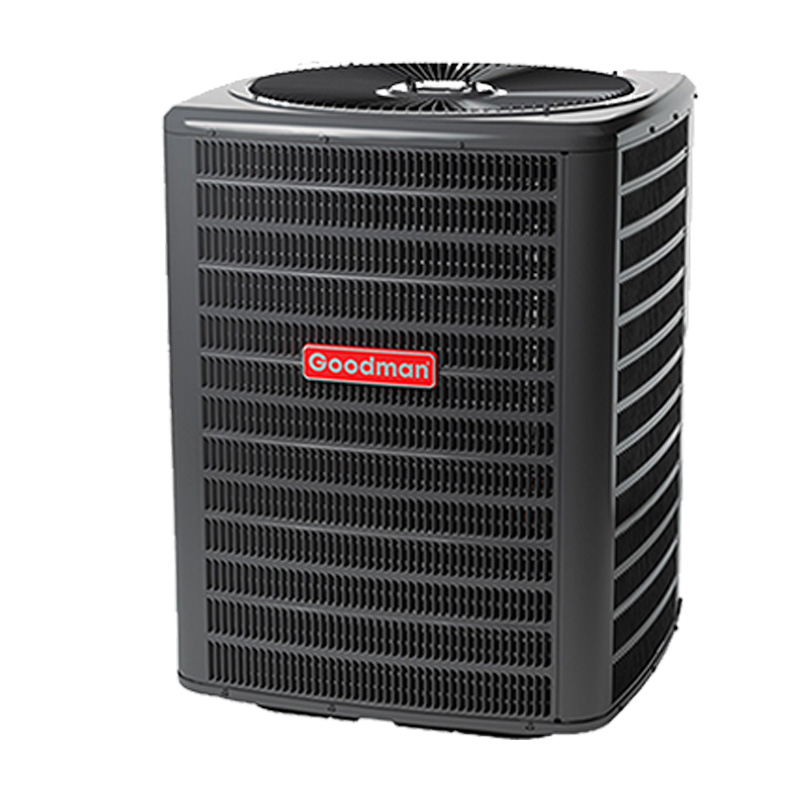
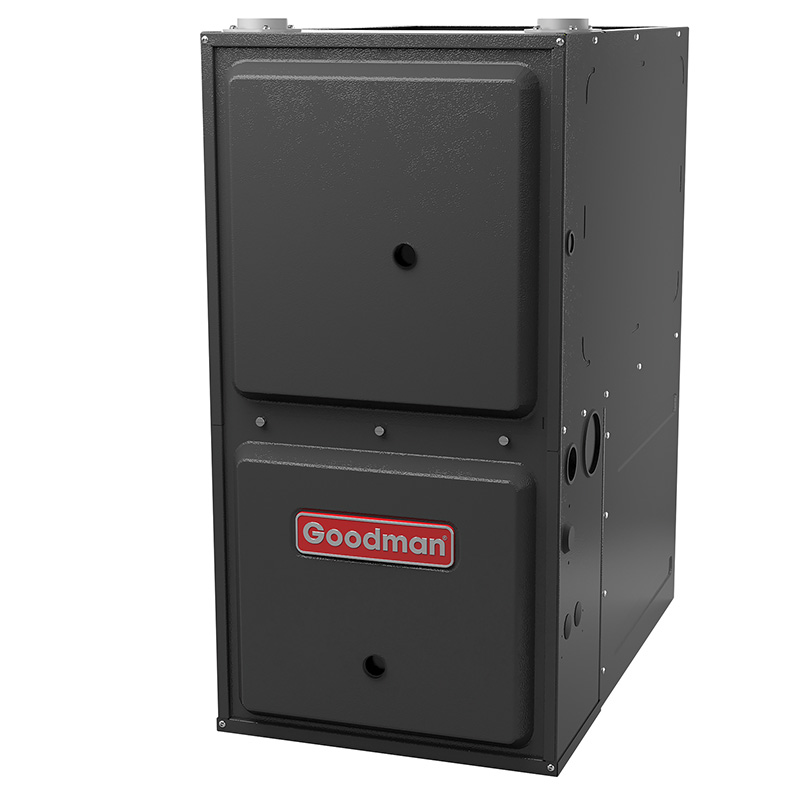
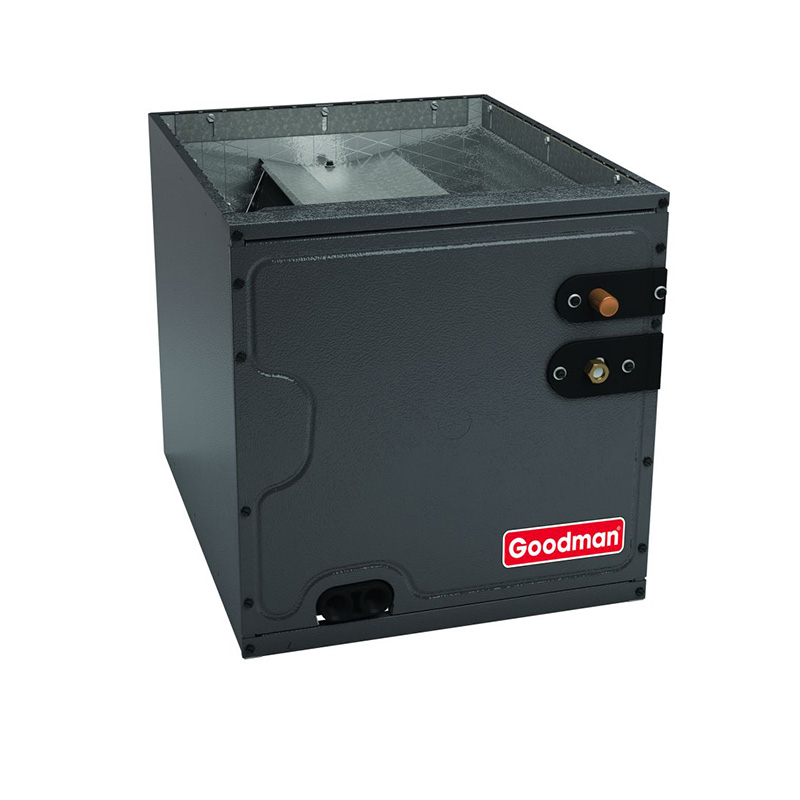
This Goodman bundle pairs a 3.5-ton, 13.4 SEER2 central air conditioner with an 80,000 BTU, 96% AFUE gas furnace in a downflow configuration, meaning the furnace discharges conditioned air downward through floor-level ductwork. That layout suits homes where the air handler sits in an upper-floor closet, garage, or utility space above a crawlspace duct system. The R-32 refrigerant charge is a forward-looking choice: R-32 has a lower global-warming potential than the R-410A it replaces, and it is now the direction the industry is heading, so future service should not be complicated by refrigerant availability. The multi-speed ECM blower motor modulates airflow more precisely than a single-speed PSC motor, which translates to quieter operation, better humidity control at part-load, and lower electricity draw from the air handler itself.
On paper the efficiency numbers are solid without being exceptional. A 13.4 SEER2 rating meets the 2023 federal minimum for most of the country and sits just above baseline, so operating costs will be reasonable but buyers in hot Southern climates who run the AC for eight or nine months a year may find a 15 or 16 SEER2 system pays back the price difference over time. The 96% AFUE furnace, however, is a genuinely high-efficiency unit: it recovers 96 cents of every dollar of gas burned, which meaningfully reduces heating bills compared with an 80% furnace over a cold-climate winter. Together the system targets homeowners who want a functional, budget-conscious upgrade from an aging R-22 or early R-410A system without paying a premium-brand price.
This system delivers genuine high-efficiency heating and adequate cooling at a price point 15 to 25 percent below Trane, Carrier, and Lennox equivalents, making it a reasonable choice for budget-focused buyers who prioritize upfront cost. The 96% AFUE furnace is a real strength, but the 13.4 SEER2 cooling side is entry-level, and Goodman's documented reliability record means the total cost of ownership depends heavily on install quality and whether you factor in a likely capacitor or coil repair somewhere in years 7 to 12.
Overall score is the average of the five ratings above.
What we like
- 96% AFUE furnace is a high-efficiency rating that measurably cuts heating bills versus 80% AFUE units
- Multi-speed ECM blower improves humidity control and runs quieter than single-speed alternatives
- R-32 refrigerant is a future-ready choice that avoids the phase-out pressure on older refrigerants
- Priced 15 to 25 percent below comparable Trane, Lennox, and Carrier systems
- Downflow design is purpose-built for the specific homes that need it, reducing adapter complexity
Trade-offs
- 13.4 SEER2 is just above the federal minimum and will not deliver the operating-cost savings of 15-plus SEER2 competitors
- Dual-run capacitor failures are the most commonly reported repair on Goodman equipment, typically showing up after year 7
- Compressor lifespan averages 10 to 14 years versus 15 to 20 years for premium-brand compressors
- A minority of owners report refrigerant leaks in the first year, usually tied to install or factory charge issues
What homeowners and pros say about Goodman
Homeowners who share feedback on Goodman systems tend to split along a clear fault line. Those who had a skilled, thorough installation often report years of uneventful service and point to the upfront price as the reason they chose Goodman over a premium brand. That tracks with the roughly 3.8 out of 5 score Goodman earns across Google dealer reviews, where affordability is the most repeated praise. The other group, overrepresented in channels like ConsumerAffairs where Goodman scores around 2.5 out of 5, describes repair bills that start to accumulate somewhere after year 7 and a sense that the savings on the front end eroded by year 10. That ConsumerAffairs score reflects a complaint-prone audience, but the pattern of mid-life repairs is consistent enough that it should be weighed honestly.
HVAC technicians tend to frame Goodman similarly: a workable, serviceable product whose longevity is more sensitive to install quality than most premium brands. The documented failure points that come up most often in professional circles are dual-run capacitors, which are a low-cost fix but a near-certainty at some point after year 7; evaporator coil leaks, which are more disruptive and expensive to address; and compressor lifespan that averages 10 to 14 years rather than the 15 to 20 years technicians associate with Trane or Carrier compressors. For this specific system, a small minority of owners also report refrigerant leaks in the first year, which technicians attribute to install or factory charge issues rather than a fundamental product defect. The R-32 refrigerant and 96% AFUE furnace are genuinely current-generation specs, and with a careful installer and realistic service expectations, this bundle represents a defensible choice for a budget-conscious replacement project.
Sources: ConsumerAffairs Goodman owner reviews, AHRI Directory of Certified Product Performance, U.S. DOE appliance and equipment efficiency standards, Goodman product specification sheets.
What it costs to run
At 13.4 SEER2, cooling this 3.5-ton system for a typical 1200-hour cooling season at the U.S. average electricity rate of $0.17/kWh works out to roughly $639 per year in cooling, about $0 less per year than a minimum-efficiency 13.4 SEER2 unit of the same size. Your real cost depends on your climate and local rate.
Method: (42,000 BTU/hr ÷ 13.4 SEER2) × 1200 hours ÷ 1000 × $0.17/kWh. Rate source: U.S. EIA average; cooling hours: moderate-climate estimate.
How it compares
| Brand | Comparable model | SEER2 | Stage | Price position |
|---|---|---|---|---|
| Goodman | 3.5 Ton 13.4 SEER2 / 96% AFUE Multi-Speed Downflow R-32 Bundle | 13.4 | Multi-speed | Value pick |
| Carrier | Performance Series 24ACC636 / 58MVC | 15 | Two-stage | Approximately 20 to 25 percent more than this Goodman bundle |
| Trane | XR15 / S9X2 96% AFUE | 15 | Single-stage | Approximately 20 to 30 percent more than this Goodman bundle |
| Lennox | Merit ML14XC1 / SLP98V | 14.3 | Single-stage / Variable | Approximately 25 to 35 percent more than this Goodman bundle |
Competitor rows are comparable single-stage units at similar efficiency; price is relative position, not a quote.
Questions about this system
Why does this system use a downflow furnace instead of a standard upflow model, and how do I know if my home needs it?
A downflow furnace discharges heated or cooled air out the bottom rather than the top, so it is designed for installations where the unit sits above the duct system, such as a main-floor closet over a crawlspace or a garage utility space with floor registers below. If your existing furnace is already a downflow model, this is a straightforward like-for-like swap. If you are not sure, your installer can confirm by looking at how your current plenum and ductwork are connected.
What is the real-world difference between a 13.4 SEER2 and a 15 or 16 SEER2 unit in annual operating cost?
The gap depends on your climate, local electricity rates, and how many cooling hours you log per year. In a moderate climate with average electricity costs, the difference between 13.4 and 16 SEER2 on a 3.5-ton system is roughly in the range of 50 to 120 dollars per cooling season, so a higher-efficiency unit can take several years to recover the price premium. In a hot Southern climate running the AC eight or more months a year, that math shifts meaningfully in favor of the higher-efficiency unit.
Is R-32 refrigerant harder or more expensive to service than R-410A?
R-32 is becoming the industry standard replacement for R-410A, so availability is growing and most HVAC technicians are or soon will be trained to handle it. It does require EPA 608 certification and slightly different handling precautions because it is mildly flammable, but for a typical homeowner the service experience should be comparable to an R-410A system in a few years. The bigger practical benefit is that R-32 is not being phased out the way R-22 was, so you will not face refrigerant scarcity issues down the road.
The 10-year parts warranty sounds strong, but what is actually covered and what does it require?
Goodman's 10-year parts warranty covers registered units and includes the compressor, coil, and most internal components, but it covers parts only, not labor. That means a compressor replacement in year 9, for example, could still cost you 800 to 1,500 dollars or more in labor and service fees even with the part covered. Registration must happen within 60 days of installation, and the warranty is void if the system is not installed by a licensed contractor, so keeping your installation paperwork is important.
How often do Goodman dual-run capacitors fail, and is it a serious repair?
Capacitor failure is the single most commonly reported repair on Goodman equipment and typically shows up after year 7, though it can happen earlier. The good news is that it is one of the least expensive HVAC repairs, generally running 300 to 600 dollars including labor, and most technicians can complete it in under an hour. It is not a sign of a failing system, but it is worth budgeting for at least one capacitor replacement over the life of the equipment.
Specifications
| Cooling capacity | 3.5 Ton |
| Efficiency | 13.4 SEER2 |
| Furnace output | 80000 BTU |
| Furnace efficiency | 96% AFUE |
| Configuration | Downflow |
| Refrigerant | R-32 |