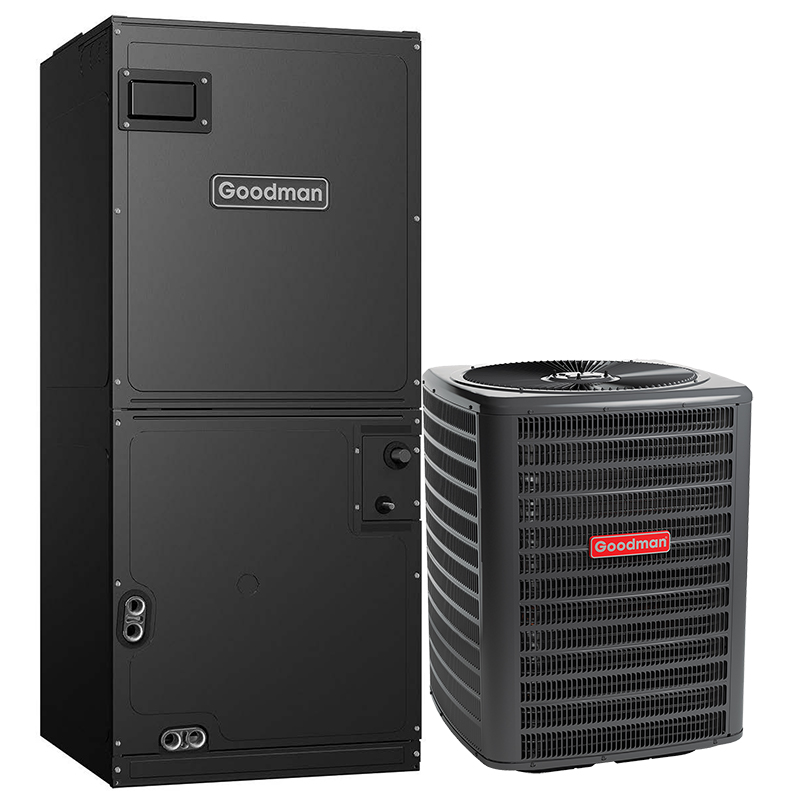
Goodman 2.5 Ton 15.2 SEER2 Split System Cooling Only w/2.5 Ton A/H
View on AC Direct see your lowest price →Check current price on AC Direct →
Key features
- 2.5-ton cooling capacity, suited to roughly 1,200 to 1,600 sq ft depending on local conditions
- 15.2 SEER2 efficiency rating meets 2023 federal minimum efficiency standards
- Single-stage operation with full-capacity compressor cycling
- Cooling-only configuration requires a separate heating source such as a gas furnace or heat strips
- Matched 2.5-ton air handler included for factory-tested system compatibility
- Goodman's value pricing typically runs 15 to 25 percent below comparable premium-brand equipment
About this system
The Goodman GSXH503010 pairs a 2.5-ton condensing unit with a matched 2.5-ton air handler to form a complete split-system cooling solution well suited to homes in the 1,200 to 1,600 square foot range, depending on climate, insulation, and ceiling height. At 15.2 SEER2, it meets the federal minimum efficiency threshold that took effect in 2023 for most U.S. regions, meaning it will keep you compliant without paying a premium for efficiency tiers you may not recoup in energy savings during the equipment’s service life.
This is a single-stage, cooling-only system, so it runs at full capacity whenever the thermostat calls for cooling. It does not modulate output to match mild days, which means it cycles on and off more frequently than two-stage or variable-speed equipment and may leave humidity slightly higher during long, humid stretches. For homeowners who prioritize upfront cost over fine-grained comfort control, or who live in drier climates where dehumidification is less critical, the trade-off is reasonable. Goodman’s value positioning, typically 15 to 25 percent below Trane, Lennox, and Carrier at comparable efficiency, makes this system one of the more accessible paths to a modern, code-compliant cooling system.
The Goodman GSXH503010 is a straightforward, budget-friendly cooling system that delivers baseline efficiency at a price point most premium brands cannot match. It suits homeowners who want a code-compliant, professionally installed system without the upfront cost of Carrier or Trane, provided they go in with realistic expectations about long-term reliability and single-stage comfort limits. It is not the best choice for buyers prioritizing humidity control, longevity beyond 10 to 12 years, or minimal repair exposure.
Overall score is the average of the five ratings above.
What we like
- Upfront cost is typically 15 to 25 percent lower than Trane, Lennox, or Carrier at similar efficiency
- 15.2 SEER2 meets current federal standards and delivers meaningful savings over older, lower-efficiency systems
- Matched air handler simplifies system compatibility and warranty compliance
- Widespread dealer and parts network makes service access easier than less common brands
- Capacitor replacements, the most common failure, are generally low-cost repairs in the $300 to $600 range
Trade-offs
- Single-stage operation means less humidity control and more frequent on/off cycling compared to two-stage or variable-speed systems
- Compressor lifespan averages 10 to 14 years, shorter than the 15 to 20 years often cited for premium brands
- Evaporator coil leaks are a documented recurring issue in owner feedback, and repairs can be costly
- A minority of owners report refrigerant leaks within the first year, typically tied to install quality rather than manufacturing
What homeowners and pros say about Goodman
Homeowners who comment on Goodman equipment online tend to split along a predictable line. On complaint-skewed platforms like ConsumerAffairs, the brand scores around 2.5 out of 5, with the recurring theme being repair costs that start climbing after roughly year seven. Capacitor failures come up often in those accounts, though owners generally acknowledge the fix is not catastrophic in cost. Evaporator coil leaks draw sharper frustration because the repair is more involved and more expensive. On Google dealer reviews, where buyers are rating the full installation experience rather than a problem that brought them online, Goodman averages closer to 3.8 out of 5 across several hundred reviews per location, with affordability cited most consistently as the reason people chose it.
Among HVAC technicians, Goodman has a mixed but not unfamiliar reputation. Pros who work on this equipment regularly point out that install quality is the single largest variable in how any Goodman system performs over time. Sloppy refrigerant charging, improper airflow setup, or undersized ductwork will accelerate the failure modes already documented in owner feedback, including the compressor lifespan concern of 10 to 14 years versus the 15 to 20 years commonly seen with premium brands. For the GSXH503010 specifically, a buyer who hires a careful contractor, sets a maintenance schedule, and keeps realistic expectations about the system’s single-stage limitations is likely to get solid value. A buyer who treats the low purchase price as a reason to skip annual service or cut corners on installation is likely to validate the lower end of the brand’s reliability ratings.
Sources: ConsumerAffairs Goodman owner reviews, AHRI Directory of Certified Product Performance, U.S. DOE appliance and equipment efficiency standards, Goodman product specification sheets.
What it costs to run
At 15.2 SEER2, cooling this 2.5-ton system for a typical 1200-hour cooling season at the U.S. average electricity rate of $0.17/kWh works out to roughly $403 per year in cooling, about $54 less per year than a minimum-efficiency 13.4 SEER2 unit of the same size. Your real cost depends on your climate and local rate.
Method: (30,000 BTU/hr ÷ 15.2 SEER2) × 1200 hours ÷ 1000 × $0.17/kWh. Rate source: U.S. EIA average; cooling hours: moderate-climate estimate.
How it compares
| Brand | Comparable model | SEER2 | Stage | Price position |
|---|---|---|---|---|
| Goodman | GSXH503010 | 15.2 | Single-stage | Value pick |
| Carrier | Comfort 24ACC6 Series | 15.2 | Single-stage | Typically 15 to 25 percent more than the Goodman |
| Trane | XR15 Series | 15.0 to 15.6 | Single-stage | Typically 15 to 25 percent more than the Goodman |
| Lennox | Merit ML14XC1 Series | 15.0 to 15.5 | Single-stage | Typically 15 to 25 percent more than the Goodman |
Competitor rows are comparable single-stage units at similar efficiency; price is relative position, not a quote.
Questions about this system
Does this system include heat, or do I need to add a furnace or heat strips separately?
This is a cooling-only system. You will need a separate heating source, such as a gas furnace, electric furnace, or heat strips in the air handler, to handle winter heating. Make sure your contractor confirms the heating component before installation.
What is the most likely repair I will face with this Goodman system, and how much will it cost?
The dual-run capacitor is the most commonly reported failure point across Goodman systems. It is also one of the least expensive fixes, typically falling in the $300 to $600 range for parts and labor. Evaporator coil leaks and eventual compressor wear are longer-term concerns worth budgeting for.
How long should I expect this system to last before needing replacement?
Goodman compressors tend to average around 10 to 14 years in practice, which is shorter than the 15 to 20 years often associated with premium brands. Proper installation and annual maintenance are the biggest factors in reaching the higher end of that range.
I've seen refrigerant leaks mentioned in Goodman reviews shortly after install. Should I be worried?
A minority of owners do report refrigerant leaks within the first year. Most technicians attribute these to installation or initial charge issues rather than a manufacturing defect, which is why choosing an experienced, licensed installer matters considerably for this brand.
Will 2.5 tons be enough for my home, or should I size up?
A 2.5-ton system typically covers homes in the 1,200 to 1,600 square foot range, but the right size depends heavily on your climate zone, insulation, window area, and ceiling height. Oversizing causes short cycling and poor humidity removal, so insist that your contractor perform a Manual J load calculation before finalizing the equipment size.
Specifications
| Cooling capacity | 2.5 Ton |
| Efficiency | 15.2 SEER2 |
| Model | GSXH503010 |