Goodman R32 100000 BTU 80% Multi-Speed ECM Gas Furnace Upflow / Horizontal (GR9S801005CN)
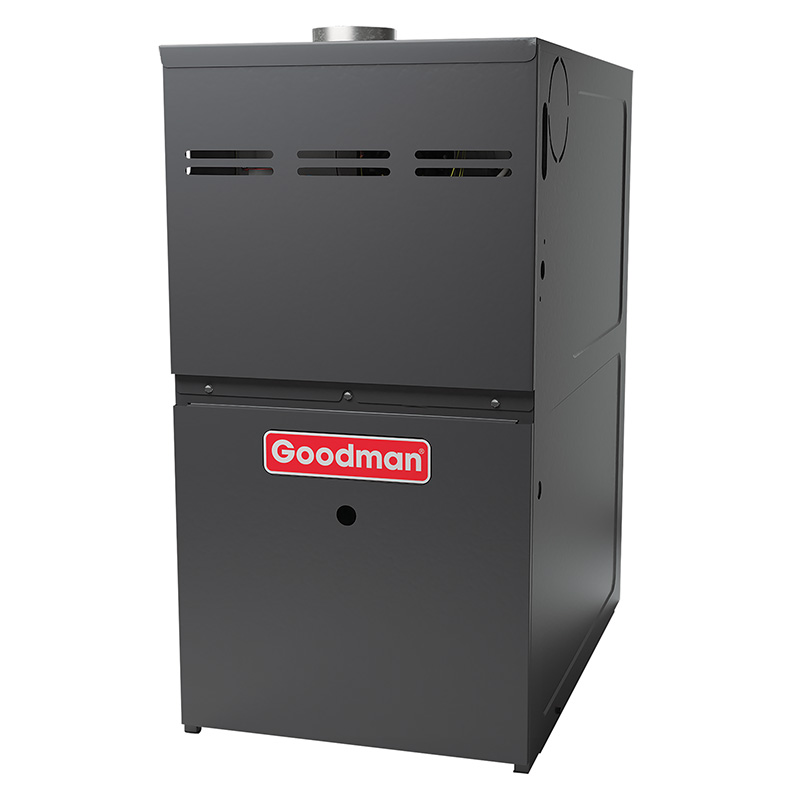
View on AC Direct see your lowest price →Check current price on AC Direct →
Key features
- 100,000 BTU input capacity, suited to larger homes with a properly sized duct system
- 80% AFUE single-stage gas valve with multi-speed ECM blower for quieter, more efficient fan operation
- Upflow/horizontal dual configuration supports basement, closet, attic, and crawl space installs
- ECM motor reduces electrical draw during continuous fan use compared to standard PSC motors
- Compatible with R-32 refrigerant system components for matched split-system pairing
- Stainless steel primary heat exchanger for corrosion resistance in the combustion path
About this system
The Goodman GR9S801005CN is a 100,000 BTU, 80% AFUE upflow/horizontal gas furnace built around an ECM (electronically commutated motor) blower and a multi-speed gas valve. The 80% AFUE rating means 80 cents of every dollar in natural gas becomes usable heat, which meets federal minimum efficiency requirements for most northern U.S. climates but falls short of the 90%+ threshold that qualifies for federal tax credits or most utility rebates. That efficiency tier is a reasonable fit for moderate climates, budget-focused replacements, or homeowners who heat less frequently and want lower upfront costs over long-term fuel savings.
The ECM blower motor is one of the more meaningful spec details here. Compared to a standard PSC motor, an ECM draws significantly less electricity during continuous fan operation, runs quieter, and manages airflow more precisely across the multiple speed stages. The upflow/horizontal cabinet configuration covers the two most common residential installations: upflow suits basement or closet installs where air rises into the duct system above, while horizontal suits attic or crawl space installs where the furnace lies on its side. The R-32 designation in the model name refers to the refrigerant class used in paired cooling equipment, not the furnace itself. A furnace does not use refrigerant, so this label signals compatibility with a matched R-32 air handler or coil rather than any characteristic of the heat exchanger itself.
This unit is sized for larger homes, typically 2,000 to 2,800 square feet depending on insulation, ceiling height, and climate zone, though a proper Manual J load calculation should always determine the right size. Oversizing a furnace shortcycles it, which shortens heat exchanger life and hurts comfort. At 100,000 BTU output this is one of the larger common residential furnace sizes, so confirming actual load before purchase matters more here than it would with a smaller unit.
The GR9S801005CN delivers a capable, ECM-equipped furnace at a price point noticeably below Carrier, Trane, and Lennox equivalents, making it a practical choice for budget-conscious buyers who prioritize upfront cost. The 80% AFUE tier limits fuel savings potential and excludes it from most rebate programs, and Goodman's real-world reliability record shows a meaningful uptick in repair costs after year seven. This is a reasonable furnace for the right buyer, but it rewards careful installation and realistic expectations about long-term ownership costs.
Overall score is the average of the five ratings above.
What we like
- Purchase price typically runs 15 to 25 percent below comparable Carrier, Trane, and Lennox units
- ECM blower motor lowers electricity use during fan-only and heating cycles compared to PSC motors
- Upflow/horizontal flexibility covers the majority of common residential installation scenarios
- Multi-speed operation improves temperature distribution and reduces cold-start blasts of air
- Widely stocked by wholesale distributors, which generally means faster parts availability for repairs
Trade-offs
- 80% AFUE does not qualify for federal efficiency tax credits or most utility rebates available to 96%+ units
- ConsumerAffairs reviews average around 2.5 out of 5, with repair cost complaints clustering after year seven of ownership
- Compressor lifespan on paired Goodman cooling equipment averages 10 to 14 years versus 15 to 20 years for premium brands
- Overall longevity is heavily dependent on installation quality, meaning a low-bid install can erase much of the upfront savings
What homeowners and pros say about Goodman
Homeowners who choose Goodman furnaces most often point to the lower purchase price as the deciding factor, and that pattern holds for units like the GR9S801005CN. Google dealer reviews across Goodman installers average around 3.8 out of 5, where affordability is the most repeated compliment and the complaints tend to focus on either installation problems or parts availability in smaller markets. ConsumerAffairs tells a harder story, with Goodman sitting at roughly 2.5 out of 5 on that platform. That channel skews toward dissatisfied owners, but the consistent theme across those reviews is repair costs that climb after approximately year seven, which is a pattern worth taking seriously when projecting total cost of ownership on a larger unit like this 100,000 BTU model.
HVAC technicians who work on Goodman equipment regularly are generally pragmatic about it. They note that dual-run capacitor failures are the most common service call on Goodman systems and describe it as a quick, low-cost fix in the 300 to 600 dollar range rather than a major reliability problem. More serious documented failure modes include evaporator coil leaks on paired cooling equipment and compressor lifespans that tend to run shorter than premium brands, averaging 10 to 14 years versus the 15 to 20 years seen on Carrier, Trane, and Lennox systems. A minority of owners also report refrigerant-related issues within the first year, which technicians largely attribute to install or initial charge problems rather than manufacturing defects. The consistent professional takeaway is that a Goodman installed carefully by an experienced technician performs meaningfully better than the same unit rushed in by a low-bid crew, making installer selection as important as unit selection for this brand.
Sources: ConsumerAffairs Goodman owner reviews, AHRI Directory of Certified Product Performance, U.S. DOE appliance and equipment efficiency standards, Goodman product specification sheets.
How it compares
| Brand | Comparable model | SEER2 | Stage | Price position |
|---|---|---|---|---|
| Goodman | GR9S801005CN | N/A (furnace only) | Single-stage with multi-speed ECM blower | Value pick |
| Carrier | Performance 80 (58TP/58TN series) | N/A (furnace only) | Single-stage with multi-speed blower | Typically 20 to 30 percent more than this Goodman |
| Trane | S8B1 (80% AFUE single-stage) | N/A (furnace only) | Single-stage with multi-speed blower | Typically 20 to 30 percent more than this Goodman |
| Lennox | Merit ML180 series | N/A (furnace only) | Single-stage with multi-speed blower | Typically 25 to 35 percent more than this Goodman |
Competitor rows are comparable single-stage units at similar efficiency; price is relative position, not a quote.
Questions about this system
Will this furnace qualify for the federal energy efficiency tax credit?
No. The federal Nonbusiness Energy Property Credit (25C) requires a gas furnace to have at least 97% AFUE in most northern climate regions. At 80% AFUE, the GR9S801005CN does not meet that threshold, and most utility rebate programs targeting high-efficiency equipment will also exclude it. If tax credits or rebates are a priority, you would need to look at 96% or higher AFUE units.
What does 'multi-speed ECM' actually mean for day-to-day comfort and my electric bill?
The ECM blower runs at different speeds to match airflow to heating demand rather than always running at full blast. This reduces the noisy, uneven temperature swings common with single-speed PSC motors and draws less electricity during continuous fan or lower-demand operation. The gas valve on this model is single-stage, meaning the burner is either fully on or off, so the ECM motor provides comfort improvement but does not deliver the full modulation of a two-stage or variable-capacity system.
Is this furnace compatible with a smart thermostat like an Ecobee or Nest?
Generally yes. The GR9S801005CN uses standard low-voltage thermostat wiring and communicates over conventional W, Y, G, R terminals. Most current smart thermostats are compatible with this wiring scheme. Confirm the thermostat you choose supports a multi-speed ECM blower if you want full speed control, and check the thermostat's compatibility checker with this specific model number before purchasing.
What are the most common repairs on Goodman furnaces like this one, and what do they typically cost?
On Goodman equipment broadly, dual-run capacitors are the most frequently reported failure, usually showing up after several years of use and typically costing 300 to 600 dollars to diagnose and replace. Ignitor failures and pressure switch issues are also common and generally inexpensive. Repair costs tend to increase after approximately year seven according to owner feedback on ConsumerAffairs, so budgeting for a service contract or a repair fund is worth considering.
Does the upflow/horizontal configuration mean I can install this furnace in an attic or crawl space?
Yes. The horizontal orientation is designed for attic and crawl space installations where the furnace lies on its side and air is drawn in and discharged horizontally. However, horizontal furnace installs require attention to condensate management, vibration isolation, and access for servicing. Attic installs in particular raise safety and liability considerations around gas lines and venting, so this configuration should be handled by a licensed installer familiar with local code requirements.
Specifications
| Furnace output | 100000 BTU |
| Configuration | Upflow |
| Refrigerant | R-32 |
| Model | GR9S801005CN |