Goodman R32 100000 BTU 80% Two Stage 9-Speed ECM Gas Furnace Low Nox Downflow (GD9T801005CX)
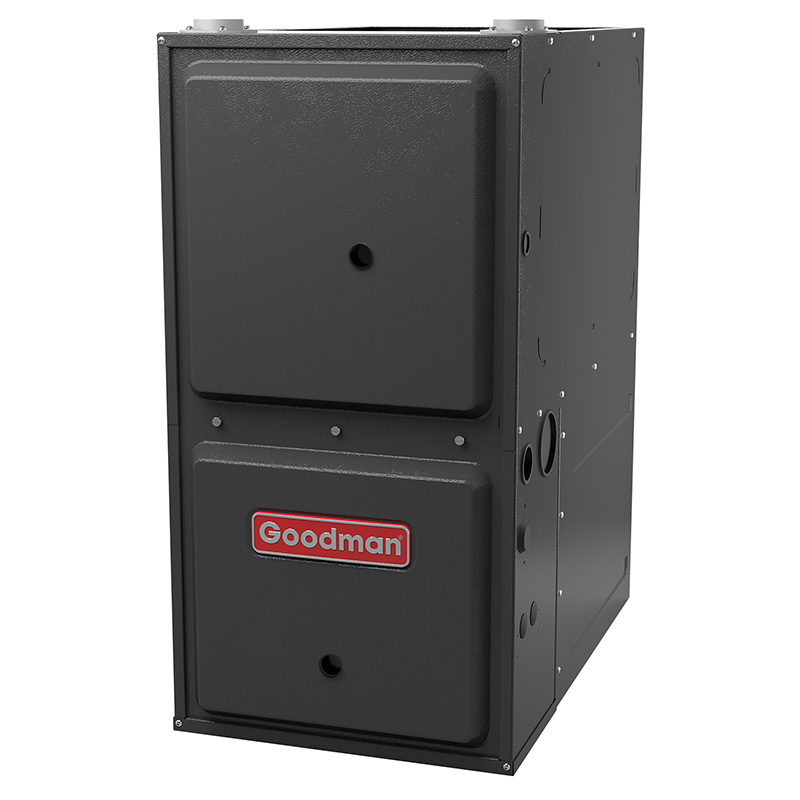
View on AC Direct see your lowest price →Check current price on AC Direct →
Key features
- 100,000 BTU two-stage gas valve for comfort on mild and cold days
- 80% AFUE efficiency rating for standard-efficiency operation
- Downflow configuration for floor-discharge duct systems and crawlspace installs
- 9-speed ECM blower motor reduces electricity use and operating noise
- Low NOx certified for California and other strict-emissions markets
- R-32 refrigerant compatibility for pairing with newer-generation cooling coils
About this system
The Goodman GD9T801005CX is a 100,000 BTU, 80% AFUE two-stage gas furnace built specifically for downflow installations, meaning it discharges heated air downward through the floor rather than upward or horizontally. That makes it the right call for homes with ductwork running beneath the floor, crawlspaces, or certain manufactured-home configurations where a standard upflow unit simply will not fit. The two-stage gas valve fires at a reduced capacity on mild days and ramps to full output only when temperatures demand it, which improves comfort, reduces temperature swings, and burns less gas compared to a single-stage furnace cycling on and off at full blast.
The 9-speed ECM (electronically commutated motor) blower is one of the standout mechanical details here. ECM motors use far less electricity than traditional PSC blower motors, run more quietly at lower speeds, and give the two-stage gas valve a matched variable airflow partner. The R-32 designation on a gas furnace refers to the refrigerant used in any matched cooling coil or system, flagging compatibility with next-generation R-32 equipment rather than the older R-410A systems being phased out. Low NOx certification means this unit meets California and other state air-quality standards restricting nitrogen oxide emissions, which is a requirement in several markets and a consideration worth checking with your local jurisdiction before purchase.
The GD9T801005CX delivers a capable two-stage, ECM-equipped furnace at a price point well below comparable Trane, Lennox, or Carrier models, making it a reasonable choice for budget-conscious buyers who understand the trade-offs. The 80% AFUE rating is honest but not exceptional, and the downflow configuration limits its audience to homeowners with specific duct layouts. Long-term cost of ownership depends heavily on installation quality and whether you budget for eventual component repairs.
Overall score is the average of the five ratings above.
What we like
- Two-stage firing improves comfort and fuel efficiency over single-stage units
- 9-speed ECM motor cuts blower electricity costs meaningfully compared to PSC motors
- Downflow design fills a real gap for floor-discharge duct systems where alternatives are scarce
- Low NOx certification satisfies strict state air-quality rules without an upcharge
- Priced 15 to 25 percent below comparable Carrier, Trane, and Lennox two-stage models
Trade-offs
- 80% AFUE is standard efficiency, not high efficiency; operating costs will be higher than 96%+ AFUE alternatives over the unit's lifetime
- Dual-run capacitors are the most commonly reported Goodman failure point, typically requiring a repair call around years 5 to 10
- Goodman compressors and components average shorter service lives than premium brands, with furnace heat exchangers and controls following similar patterns
- Downflow-only configuration means the unit is a poor fit if your duct layout ever changes or if you are not certain of your existing setup
What homeowners and pros say about Goodman
Goodman holds a ConsumerAffairs score of roughly 2.5 out of 5, though that channel skews heavily toward owners who experienced problems rather than satisfied ones who never felt the need to post. Google dealer reviews average around 3.8 out of 5, where the most consistent praise is straightforward: the equipment is priced well below Carrier, Trane, and Lennox, and for many buyers that gap is decisive. For a downflow two-stage furnace like the GD9T801005CX, that value positioning is real, and contractors who install Goodman regularly point out that a well-executed install on a Goodman unit often outperforms a sloppy install on a premium brand.
The documented failure modes on Goodman equipment are worth knowing before you buy. Dual-run capacitors are the most frequently reported issue across owner reviews, usually a low-drama repair but one that comes with a service call cost on top of the part. Evaporator coil leaks show up in a meaningful share of reviews as well, and Goodman compressors tend to average 10 to 14 years of service life compared to 15 to 20 for premium competitors. For a furnace specifically, the heat exchanger and control board are the long-term watch items, and the ConsumerAffairs pattern of repair costs climbing after year 7 is consistent enough to factor into your ownership plan. None of this makes the GD9T801005CX a bad furnace, but it does mean setting realistic expectations and having a reliable service contractor identified before problems arise.
Sources: ConsumerAffairs Goodman owner reviews, AHRI Directory of Certified Product Performance, U.S. DOE appliance and equipment efficiency standards, Goodman product specification sheets.
How it compares
| Brand | Comparable model | SEER2 | Stage | Price position |
|---|---|---|---|---|
| Goodman | GD9T801005CX | N/A (furnace only) | Two-stage | Value pick |
| Carrier | Performance 80 / 59TP6 | N/A (furnace only) | Two-stage | Moderately higher than Goodman, mid-tier pricing |
| Trane | S8X2 (80% two-stage) | N/A (furnace only) | Two-stage | Higher than Goodman, premium brand pricing |
| Lennox | ML196E (80% two-stage) | N/A (furnace only) | Two-stage | Higher than Goodman, premium brand pricing |
Competitor rows are comparable single-stage units at similar efficiency; price is relative position, not a quote.
Questions about this system
Is 80% AFUE going to cost me significantly more in gas bills compared to a 96% furnace?
Yes, over a full heating season, roughly 20% of the fuel burned in an 80% AFUE furnace exits as exhaust rather than heating your home, compared to about 4% in a 96% unit. On a 100,000 BTU furnace running a full winter, the difference in gas cost is real and compounds over the unit's lifespan, so the lower purchase price may be partially offset by higher operating costs depending on your climate and gas rates.
What does the downflow configuration mean, and how do I know if my home needs it?
A downflow furnace draws return air in at the top and pushes conditioned air out the bottom, directly into floor-level ductwork below the unit. If your furnace sits on the main floor or in a closet above a crawlspace or basement with ducts running beneath, downflow is likely your correct configuration. If you are unsure, have an HVAC technician verify your duct layout before purchasing, since installing the wrong orientation is a costly mistake.
What does R-32 compatibility mean on a gas furnace, and does it affect what cooling equipment I can pair with it?
Gas furnaces do not use refrigerant themselves, but the R-32 designation indicates the matched evaporator coil and any paired outdoor cooling unit should use R-32 refrigerant rather than the older R-410A that is being phased out under EPA regulations. If you are adding or replacing a central AC system alongside this furnace, confirm your coil and condenser are also R-32 rated to stay compliant with current and upcoming refrigerant rules.
What repairs should I budget for over the life of a Goodman furnace like this one?
The most commonly reported failure on Goodman equipment involves dual-run capacitors, typically a straightforward repair in the $300 to $600 range when it happens. Control boards and ignitors are also common furnace wear items across all brands. Goodman's documented track record on ConsumerAffairs shows repair costs climbing after roughly year 7, so budgeting for at least one or two service calls in the back half of the unit's life is prudent planning.
Does the Low NOx rating matter if I am not in California?
Low NOx certification is currently required in California and a handful of other states with strict air-quality standards, but it does not hurt performance or efficiency in states that do not require it. If you are outside a Low NOx jurisdiction, this certification is simply a non-factor rather than a benefit or a drawback, and the unit will operate the same as a non-certified furnace in those markets.
Specifications
| Furnace output | 100000 BTU |
| Configuration | Downflow |
| Refrigerant | R-32 |
| Model | GD9T801005CX |