Goodman R32 100000 BTU 96% Two-Stage Multi-Speed ECM Gas Furnace Downflow ( GD9T961005CN)
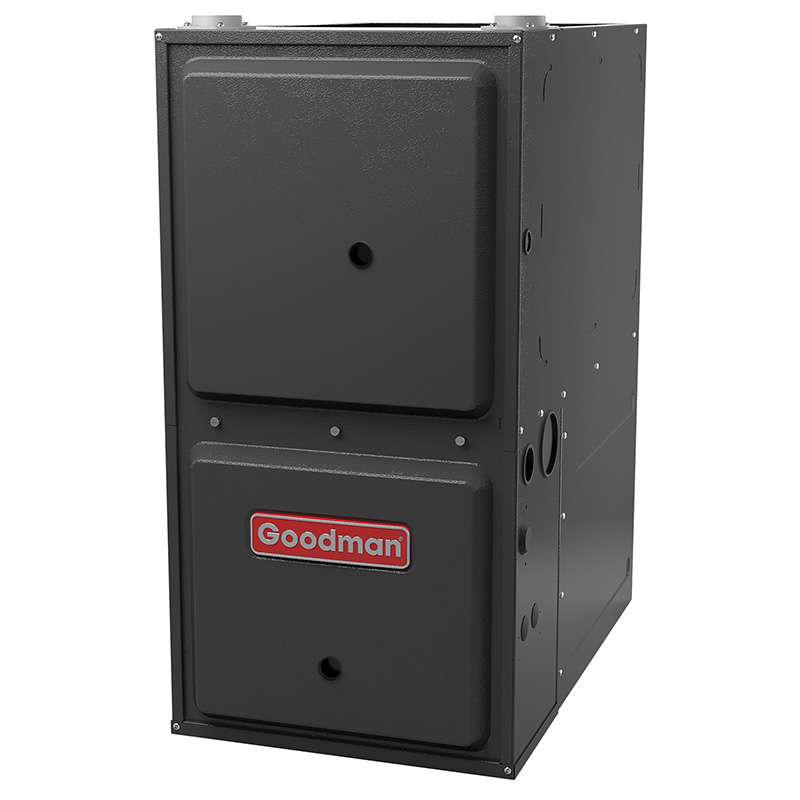
View on AC Direct see your lowest price →Check current price on AC Direct →
Key features
- 96% AFUE two-stage burner reduces fuel use and minimizes temperature swings
- Downflow configuration discharges heated air downward, suited for slab or crawlspace duct systems
- Multi-speed ECM blower motor cuts electrical draw and runs quieter than PSC motors
- 100,000 BTU capacity covers mid-to-large homes in cold climates
- Two-stage operation lets the furnace run at partial capacity during milder weather
- Compatible with standard communicating and non-communicating thermostat wiring
About this system
The Goodman GD9T961005CN is a 100,000 BTU, 96% AFUE two-stage gas furnace built in a downflow configuration, meaning it draws return air from the top and discharges heated air downward through the floor. That orientation makes it the right fit for installations in closets, utility spaces, or platforms above a crawlspace or slab where ducts run beneath the living area rather than through an attic. The two-stage burner fires at a lower rate most of the time and steps up to full capacity only when outdoor temperatures drop sharply, which keeps temperature swings smaller and lets the blower run longer cycles that do a better job of evening out hot and cold spots throughout the home.
The multi-speed ECM (electronically commutated motor) blower is a meaningful upgrade over PSC motors found on entry-level furnaces. It ramps airflow up and down in response to system demand, uses noticeably less electricity than a fixed-speed motor over a heating season, and runs quietly enough that many homeowners forget it is on. At 96% AFUE this unit sits in the high-efficiency tier, converting 96 cents of every dollar of gas into usable heat, which satisfies most utility rebate thresholds and meets or exceeds Energy Star requirements in most regions. It is worth noting that R-32 refrigerant designations in the model name are typically associated with the matched cooling system in a split configuration; the furnace itself runs on natural gas or propane and does not handle refrigerant directly.
This furnace suits a homeowner replacing an aging unit in a downflow application who wants meaningfully lower heating bills than an 80% furnace delivers, without paying the premium that Carrier, Trane, or Lennox charge for similar efficiency numbers. It is a particularly practical choice in mid-size homes between roughly 2,000 and 3,000 square feet in climates where the heating load drives the equipment decision more than cooling.
The GD9T961005CN delivers a legitimate 96% AFUE and a well-specified ECM blower at a price point that undercuts comparable Carrier and Trane units by a meaningful margin. The trade-off is a brand with a documented history of higher repair frequency after year seven and compressor lifespans that run shorter than premium competitors, though a furnace's compressor concern is moot since it has none. Installation quality is the single largest variable in how long any Goodman lasts, so budgeting for an experienced contractor is as important as the equipment price itself.
Overall score is the average of the five ratings above.
What we like
- 96% AFUE keeps annual heating costs competitive with top-tier brands
- Two-stage firing plus ECM blower improves comfort and lowers electricity use versus single-stage units
- Downflow design fills a specific installation niche that many brands do not address at this efficiency level
- Purchase price typically runs 15 to 25 percent below Trane, Lennox, and Carrier equivalents
- Two-stage operation extends equipment run times, which helps with humidity control in mixed climates
Trade-offs
- Goodman's ConsumerAffairs rating sits around 2.5 out of 5, with repair costs after year seven a recurring complaint
- Dual-run capacitors are a documented weak point across the Goodman line, though the repair is usually low-cost when caught promptly
- Downflow configuration limits installation flexibility; the unit cannot be repositioned to a horizontal or upflow application
- Long-term reliability does not consistently match premium brands, and that gap becomes more apparent in the second decade of ownership
What homeowners and pros say about Goodman
Owners and installers who leave reviews on Google dealer pages give Goodman equipment an average of around 3.8 out of 5 stars, and the most consistent praise is straightforward: you get a 96% AFUE furnace with a real ECM blower for substantially less than a Carrier or Trane equivalent. For budget-constrained buyers replacing a failed unit mid-winter, that price gap is genuinely meaningful. Contractors who work with the brand regularly note that a well-installed Goodman furnace is difficult to distinguish from a premium unit in day-to-day operation, especially in the first several years.
The more critical picture comes from ConsumerAffairs, where Goodman sits at roughly 2.5 out of 5, a score shaped by the platform’s complaint-heavy audience but not without real signal. The recurring theme in those reviews is repair costs that start climbing around year seven or eight, and the documented failure modes across the brand are specific: dual-run capacitors fail more often than on premium equipment, though the fix typically runs between 300 and 600 dollars when addressed promptly. Evaporator coil leaks show up in a meaningful share of owner accounts as well. The furnace itself does not carry the compressor lifespan concern that affects Goodman cooling equipment, where averages of 10 to 14 years fall short of the 15 to 20 years more commonly seen with Trane and Carrier. What ties most of the negative feedback together is install quality: a poorly sized or commissioned unit gives this already-lean brand less margin to overcome the difference, which is why experienced technicians treat contractor selection as non-negotiable when recommending a Goodman to cost-sensitive customers.
Sources: ConsumerAffairs Goodman owner reviews, AHRI Directory of Certified Product Performance, U.S. DOE appliance and equipment efficiency standards, Goodman product specification sheets.
How it compares
| Brand | Comparable model | SEER2 | Stage | Price position |
|---|---|---|---|---|
| Goodman | GD9T961005CN | N/A (furnace only) | Two-stage | Value pick |
| Carrier | Performance 96 (59TP6) | N/A (furnace only) | Two-stage | Roughly 20 to 25 percent higher than Goodman |
| Trane | S9X2 (XR96) | N/A (furnace only) | Two-stage | Roughly 20 to 30 percent higher than Goodman |
| Lennox | Merit ML196V | N/A (furnace only) | Two-stage | Roughly 25 to 35 percent higher than Goodman |
Competitor rows are comparable single-stage units at similar efficiency; price is relative position, not a quote.
Questions about this system
Why does this furnace show R-32 in the name if furnaces do not use refrigerant?
The R-32 designation refers to the refrigerant used by the matched air conditioner or heat pump in a complete split system. The GD9T961005CN is a gas furnace only and handles no refrigerant itself; the label helps contractors confirm the correct matched indoor coil when building a split system.
What does downflow mean and how do I know if my home needs it?
A downflow furnace pulls return air in through the top cabinet and pushes conditioned air out through the bottom into ducts that run beneath the unit, typically under a slab, through a crawlspace, or into a basement floor plenum. If your current furnace sits on a platform or closet floor with supply ducts going down, you need a downflow unit. Substituting an upflow model would require significant ductwork changes.
What Goodman warranty comes with the GD9T961005CN?
Goodman's standard warranty on this unit is a 10-year parts limited warranty when registered within 60 days of installation, dropping to five years on parts if registration is missed. The heat exchanger typically carries a longer limited warranty. Labor is not covered; that is between you and your installing contractor.
Is a two-stage furnace noticeably better than a single-stage in a real home?
In most homes, yes. The lower first-stage fire rate runs more frequently and for longer cycles, which reduces the temperature swings between thermostat calls and does a better job circulating air throughout the house. The difference is most noticeable in shoulder-season weather when a single-stage unit would short-cycle on and off quickly.
How important is installer quality for a Goodman furnace specifically?
Technicians consistently identify install quality as the largest factor in Goodman lifespan, more so than with premium brands that have tighter manufacturing tolerances. A properly sized, correctly commissioned Goodman installation can perform reliably for 15 or more years; a rushed or undersized installation from a low-bid contractor is where the brand's weaker reviews tend to originate. Vetting your contractor carefully is not optional with this brand.
Specifications
| Furnace output | 100000 BTU |
| Configuration | Downflow |
| Refrigerant | R-32 |
| Model | GD9T961005CN |