Goodman R32 120000 BTU 80% Two Stage 9-Speed ECM Gas Furnace Upflow / Horizontal (GR9T801205DN)
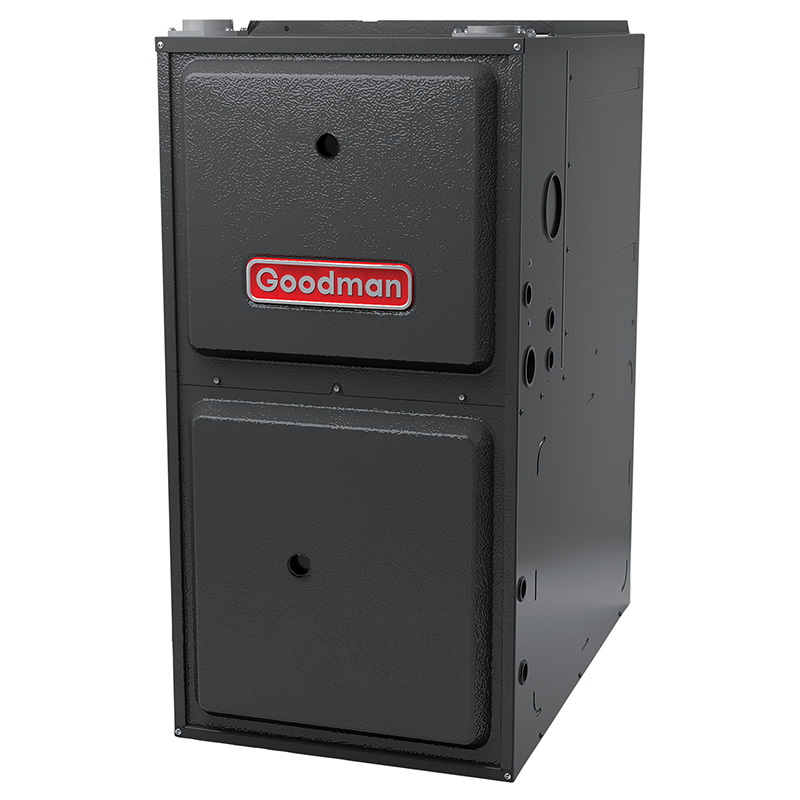
View on AC Direct see your lowest price →Check current price on AC Direct →
Key features
- 120,000 BTU output for large homes or cold-climate applications
- 80% AFUE two-stage burner reduces temperature swings versus single-stage
- Nine-speed ECM blower motor cuts electricity use and allows precise airflow tuning
- Upflow and horizontal configuration supports common installation orientations
- Compatible with R-32 system components for future-oriented refrigerant pairing
- Factory-installed pressure switches and redundant gas valve for safe startup
About this system
The Goodman GR9T801205DN is a 120,000 BTU, 80% AFUE two-stage gas furnace designed for upflow and horizontal installations. At 80% AFUE, it converts 80 cents of every fuel dollar into usable heat, which meets the federal minimum for northern-climate furnaces but sits below the 90%+ tier that maximizes long-term fuel savings. Two-stage operation means the burner runs at a lower output most of the time and steps up to full capacity only on the coldest days, reducing temperature swings and easing the load on the heat exchanger over time.
The nine-speed ECM blower motor is the real workhorse here. ECM (electronically commutated motor) technology uses significantly less electricity than a conventional PSC motor, and the nine selectable speeds let an installer fine-tune airflow for your duct layout. That matters especially at 120,000 BTU, a size typically matched to larger homes in colder climates where static pressure and duct sizing are critical to comfort. The R-32 refrigerant designation in the model number reflects Goodman’s product line update, though in a gas furnace this is most relevant when the unit is paired with a compatible R-32 air handler or coil.
This furnace suits homeowners in climates with genuinely cold winters who need a high-capacity unit, prefer upflow or horizontal installation, and want two-stage comfort without stepping up to a premium brand price point. It is a particularly practical choice for replacing an aging 80% furnace in an existing system where upgrading to 90%+ would require expensive venting changes.
The GR9T801205DN delivers two-stage comfort and an efficient ECM motor at a price 15 to 25 percent below comparable Trane, Lennox, and Carrier models, making it a workable choice for budget-conscious buyers in large homes. However, 80% AFUE is the low end of the efficiency range, and Goodman's documented track record of rising repair costs after year seven means total ownership cost narrows compared to premium brands over a 15-plus-year lifespan. Installation quality is the single biggest variable in how this unit performs and how long it lasts.
Overall score is the average of the five ratings above.
What we like
- Lower upfront cost versus Trane, Lennox, and Carrier equivalents
- Two-stage operation improves comfort and reduces short-cycling compared to single-stage
- Nine-speed ECM motor meaningfully lowers blower electricity consumption
- Broad parts availability through Goodman's large dealer network
- Upflow/horizontal flexibility fits a wide range of home configurations
Trade-offs
- 80% AFUE means roughly 20% of fuel cost is lost, and the efficiency gap versus 96%+ units adds up in cold climates with high heating loads
- Goodman's ConsumerAffairs rating sits around 2.5 out of 5, with repair costs after year seven a recurring complaint
- Compressor and component lifespan averages 10 to 14 years versus 15 to 20 for premium brands, affecting long-term value
- Performance is heavily dependent on install quality, meaning a rushed or poorly matched installation can undercut the unit's potential
What homeowners and pros say about Goodman
Homeowners who chose Goodman furnaces most often cite price as the deciding factor, and Google dealer reviews across locations average around 3.8 out of 5, where affordability is the most frequently mentioned positive. Those reviews tend to come from buyers early in ownership, though. On ConsumerAffairs, where longer-term owners are more represented, Goodman lands around 2.5 out of 5, and the pattern is consistent: satisfaction holds in the first several years, then repair costs start to climb after roughly year seven. For a 120,000 BTU unit running hard in a cold climate, that timeline is worth factoring into your total-cost calculation before signing a purchase order.
HVAC professionals who work on Goodman equipment regularly point to two recurring issues: dual-run capacitor failures, which are common but relatively inexpensive to fix at $300 to $600 per occurrence, and evaporator coil leaks, which show up in a meaningful share of owner reviews and can be more costly to address. Compressor lifespan on Goodman equipment tends to average 10 to 14 years, versus 15 to 20 years on Trane, Lennox, and Carrier units, which affects long-run value. Technicians are also consistent on one point: the install matters more with Goodman than with premium brands, because there is less engineering margin built in. A skilled contractor with experience sizing high-BTU systems can get solid performance from this unit; a rushed install can undercut it quickly.
Sources: ConsumerAffairs Goodman owner reviews, AHRI Directory of Certified Product Performance, U.S. DOE appliance and equipment efficiency standards, Goodman product specification sheets.
How it compares
| Brand | Comparable model | SEER2 | Stage | Price position |
|---|---|---|---|---|
| Goodman | GR9T801205DN | N/A (gas furnace) | Two-stage | Value pick |
| Carrier | Performance 80 (58TP0) | N/A (gas furnace) | Two-stage | Typically 20 to 25 percent more than the Goodman |
| Trane | S8X2 (XR80 series) | N/A (gas furnace) | Two-stage | Typically 20 to 30 percent more than the Goodman |
| Lennox | Merit ML180 | N/A (gas furnace) | Single-stage | Typically 15 to 25 percent more than the Goodman |
Competitor rows are comparable single-stage units at similar efficiency; price is relative position, not a quote.
Questions about this system
Is 80% AFUE good enough for a cold-climate home, or should I upgrade to a 96% furnace?
At 120,000 BTU in a cold climate, the fuel wasted by an 80% unit adds up noticeably over a heating season. If your venting can accommodate PVC exhaust pipes, a 96%+ two-stage furnace will pay back the price difference in fuel savings over roughly 5 to 8 years in a very cold zone. If upgrading the flue is expensive or impossible, the 80% unit is a practical compromise.
What does the nine-speed ECM blower actually do for me compared to a standard motor?
A conventional PSC blower motor runs at fixed speeds and consumes roughly 500 to 800 watts continuously. An ECM motor can drop to as low as 75 to 100 watts during steady-state operation, which reduces your annual electricity bill and runs more quietly. The nine selectable speeds also allow an installer to dial in airflow precisely for your duct system, which matters a lot at high BTU outputs where oversized airflow can cause comfort complaints.
What are the most common repairs I should budget for with a Goodman furnace?
Dual-run capacitors are the most frequently reported failure point across Goodman equipment and typically cost between $300 and $600 to diagnose and replace. Owners also report evaporator coil leaks showing up in a meaningful portion of reviews. Goodman's ConsumerAffairs score of around 2.5 out of 5 reflects a pattern of repair costs climbing after roughly year seven, so budgeting for a service contract after the warranty period is a reasonable precaution.
Does the R-32 label on this furnace mean I have to use R-32 refrigerant in my cooling system?
For a gas furnace, the refrigerant designation is relevant only when the unit is paired with a matched coil or air handler in a split system. The furnace itself does not use refrigerant. However, Goodman has updated its product line to align with R-32 compatible components, so if you are adding or replacing a cooling coil, you should confirm compatibility with the specific coil model to ensure warranty coverage.
How important is the contractor I hire for installing this unit?
Very important. HVAC technicians consistently cite install quality as the single biggest factor in how long a Goodman unit lasts and how well it performs. At 120,000 BTU, proper duct sizing, static pressure measurement, and gas pressure setup are critical. A poorly matched or rushed installation can cause short-cycling, heat exchanger stress, and early component failure regardless of the equipment quality.
Specifications
| Furnace output | 120000 BTU |
| Configuration | Upflow |
| Refrigerant | R-32 |
| Model | GR9T801205DN |