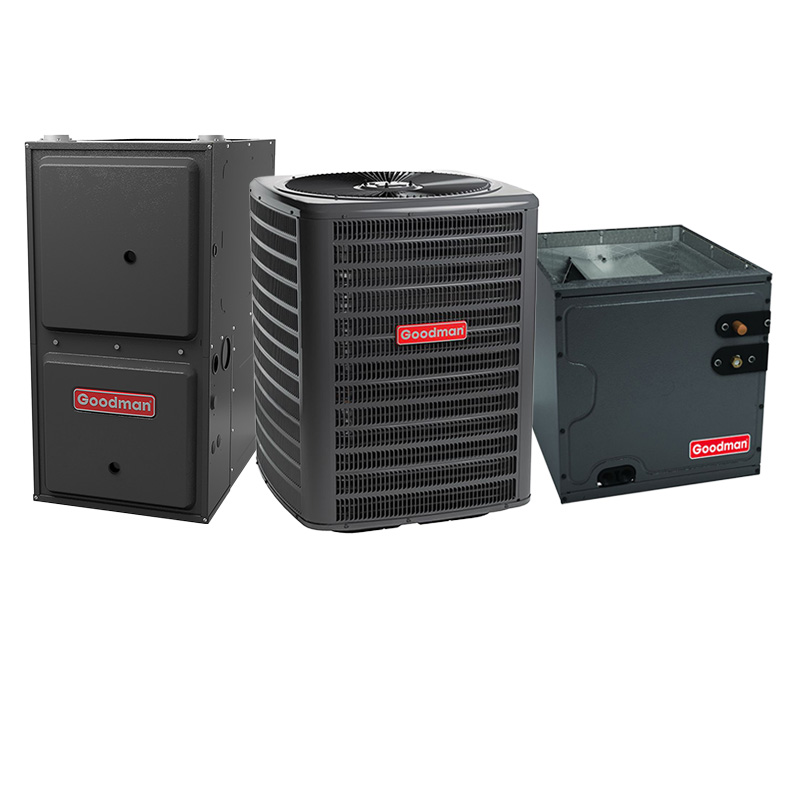
Goodman R32 2.5 Ton 13.8 SEER2 80000 BTU 80% Two Stage 9-Speed ECM Gas Furnace and Air Conditioner System – Upflow
View on AC Direct see your lowest price →Check current price on AC Direct →
Key features
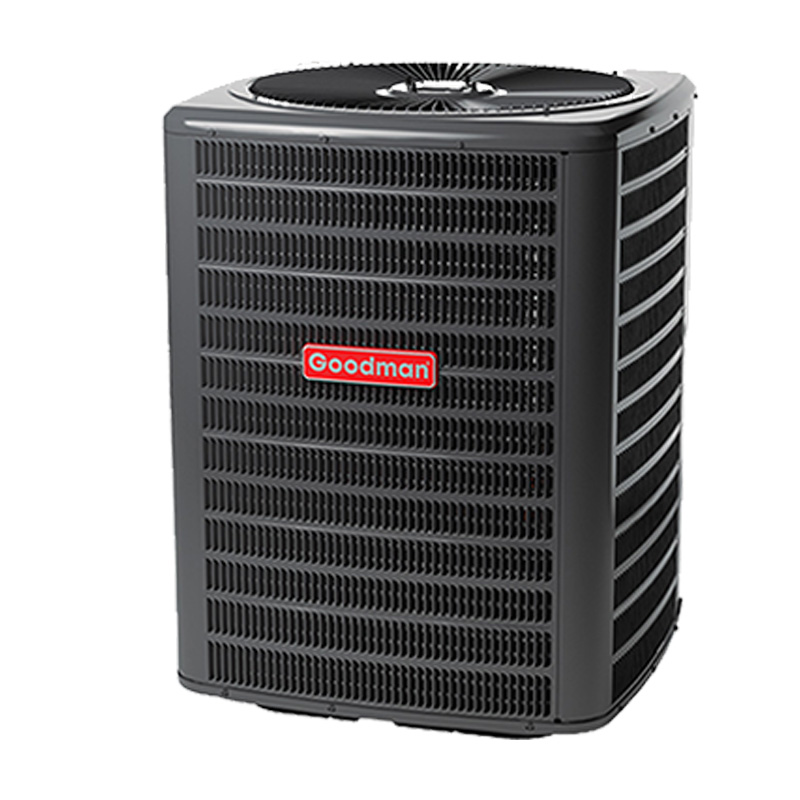
- 2.5-ton two-stage R-32 air conditioner rated 13.8 SEER2
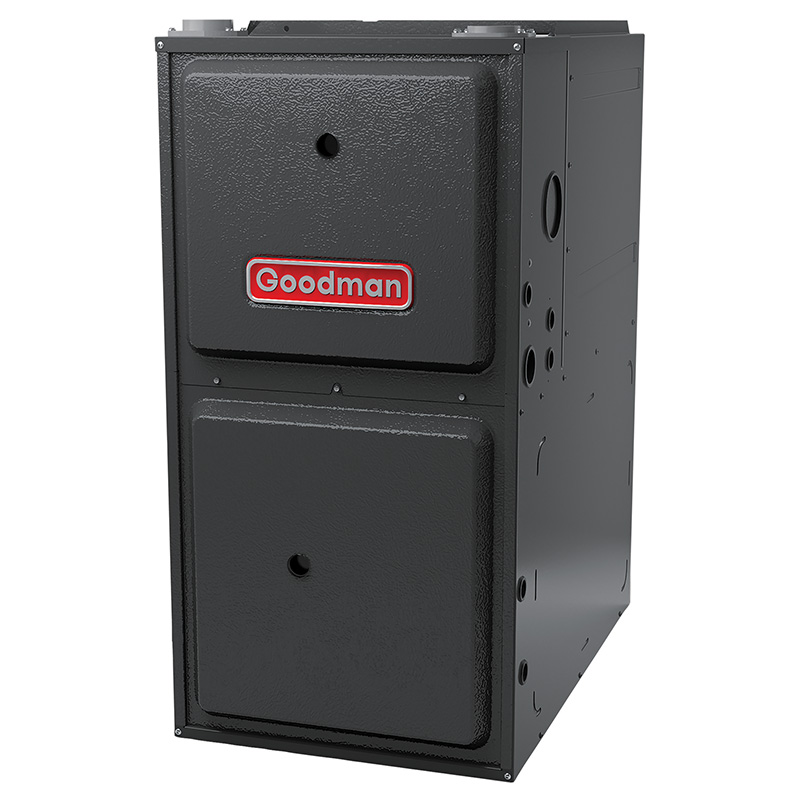
- 80,000 BTU upflow gas furnace at 80% AFUE efficiency
- Nine-speed ECM variable-speed blower motor for quiet, efficient airflow
- R-32 refrigerant with lower global-warming potential than R-410A
- Two-stage compressor reduces short-cycling and improves dehumidification
- Upflow configuration suits homes with basement or closet furnace installations
About this system
This Goodman bundle pairs a 2.5-ton R-32 central air conditioner rated at 13.8 SEER2 with an 80,000 BTU upflow gas furnace running at 80% AFUE. The combination is aimed at homes in the 1,200 to 1,800 square-foot range that have existing ductwork configured for upflow installation, meaning the furnace draws return air from the bottom and discharges conditioned air upward into the supply plenum. R-32 refrigerant carries a lower global-warming potential than the R-410A it replaces, and it also allows for slightly smaller refrigerant line sets, which can simplify a replacement job.
The two-stage cooling compressor and nine-speed ECM blower motor are the two specifications that separate this system from entry-level single-stage equipment. Two-stage operation lets the outdoor unit run at a reduced capacity on mild days, which improves humidity control and reduces short-cycling. The variable-speed ECM fan motor adjusts airflow in small increments rather than switching between fixed speeds, cutting blower electricity use and reducing the abrupt blasts of air that single-speed systems produce. Together, these features make this a mid-tier comfort system, not a basic box. The 13.8 SEER2 rating sits near the federal minimum for most U.S. climate regions, so operating costs will be competitive but not exceptional compared with 16-plus SEER2 alternatives.
Goodman positions this system as a practical, budget-conscious choice for homeowners who want a meaningful step above bare-minimum equipment without paying premium-brand prices. The upflow configuration is the most common residential orientation, so compatible coil cabinets and accessories are widely stocked. Buyers should factor in that Goodman’s long-term performance record is strongly influenced by installer quality, making contractor selection as important as equipment selection.
This Goodman system delivers genuine mid-tier comfort features, specifically two-stage cooling and a nine-speed ECM blower, at a price point that undercuts comparable Carrier, Trane, and Lennox equipment by roughly 15 to 25 percent. The efficiency rating is adequate rather than impressive, and long-term ownership costs depend heavily on installer quality and a willingness to budget for likely capacitor replacement and possible coil work after the first decade. It is a reasonable buy for cost-conscious homeowners who vet their contractor carefully and understand the trade-offs.
Overall score is the average of the five ratings above.
What we like
- Two-stage compressor meaningfully improves humidity control versus single-stage entry units
- Nine-speed ECM blower cuts fan electricity use and softens airflow noise
- R-32 refrigerant is lower-impact and often results in a simpler charge process for qualified technicians
- Price is typically 15 to 25 percent below comparable Trane, Lennox, and Carrier systems
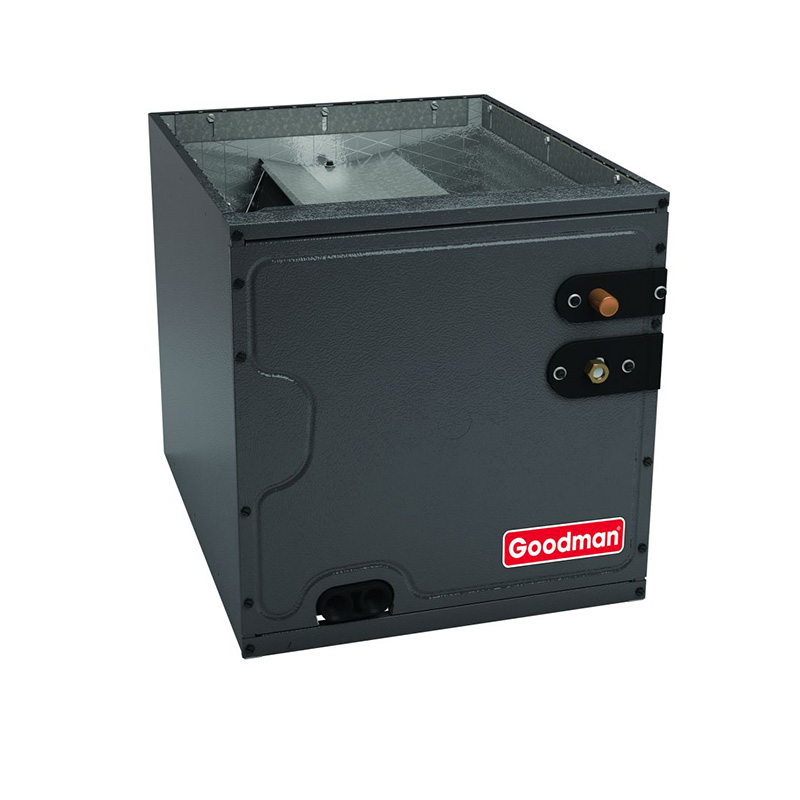
- Upflow orientation is the most common residential configuration, so parts and coil cabinets are broadly available
Trade-offs
- 13.8 SEER2 is near the federal minimum and will not produce the utility savings of a 16-plus SEER2 system over time
- Dual-run capacitors are the most frequently reported failure point, adding expected repair costs after year five or six
- Compressor lifespan averages 10 to 14 years versus 15 to 20 years for premium brands, which affects replacement planning
- A minority of owners report refrigerant leaks in the first year, most often tied to installation quality rather than the equipment itself
What homeowners and pros say about Goodman
Homeowners who comment on Goodman equipment tend to split along a clear line: those who had a skilled installer and those who did not. Google dealer reviews average around 3.8 out of 5 across locations, and the most repeated praise is that the systems deliver reliable cooling and heating for the money, particularly in the first several years of ownership. ConsumerAffairs tells a harsher story, sitting at roughly 2.5 out of 5, though that platform draws a disproportionate share of frustrated owners rather than satisfied ones. The pattern that emerges from both channels is that repair costs and frustration tend to climb after around year seven, with dual-run capacitor failures appearing as the most frequently cited service call and evaporator coil leaks showing up in a meaningful number of longer-term owner accounts.
HVAC technicians generally describe Goodman as straightforward to diagnose and service, with widely available replacement parts. The concern most often raised by experienced installers is compressor longevity: Goodman compressors tend to average 10 to 14 years in real-world use, compared with 15 to 20 years seen in premium-brand equipment under similar conditions. A smaller but notable share of first-year refrigerant leak reports also surfaces in owner reviews, and technicians consistently attribute these to charge errors at installation rather than factory defects, reinforcing that contractor quality is the single biggest variable in how this equipment performs over its lifespan. For this specific two-stage, ECM-equipped system, the additional mechanical complexity relative to a base single-stage unit means clean commissioning and a proper airflow setup matter even more than they do on simpler equipment.
Sources: ConsumerAffairs Goodman owner reviews, AHRI Directory of Certified Product Performance, U.S. DOE appliance and equipment efficiency standards, Goodman product specification sheets.
What it costs to run
At 13.8 SEER2, cooling this 2.5-ton system for a typical 1200-hour cooling season at the U.S. average electricity rate of $0.17/kWh works out to roughly $443 per year in cooling, about $14 less per year than a minimum-efficiency 13.4 SEER2 unit of the same size. Your real cost depends on your climate and local rate.
Method: (30,000 BTU/hr ÷ 13.8 SEER2) × 1200 hours ÷ 1000 × $0.17/kWh. Rate source: U.S. EIA average; cooling hours: moderate-climate estimate.
How it compares
| Brand | Comparable model | SEER2 | Stage | Price position |
|---|---|---|---|---|
| Goodman | This system (R-32 2.5T two-stage / 80K BTU upflow) | 13.8 | two-stage | Value pick |
| Carrier | Performance 14 (24ACC6 series) | 13.8-14.3 | single-stage | Typically 15 to 25 percent more than this Goodman system |
| Trane | XR14c series | 14.0-14.5 | single-stage | Typically 15 to 25 percent more than this Goodman system |
| Lennox | Merit ML14XC1 series | 14.0 | single-stage | Typically 15 to 25 percent more than this Goodman system |
Competitor rows are comparable single-stage units at similar efficiency; price is relative position, not a quote.
Questions about this system
Does the R-32 refrigerant require any special handling compared to the R-410A system I'm replacing?
Yes, R-32 is mildly flammable and classified A2L, so technicians need specific training and equipment to handle it safely. Most licensed HVAC contractors are already certified or in the process of getting certified as R-32 becomes the industry standard, but confirm with your contractor before booking.
The furnace is rated 80% AFUE. Should I consider a 96% model instead?
An 80% furnace vents combustion gases through a standard B-vent, which is often already in place on a replacement job, keeping installation straightforward and less expensive. A 96% AFUE model requires PVC condensate venting, which can add significant labor cost in retrofit situations. In warmer climates where heating hours are low, the payback period on the efficiency upgrade can stretch to a decade or more.
What is the realistic warranty coverage on this system?
Goodman typically offers a 10-year parts warranty on registered units, which covers components including the compressor and heat exchanger. Registration must usually be completed within a set window after installation, so confirm that step with your contractor. Labor is not covered by the manufacturer warranty and must be arranged through your installer or a service plan.
How often should I expect to replace the dual-run capacitor, and what does that cost?
Capacitor failure is the most commonly reported repair on Goodman equipment, and it can occur as early as year five or six in hot climates where the system runs heavily. A capacitor replacement typically runs between 300 and 600 dollars including labor, and it is a fast repair when scheduled promptly. Keeping a service agreement in place makes it easier to catch this before it causes a no-cool situation in peak summer.
My house is 1,600 square feet. Is 2.5 tons the right size, or should I go up to 3 tons?
Square footage alone is not enough to determine the correct tonnage. A proper Manual J load calculation factors in insulation levels, ceiling height, window area, local climate, and air infiltration. In most U.S. climates a well-insulated 1,600-square-foot home lands close to 2.5 tons, but an oversized unit will short-cycle, reduce humidity control, and increase wear on components. Ask your contractor to provide a load calculation before finalizing the equipment size.
Specifications
| Cooling capacity | 2.5 Ton |
| Efficiency | 13.8 SEER2 |
| Furnace output | 80000 BTU |
| Configuration | Upflow |
| Refrigerant | R-32 |