Goodman 3.5 Ton 15.2 SEER2 Split System with Electric Heat w/4 Ton A/H C
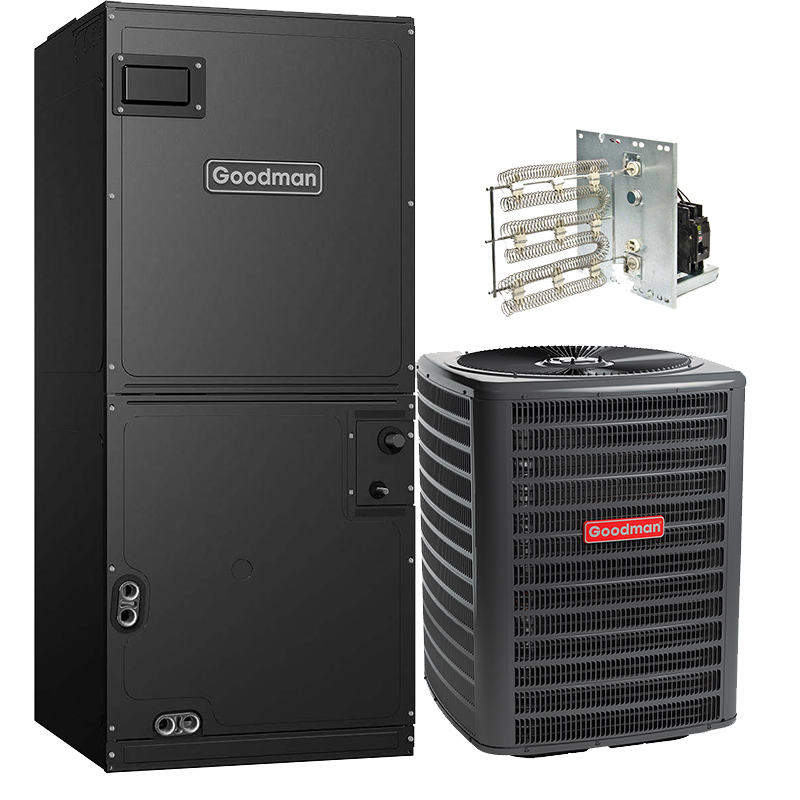
View on AC Direct see your lowest price →Check current price on AC Direct →
Key features
- 3.5-ton cooling capacity paired with a 4-ton air handler for electric heat compatibility
- 15.2 SEER2 efficiency rating, meeting and exceeding current federal minimum standards
- Single-stage scroll compressor for straightforward, lower-cost operation
- Compatible with electric heat strips in the matched air handler
- Factory-tested refrigerant circuit with Goodman's 10-year parts warranty (registration required)
- Designed for R-410A refrigerant with standard split-system installation requirements
About this system
The Goodman GSXH501810 is a 3.5-ton, 15.2 SEER2 single-stage split system paired with a 4-ton air handler sized for electric heat. That slight oversizing on the air handler side is intentional, giving the system adequate static pressure headroom and coil surface area for the electric heat strips typically added during installation. At 15.2 SEER2, it clears the federal minimum efficiency threshold by a comfortable margin without crossing into the premium-tier pricing territory of two-stage or variable-capacity compressors.
This system fits best in homes roughly 1,800 to 2,400 square feet in climates where cooling is the primary load and heating is supplemented or handled entirely by electric resistance strips. It is a practical choice for budget-conscious buyers replacing aging R-22 or early R-410A equipment, for landlords maintaining rental properties, or for new construction projects where upfront cost discipline matters more than long-term efficiency optimization. Single-stage operation means the compressor runs at full capacity whenever it is on, which keeps the price down but does produce slightly more humidity variation and on-off cycling compared to a modulating system.
The GSXH501810 delivers honest, mid-tier efficiency at a price point that is noticeably lower than comparable Carrier, Trane, or Lennox equipment, making it a reasonable choice when upfront cost is the primary constraint. Its long-term ownership picture is more mixed, with documented vulnerabilities around capacitors, evaporator coil integrity, and compressor longevity that lag behind premium brands. Quality installation is not just recommended here, it is the single most important variable in how this unit performs over its lifetime.
Overall score is the average of the five ratings above.
What we like
- Purchase price typically 15 to 25 percent below comparable Carrier, Trane, and Lennox units
- 15.2 SEER2 provides meaningful efficiency improvement over older R-22 era replacements
- 4-ton air handler pairing provides good static pressure headroom for electric heat strip installations
- 10-year parts warranty with registration is competitive for the value segment
- Dual-run capacitor failures, the most common repair, are generally a low-cost fix in the $300 to $600 range
Trade-offs
- Single-stage compressor cycles fully on and off, producing more humidity swings than two-stage or variable systems
- Compressor lifespan averages 10 to 14 years versus 15 to 20 years reported for premium-brand compressors
- Evaporator coil leaks appear in a meaningful share of owner reports, a cost that can approach or exceed the savings over a premium unit
- A minority of owners report refrigerant leaks within the first year, most traced to installation or initial charge issues rather than factory defects
What homeowners and pros say about Goodman
Homeowners who shop Goodman almost always arrive at the same starting point: the price gap versus Carrier, Trane, and Lennox is real and it is significant, typically 15 to 25 percent at the equipment level. On Google dealer review pages, where buyers who have had the system installed and running for some time leave feedback, Goodman averages around 3.8 out of 5 stars across hundreds of reviews per dealership, and affordability is the praise that comes up most consistently. That is a genuinely solid number for a value brand. On ConsumerAffairs, the score drops to roughly 2.5 out of 5, but that platform skews heavily toward people reporting problems, and the complaints cluster around repair costs that tend to accelerate after about year 7 of ownership.
HVAC technicians who service Goodman equipment regularly point to three recurring issues worth knowing before you buy the GSXH501810. Dual-run capacitor failures are the most common service call and are usually a quick, low-cost repair in the $300 to $600 range. Evaporator coil leaks show up in a meaningful portion of owner accounts and carry a much higher repair cost. Compressor lifespan on Goodman units tends to average 10 to 14 years, a shorter window than the 15 to 20 years reported for premium brands. A minority of owners also report refrigerant leaks within the first year, and those are almost always traced back to installation or initial charge errors rather than anything that left the factory wrong. That last point is why every technician who works on Goodman equipment consistently says the same thing: the installer matters as much as the equipment itself.
Sources: ConsumerAffairs Goodman owner reviews, AHRI Directory of Certified Product Performance, U.S. DOE appliance and equipment efficiency standards, Goodman product specification sheets.
What it costs to run
At 15.2 SEER2, cooling this 3.5-ton system for a typical 1200-hour cooling season at the U.S. average electricity rate of $0.17/kWh works out to roughly $564 per year in cooling, about $75 less per year than a minimum-efficiency 13.4 SEER2 unit of the same size. Your real cost depends on your climate and local rate.
Method: (42,000 BTU/hr ÷ 15.2 SEER2) × 1200 hours ÷ 1000 × $0.17/kWh. Rate source: U.S. EIA average; cooling hours: moderate-climate estimate.
How it compares
| Brand | Comparable model | SEER2 | Stage | Price position |
|---|---|---|---|---|
| Goodman | GSXH501810 (this system) | 15.2 | Single-stage | Value pick |
| Carrier | Comfort 24ACC636 series | 15.2 | Single-stage | Typically 15 to 25 percent more than this Goodman |
| Trane | XR15 series | 15.0 to 16.0 | Single-stage | Typically 15 to 25 percent more than this Goodman |
| Lennox | Merit ML14XC1 series | 15.2 to 16.0 | Single-stage | Typically 15 to 25 percent more than this Goodman |
Competitor rows are comparable single-stage units at similar efficiency; price is relative position, not a quote.
Questions about this system
Why is the air handler rated at 4 tons when the condenser is only 3.5 tons?
The slight mismatch is intentional and common practice. The larger air handler coil provides more surface area, which improves latent heat removal and gives the system room to accommodate electric heat strips without restricting airflow. Goodman specifies this pairing, so it is not a compatibility issue.
What electric heat strip sizes can I add to this air handler?
The 4-ton air handler in this pairing is designed to accept electric heat kits, but the specific kilowatt options depend on the air handler model number and your electrical service capacity. Your installer should confirm the correct heat kit part number and verify that your breaker panel can support the added load before purchase.
How important is the installer for this system, and what should I look for?
Installation quality is widely cited by HVAC technicians as the single biggest factor in how long a Goodman system lasts. You should specifically ask the contractor to verify refrigerant charge with gauges, pressure-test the line set before charging, and confirm proper airflow. Skipping those steps is the most common cause of first-year refrigerant leak complaints.
What is the most common repair I should budget for over the first 10 years?
Dual-run capacitor failure is the most frequently reported issue on Goodman equipment. It is also one of the least expensive HVAC repairs, typically running $300 to $600 depending on labor rates in your area, and it is usually a same-day fix. Keeping a service contract or setting aside a small repair fund covers this scenario comfortably.
Does the 10-year parts warranty require anything from me after purchase?
Yes, Goodman requires product registration within a set window after installation to activate the full 10-year parts warranty. Without registration, the coverage typically drops to five years on parts. Register on Goodman's website as soon as your contractor completes the installation and keep the paperwork with your home records.
Specifications
| Cooling capacity | 3.5 Ton |
| Efficiency | 15.2 SEER2 |
| Model | GSXH501810 |