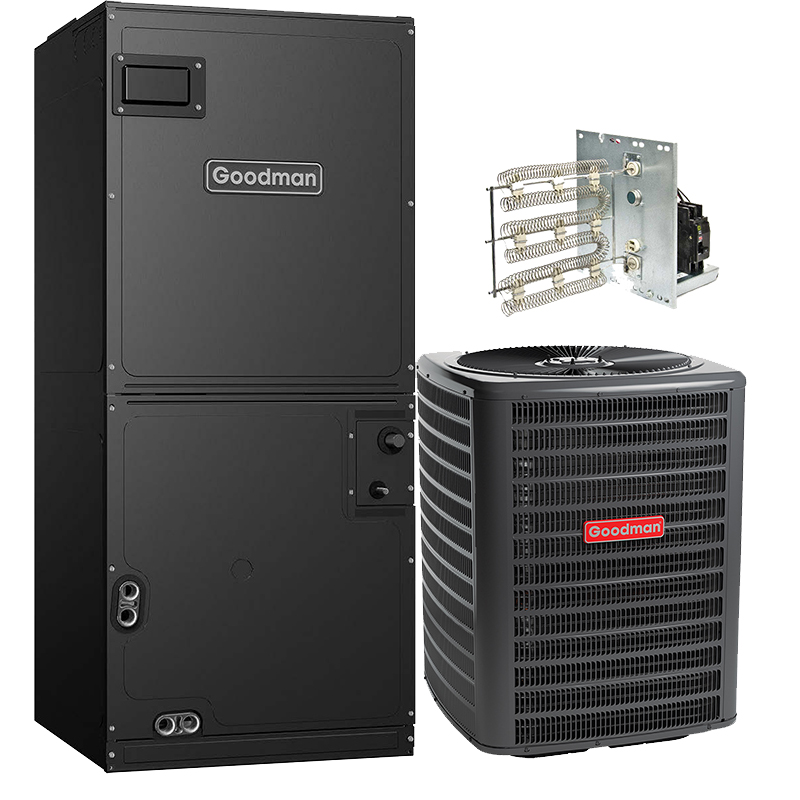
Goodman 4 Ton 15.2 SEER2 Split System with Electric Heat w/4 Ton A/H
View on AC Direct see your lowest price →Check current price on AC Direct →
Key features
- 15.2 SEER2 efficiency rating, meeting current federal minimum standards for most U.S. regions
- 4-ton capacity matched condenser and air handler, designed as a complete split system
- Single-stage compressor operation at full capacity on every cooling cycle
- Electric heat configuration, no gas line required
- R-410A or R-454B refrigerant compatibility depending on production date (verify with supplier)
- Goodman limited parts warranty, with registration required for full coverage period
About this system
The Goodman GSXH501810 pairs a 4-ton, 15.2 SEER2 single-stage condenser with a matched 4-ton air handler, making it a complete electric-heat split system sized for larger homes typically in the 2,000 to 2,600 square foot range, depending on local climate and insulation. At 15.2 SEER2, the system clears the federal minimum for most U.S. regions and delivers a meaningful efficiency step up from older 13 or 14 SEER equipment, though it stops well short of two-stage or variable-speed systems that can push into the 18 to 20 SEER2 range. Buyers should understand that single-stage operation means the compressor runs at full capacity whenever it cycles on, which is efficient enough on the hottest days but can lead to short-cycling and slightly less precise humidity control on mild days.
This configuration is built for homeowners who need a reliable, code-compliant replacement or new-install without the premium price tag of Trane, Carrier, or Lennox equipment. The included air handler handles the electric heat strips, so no gas line is required, making it a practical choice in all-electric homes or climates where heating loads are modest. As with every Goodman system, the long-term outcome depends heavily on who installs it and how well refrigerant charge and airflow are set up at commissioning. A clean, properly charged install is the single biggest variable in how this unit performs over its service life.
The Goodman GSXH501810 is a competent entry-level system that delivers code-compliant efficiency at a price that is typically 15 to 25 percent below comparable Carrier, Trane, or Lennox equipment. It suits budget-conscious buyers who are committed to using a qualified installer and staying on top of routine maintenance. Owners willing to accept a shorter expected compressor lifespan and the possibility of capacitor or coil service calls in the back half of its life will find the upfront savings worthwhile; those who want fewer long-term worries may prefer spending more for a premium brand.
Overall score is the average of the five ratings above.
What we like
- Purchase price typically 15 to 25 percent below comparable Carrier, Trane, and Lennox systems
- Matched condenser and air handler shipped together, reducing compatibility guesswork
- 15.2 SEER2 rating meets current federal efficiency requirements in all U.S. climate zones
- Electric heat configuration works in all-electric homes without any gas infrastructure
- Wide dealer and parts availability across most U.S. markets makes service calls easier to schedule
Trade-offs
- Single-stage operation can cause short-cycling and humidity control issues on mild days
- Compressor lifespan tends to average 10 to 14 years, shorter than the 15 to 20 years reported for premium brands
- Dual-run capacitors are the most commonly reported failure, typically requiring a 300 to 600 dollar service call
- Evaporator coil leaks appear in a meaningful share of owner reviews, and a small minority report refrigerant leaks within the first year that point to install or factory charge issues
What homeowners and pros say about Goodman
On platforms where verified purchasers leave feedback, Goodman occupies a familiar spot: widely praised for upfront affordability and widely criticized when repair bills arrive years later. ConsumerAffairs scores for Goodman sit at roughly 2.5 out of 5, a number that reflects the platform’s tendency to attract dissatisfied owners, but the recurring theme in those reviews is repair costs climbing after roughly year seven, which aligns with the documented compressor lifespan of 10 to 14 years compared to 15 to 20 years for premium brands. Google dealer reviews tell a more balanced story, averaging around 3.8 out of 5 across locations, where affordability and availability draw the most consistent praise.
HVAC technicians who work on Goodman equipment regularly point to dual-run capacitor failure as the most predictable service call, usually a low-cost fix in the 300 to 600 dollar range and not a reason to avoid the brand outright. More consequential are evaporator coil leaks, which appear often enough in owner accounts to be worth budgeting for, and the minority of refrigerant leak reports in year one that technicians typically attribute to install or charge problems rather than the unit itself. For a 4-ton electric system like this one, the professional consensus is consistent: get a quality installer, keep up with annual maintenance, and the Goodman will earn its lower price; cut corners on the install and the savings can evaporate quickly in service costs.
Sources: ConsumerAffairs Goodman owner reviews, AHRI Directory of Certified Product Performance, U.S. DOE appliance and equipment efficiency standards, Goodman product specification sheets.
What it costs to run
At 15.2 SEER2, cooling this 4-ton system for a typical 1200-hour cooling season at the U.S. average electricity rate of $0.17/kWh works out to roughly $644 per year in cooling, about $87 less per year than a minimum-efficiency 13.4 SEER2 unit of the same size. Your real cost depends on your climate and local rate.
Method: (48,000 BTU/hr ÷ 15.2 SEER2) × 1200 hours ÷ 1000 × $0.17/kWh. Rate source: U.S. EIA average; cooling hours: moderate-climate estimate.
How it compares
| Brand | Comparable model | SEER2 | Stage | Price position |
|---|---|---|---|---|
| Goodman | GSXH501810 with matched 4-ton A/H | 15.2 | Single-stage | Value pick |
| Carrier | Comfort 24ACC6 series, 4-ton | 15.2 | Single-stage | Typically 15 to 25 percent more than Goodman |
| Trane | XR15 series, 4-ton | 15.0 to 15.6 depending on coil match | Single-stage | Typically 15 to 25 percent more than Goodman |
| Lennox | Merit ML15XC1 series, 4-ton | 15.2 | Single-stage | Typically 15 to 25 percent more than Goodman |
Competitor rows are comparable single-stage units at similar efficiency; price is relative position, not a quote.
Questions about this system
Do I need to register the system to get the full warranty, and what does the warranty actually cover?
Yes, Goodman requires product registration within a set window after installation to unlock the full limited parts warranty period. Without registration you typically receive a shorter base coverage. The warranty covers parts but not labor, so any repair visit will carry a technician charge on top of parts even while the system is under warranty.
Is a 4-ton unit the right size for my house, or should I get a load calculation done first?
A load calculation is strongly recommended before purchasing any system. A 4-ton unit is often suitable for homes in the 2,000 to 2,600 square foot range, but local climate, insulation levels, window area, and ceiling height all affect the right size. An oversized unit will short-cycle and struggle to control humidity, while an undersized one will run constantly on the hottest days.
What is the most likely repair I will need in the first 10 years?
Based on documented owner experience, dual-run capacitor failure is the most commonly reported issue with Goodman equipment and is typically a straightforward repair in the 300 to 600 dollar range. Evaporator coil leaks also appear in a notable share of reviews and are a more costly repair. Refrigerant leaks reported within the first year usually trace back to install or factory charge problems rather than the unit itself.
Can this air handler be used with a heat pump instead of a straight-cool condenser in the future?
Air handlers and condensers need to be matched for compatibility, and switching from a straight-cool condenser to a heat pump involves different refrigerant circuit and control wiring requirements. Any future change should be evaluated by a licensed HVAC technician who can confirm whether the existing air handler is compatible with the new outdoor unit you are considering.
How important is installer quality with a Goodman system compared to a premium brand?
Installation quality is critical for any HVAC system, but technicians consistently cite it as the single biggest factor in Goodman longevity specifically. Proper refrigerant charge, correct airflow setup, and secure electrical connections at startup have an outsized effect on how long this equipment lasts and how efficiently it runs. Choosing a licensed, experienced installer is at least as important as the equipment choice itself.
Specifications
| Cooling capacity | 4 Ton |
| Efficiency | 15.2 SEER2 |
| Model | GSXH501810 |