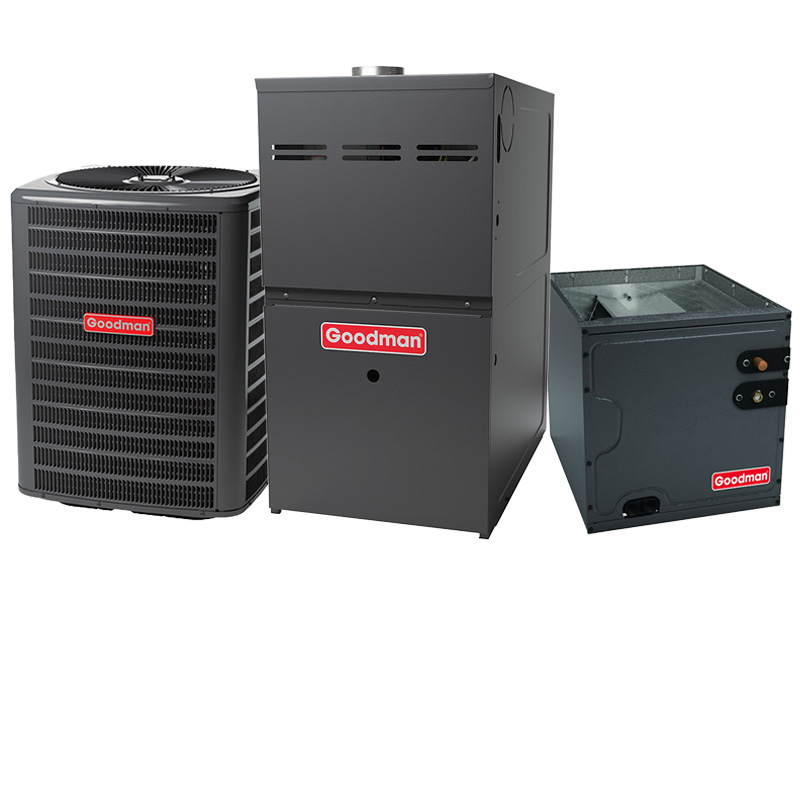
Goodman R32 5 Ton 13.6 SEER2 80000 BTU 80% Multi-Speed ECM Gas Furnace and Air Conditioner System – Upflow
View on AC Direct see your lowest price →Check current price on AC Direct →
Key features
- 5-ton cooling capacity suited to larger homes, roughly 2,400 to 3,200 sq ft depending on climate and insulation
- 13.6 SEER2 efficiency rating meets current federal minimums without a premium-tier price
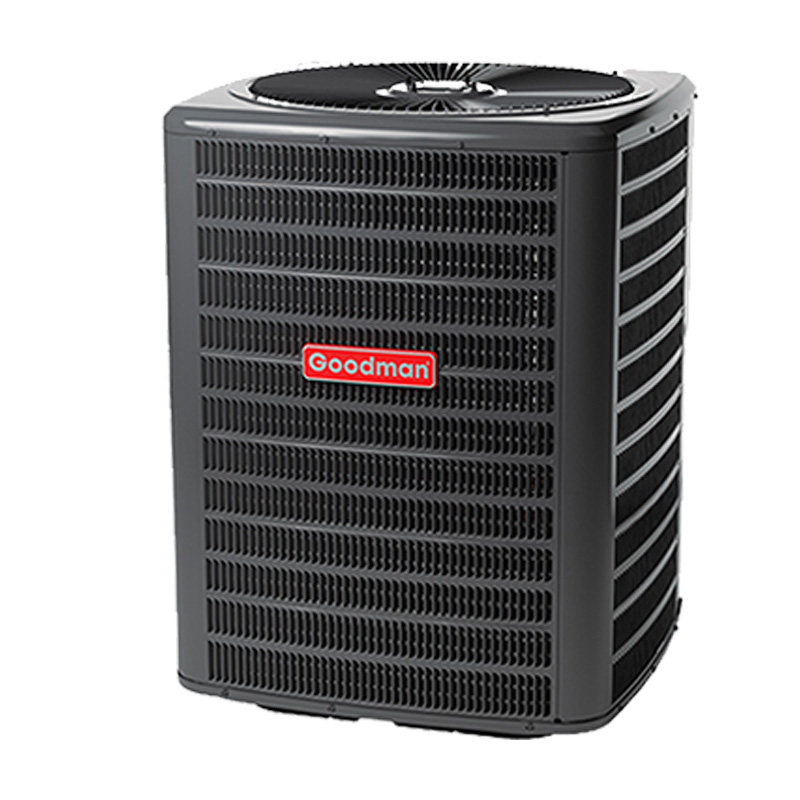
- R-32 refrigerant offers lower global-warming potential than R-410A and is recognized under current EPA regulations
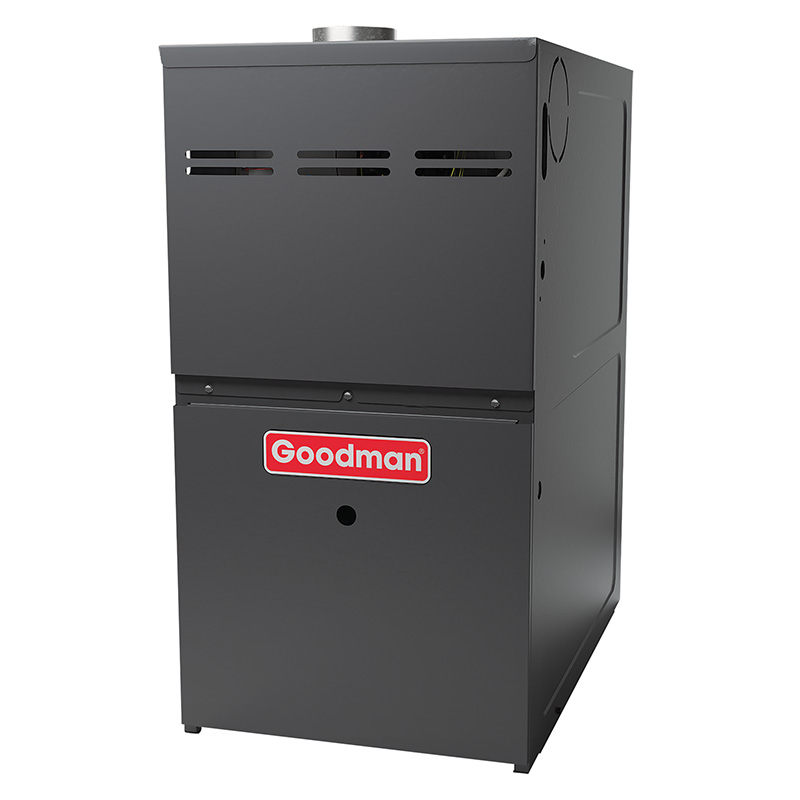
- 80,000 BTU, 80% AFUE gas furnace provides straightforward single-stage heat output in an upflow cabinet
- Multi-speed ECM blower motor improves humidity control, temperature consistency, and blower energy use versus single-speed motors
- Matched system sold as a bundle, simplifying AHRI-certified efficiency verification and warranty documentation
About this system
This Goodman package pairs a 5-ton, 13.6 SEER2 R-32 air conditioner with an 80,000 BTU, 80% AFUE multi-speed ECM gas furnace in an upflow configuration, making it a practical choice for larger homes in the 2,400 to 3,200 square foot range that need serious cooling capacity alongside reliable heating. The R-32 refrigerant is a lower global-warming-potential alternative to the older R-410A, and its higher energy density means the system can use a smaller refrigerant charge while still meeting modern EPA requirements. At 13.6 SEER2, this unit clears the federal minimum efficiency threshold for most U.S. climate zones without reaching premium-tier efficiency levels, which keeps the purchase price lower but means annual operating costs will run slightly higher than a 16 or 17 SEER2 system over a 15-year span.
The multi-speed ECM blower motor is a genuine step above a basic single-speed PSC motor. It ramps airflow up and down in response to demand, which improves dehumidification, reduces temperature swings between cycles, and cuts blower electricity consumption meaningfully compared to fixed-speed alternatives. The upflow configuration directs conditioned air upward into ductwork above the unit, suiting the majority of basement or ground-level mechanical room installations. This system suits homeowners who want a complete matched system at a lower entry price and who are comfortable with the understanding that long-term cost depends heavily on install quality and a proactive maintenance routine.
This Goodman combination system delivers solid capacity and a better-than-baseline blower motor at a price point that undercuts comparable Carrier, Trane, and Lennox equipment by roughly 15 to 25 percent. Efficiency is entry-level rather than impressive, and long-term satisfaction will hinge on installation quality and consistent maintenance more than it would with a premium brand. Buyers who budget carefully for eventual capacitor replacement and keep up with annual service checks will get reasonable value from this system.
Overall score is the average of the five ratings above.
What we like
- Lower upfront cost than comparable Carrier, Trane, or Lennox matched systems at a similar efficiency tier
- Multi-speed ECM motor improves comfort and humidity control beyond what basic single-stage blowers offer
- R-32 refrigerant positions the system for current regulatory requirements without an immediate phase-out concern
- Matched system simplifies permitting, AHRI documentation, and warranty claims through a single manufacturer
- Widely serviced brand with broad parts availability across most U.S. markets, reducing service lead times
Trade-offs
- Dual-run capacitors are the most commonly reported failure point on Goodman condensers, typically requiring a 300 to 600 dollar repair within the first several years of operation
- Compressor lifespan tends to average 10 to 14 years versus 15 to 20 years for premium brands, a meaningful difference on a 5-ton unit where compressor replacement is expensive
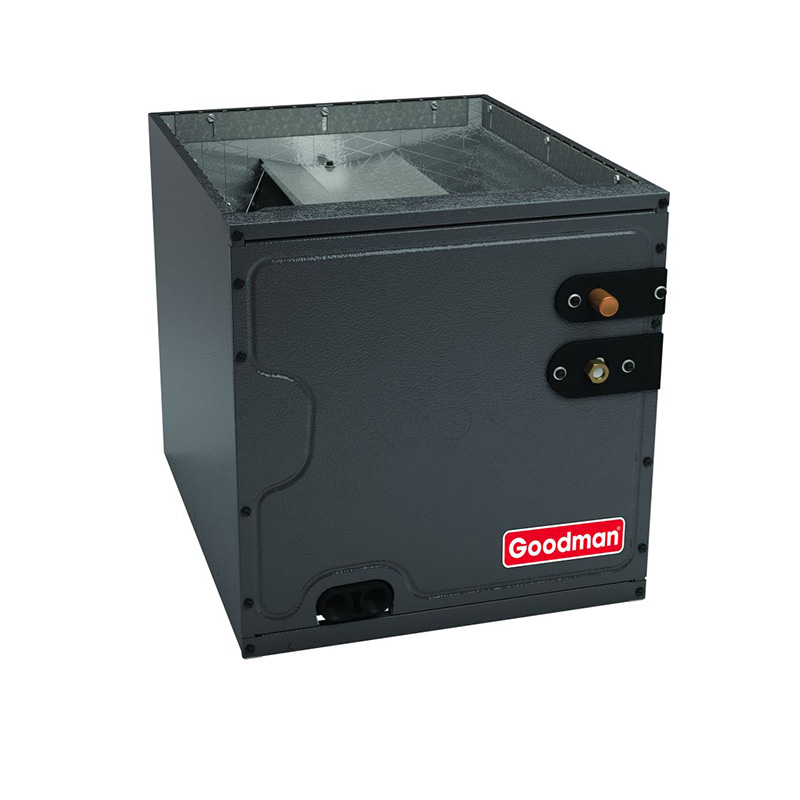
- Evaporator coil leaks appear in a notable share of owner reports, and a minority of owners have experienced refrigerant loss within the first year, often traceable to install or charge issues
- 13.6 SEER2 efficiency will cost more to operate annually than a 16 or 17 SEER2 alternative, and the gap compounds over the system's lifespan in high-cooling-demand climates
What homeowners and pros say about Goodman
Homeowners who post about Goodman online tend to cluster at the extremes. On ConsumerAffairs, where the brand scores around 2.5 out of 5, the recurring story is a system that runs adequately for the first several years and then starts generating repair bills after roughly year seven, with evaporator coil leaks and compressor issues mentioned frequently. On Google dealer reviews, where the brand averages closer to 3.8 out of 5, the tone is more balanced and affordability is the single most common compliment. Neither score is a full picture on its own, but together they suggest a brand that delivers on its value proposition when everything goes right and disappoints when it does not.
HVAC technicians who work on Goodman equipment regularly point to two consistent patterns specific to this product line. First, dual-run capacitor failures on the condenser are a near-routine service call, and most experienced technicians simply budget for one within the first several years. Second, they are consistent that installation quality is the biggest variable in how long a Goodman system lasts, citing R-32 charge accuracy and proper ductwork sizing as factors that separate the units that run 12 to 14 years without major trouble from the ones that develop refrigerant or coil issues early. Compressor longevity on Goodman equipment averaging 10 to 14 years is also a recognized industry data point compared to 15 to 20 years on premium brands, which matters more on a 5-ton unit where compressor replacement represents a substantial cost relative to the original system price.
Sources: ConsumerAffairs Goodman owner reviews, AHRI Directory of Certified Product Performance, U.S. DOE appliance and equipment efficiency standards, Goodman product specification sheets.
What it costs to run
At 13.6 SEER2, cooling this 5-ton system for a typical 1200-hour cooling season at the U.S. average electricity rate of $0.17/kWh works out to roughly $900 per year in cooling, about $13 less per year than a minimum-efficiency 13.4 SEER2 unit of the same size. Your real cost depends on your climate and local rate.
Method: (60,000 BTU/hr ÷ 13.6 SEER2) × 1200 hours ÷ 1000 × $0.17/kWh. Rate source: U.S. EIA average; cooling hours: moderate-climate estimate.
How it compares
| Brand | Comparable model | SEER2 | Stage | Price position |
|---|---|---|---|---|
| Goodman | R-32 5 Ton 13.6 SEER2 80% ECM Gas Furnace and AC System | 13.6 | Single-stage | Value pick |
| Carrier | Comfort Series (24ACC6 / 58CVA) | ~14.0 | Single-stage | Typically 15 to 25 percent more than this Goodman system |
| Trane | XR14 / S8X1 80% Gas Furnace System | ~14.0 | Single-stage | Typically 15 to 25 percent more than this Goodman system |
| Lennox | Merit Series (ML14XC1 / ML180E) | ~14.0 | Single-stage | Typically 15 to 25 percent more than this Goodman system |
Competitor rows are comparable single-stage units at similar efficiency; price is relative position, not a quote.
Questions about this system
Does R-32 refrigerant require any special handling or certifications that my installer might not already have?
R-32 is mildly flammable (classified A2L), so technicians need EPA Section 608 certification and should be aware of the handling differences from R-410A. Most licensed HVAC contractors in the U.S. are already training on A2L refrigerants as the industry transitions, but it is worth confirming your installer is up to date before booking the job.
What is the warranty coverage on this Goodman system and are there any registration requirements?
Goodman typically offers a 10-year parts warranty on registered systems, which requires online registration within a set window after installation. Without registration the coverage generally drops to a shorter base period. The compressor often carries its own extended coverage term, so read the warranty documentation for this specific model carefully and register promptly.
The capacitor failure issue keeps coming up in Goodman reviews. How serious is that, and can I do anything to get ahead of it?
Dual-run capacitor failure is the most commonly reported issue on Goodman condensers and typically runs 300 to 600 dollars to fix. It is not a system-ending repair, but it can leave you without cooling on a hot day. Having your technician test capacitor health during annual maintenance visits is the most practical way to catch a weakening capacitor before it fails completely.
Is a 5-ton unit definitely the right size for my home, or could I get away with 4 tons?
Tonnage should always be confirmed with a Manual J load calculation performed by a licensed HVAC contractor based on your home's square footage, insulation levels, window area, and local climate. An oversized unit short-cycles, which hurts humidity control and accelerates wear, while an undersized unit runs constantly and cannot keep up on peak days. Do not rely on square footage rules of thumb alone for a system this size.
How much more would I spend each year running this 13.6 SEER2 system compared to a 16 SEER2 alternative?
The exact difference depends on your local electricity rate, how many cooling hours your climate produces, and your thermostat settings, but a rough estimate for a 5-ton unit in a moderate to warm climate could be 150 to 300 dollars per year more in cooling costs compared to a 16 SEER2 system. Over 12 to 15 years that gap can offset a significant portion of the upfront savings, which is why efficiency tier matters more the longer and hotter your cooling season is.
Specifications
| Cooling capacity | 5 Ton |
| Efficiency | 13.6 SEER2 |
| Furnace output | 80000 BTU |
| Configuration | Upflow |
| Refrigerant | R-32 |