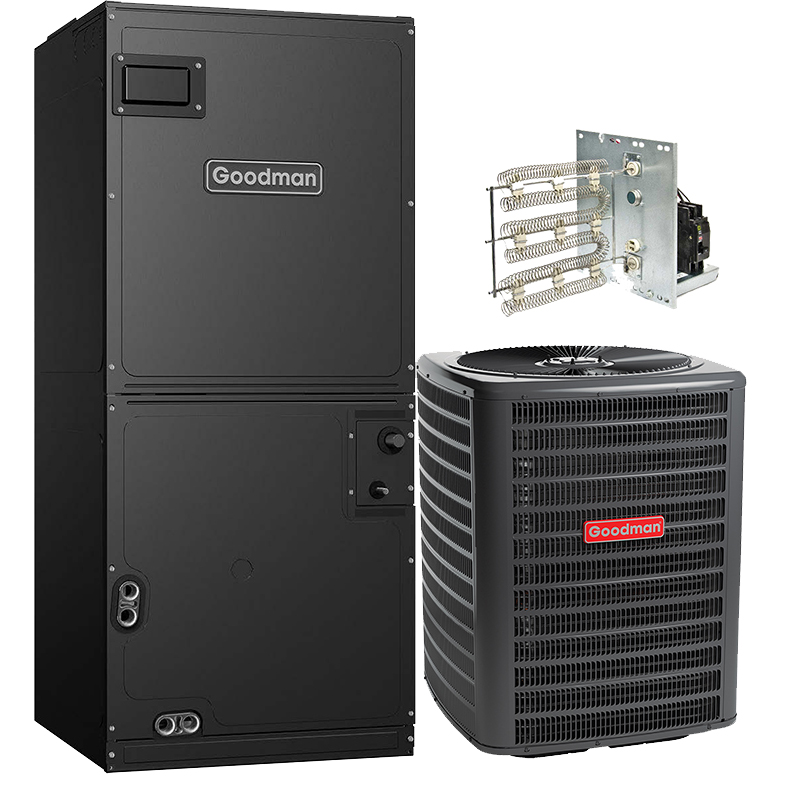
Goodman 3.5 Ton 15.2 SEER2 Split System with Electric Heat w/3.5 Ton A/H
View on AC Direct see your lowest price →Check current price on AC Direct →
Key features
- 3.5-ton cooling capacity suited for approximately 1,600 to 2,200 sq ft (load calculation required)
- 15.2 SEER2 efficiency rating meets 2023 federal minimums with moderate energy savings
- Single-stage compressor operation for straightforward maintenance and repair
- Matched air handler with electric heat strips included as a complete split system
- Compatible with Goodman's 10-year parts warranty when registered within 60 days of install
- R-410A refrigerant system (confirm refrigerant type with distributor at time of purchase)
About this system
The Goodman GSXH501810 pairs a 3.5-ton, 15.2 SEER2 condensing unit with a matching 3.5-ton air handler to form a complete split system with electric heat. At 3.5 tons, this configuration is sized for homes roughly in the 1,600 to 2,200 square foot range, though a proper Manual J load calculation should always guide final sizing decisions. The 15.2 SEER2 rating clears the federal minimum efficiency thresholds that took effect in 2023 and sits in the entry-to-mid efficiency tier, meaning you will see real savings over an aging R-22 or early 2000s system, but the unit will not match the operating cost reductions possible with a 17 or 18 SEER2 system if you run cooling heavily for six or more months per year.
This system is a single-stage design, meaning the compressor runs at full capacity whenever it is on. That is simple, proven, and easier to service than two-stage or variable-speed equipment, but it does mean the system cycles on and off more frequently during mild weather rather than running at a reduced output to manage humidity and maintain even temperatures. The electric heat component handles heating through resistance strips in the air handler, which is straightforward to install and maintain but carries higher operating costs than a heat pump or gas furnace in most climates. This setup suits mild-winter regions or buyers who want a dedicated cooling system with a low-cost backup heat source rather than a primary heating solution.
The Goodman GSXH501810 is a workable, budget-conscious cooling and electric heat solution for homeowners who prioritize upfront cost savings and can accept a somewhat shorter expected compressor lifespan and higher long-term service odds than premium-brand alternatives. It delivers on its core promise of affordable, code-compliant cooling when properly installed, but that last qualifier carries real weight with this brand. Buyers who treat installer selection as seriously as equipment selection will have a meaningfully better experience.
Overall score is the average of the five ratings above.
What we like
- Purchase price typically runs 15 to 25 percent below comparable Carrier, Trane, and Lennox systems
- 15.2 SEER2 delivers genuine efficiency improvement over systems made before 2006
- Single-stage design keeps service calls relatively simple and parts widely available
- Complete matched system reduces compatibility uncertainty between indoor and outdoor units
- 10-year parts warranty (registered) provides reasonable parts cost protection during the most likely repair window
Trade-offs
- Dual-run capacitors are the most commonly reported failure point, typically around years 5 to 9, adding $300 to $600 per service call
- Evaporator coil leaks appear in a meaningful share of owner reports and can be a costly mid-life repair
- Compressor life averages 10 to 14 years versus 15 to 20 years typical of premium brands, shortening the replacement cycle
- Electric heat strips carry significantly higher operating costs than a heat pump or gas furnace in most climates, making this a poor primary heating choice in cold regions
What homeowners and pros say about Goodman
Homeowners who share feedback on ConsumerAffairs give Goodman equipment roughly 2.5 out of 5, though that platform skews toward buyers who experienced problems and sought a place to vent. The recurring theme in those reviews is repair costs that begin climbing after roughly year 7, with capacitor failures and evaporator coil issues mentioned most often. Google dealer reviews, which capture a broader mix of experiences, land around 3.8 out of 5 across locations, and affordability is consistently the most praised aspect. The gap between those two scores is telling: buyers who got a good install and kept up with maintenance report solid results, while those who did not tend to encounter the documented failure modes sooner.
HVAC professionals tend to describe Goodman as a brand that rewards a careful installation more than most. The dual-run capacitor is widely known among technicians as the first thing to watch on these units, a straightforward fix but one that will eventually arrive for most owners. Evaporator coil leaks and a compressor lifespan that averages 10 to 14 years rather than the 15 to 20 years common on premium brands are the other trade-offs pros point out honestly to customers comparing quotes. For the GSXH501810 specifically, the conversation among technicians often centers on making sure the refrigerant charge is set precisely at startup, since a small percentage of early refrigerant leak reports trace back to install-day errors rather than factory defects. The bottom line from both camps is consistent: the savings at purchase are real, the risks are manageable with good installation and realistic maintenance expectations, and the brand is not the right fit for buyers who want to set it and forget it for two decades.
Sources: ConsumerAffairs Goodman owner reviews, AHRI Directory of Certified Product Performance, U.S. DOE appliance and equipment efficiency standards, Goodman product specification sheets.
What it costs to run
At 15.2 SEER2, cooling this 3.5-ton system for a typical 1200-hour cooling season at the U.S. average electricity rate of $0.17/kWh works out to roughly $564 per year in cooling, about $75 less per year than a minimum-efficiency 13.4 SEER2 unit of the same size. Your real cost depends on your climate and local rate.
Method: (42,000 BTU/hr ÷ 15.2 SEER2) × 1200 hours ÷ 1000 × $0.17/kWh. Rate source: U.S. EIA average; cooling hours: moderate-climate estimate.
How it compares
| Brand | Comparable model | SEER2 | Stage | Price position |
|---|---|---|---|---|
| Goodman | GSXH501810 (this system) | 15.2 | Single-stage | Value pick |
| Carrier | Comfort 15 Series (24ACC6) | 15 to 15.5 | Single-stage | Typically 15 to 25 percent more than this Goodman |
| Trane | XR15 Series | 15 to 15.6 | Single-stage | Typically 15 to 25 percent more than this Goodman |
| Lennox | Merit 14ACX / ML14XC1 Series | 15 to 15.5 | Single-stage | Typically 15 to 25 percent more than this Goodman |
Competitor rows are comparable single-stage units at similar efficiency; price is relative position, not a quote.
Questions about this system
Does this system work as a primary heat source, or is the electric heat only for backup?
The electric resistance strips in the air handler can technically serve as a primary heat source, but operating costs are substantially higher than a heat pump or gas furnace in most climates. In mild-winter regions where heating is infrequent, this may be acceptable. In areas with extended cold seasons, plan for significantly higher utility bills if relying on the electric heat regularly.
What is the actual warranty coverage and what do I need to do to get it?
Goodman offers a 10-year parts limited warranty and a lifetime compressor warranty on this unit, but only if you register the equipment online within 60 days of the installation date. Without registration, coverage drops to 5 years on parts. Labor is never covered by the manufacturer, so factor in service call costs when budgeting for ownership.
How important is installer quality with a Goodman system specifically?
Very important. HVAC technicians consistently cite install quality as the single biggest factor in how long a Goodman system lasts. A minority of owners report refrigerant leaks within the first year, and these are usually traced back to installation or initial charge errors rather than equipment defects. Selecting an experienced, licensed contractor matters more here than with some premium brands that have tighter factory tolerances.
What are the most likely repair costs I should budget for over the life of this system?
Dual-run capacitor failure is the most commonly reported issue and typically costs $300 to $600 to repair. Evaporator coil leaks appear in a meaningful share of owner reviews and can run considerably more. Budgeting a small annual reserve for these possibilities is a realistic ownership strategy, particularly after year 7 when the ConsumerAffairs complaint pattern shows repair costs climbing.
Is 3.5 tons the right size for my home, and can I just go by square footage?
Square footage is a rough starting point only. The correct sizing depends on your local climate, insulation levels, window area, ceiling height, and home orientation. A proper Manual J load calculation performed by your installing contractor is the only reliable way to confirm 3.5 tons is appropriate. Oversizing causes short-cycling and poor humidity control; undersizing leaves the system running constantly and struggling on hot days.
Specifications
| Cooling capacity | 3.5 Ton |
| Efficiency | 15.2 SEER2 |
| Model | GSXH501810 |