Goodman R32 80000 BTU 80% Multi-Speed ECM Gas Furnace Low Nox Downflow (GD9S800804BX)
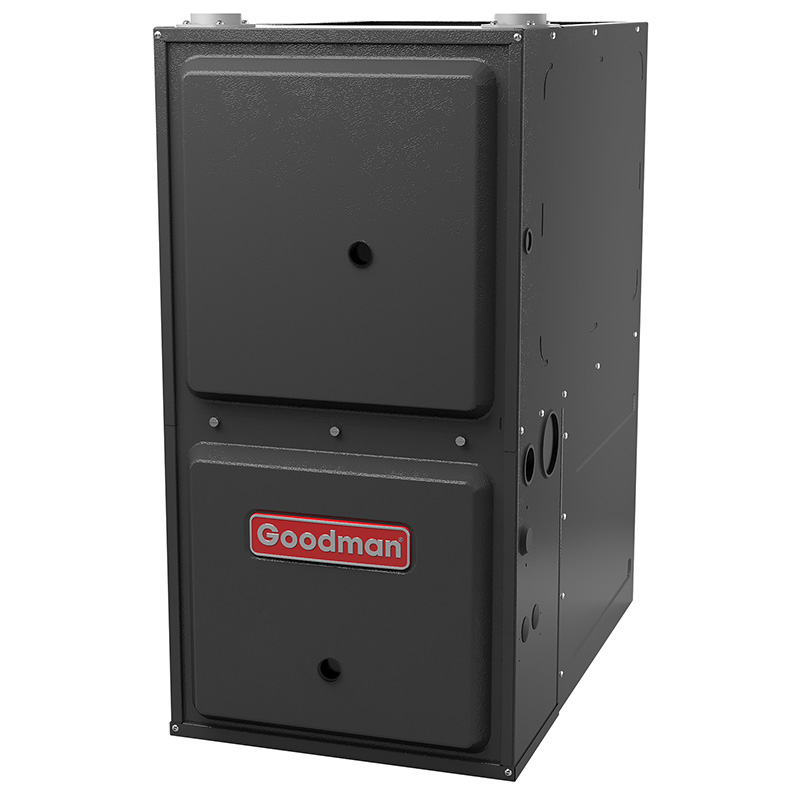
View on AC Direct see your lowest price →Check current price on AC Direct →
Key features
- 80,000 BTU output with 80% AFUE non-condensing efficiency
- Downflow configuration for slab-on-grade and platform-mounted installs
- Multi-speed ECM blower motor reduces electrical consumption vs. PSC motors
- Low NOx combustion meets SCAQMD and similar regional emission standards
- Designed to pair with R-32 refrigerant air conditioning equipment
- Four-ton nominal airflow capacity suits mid-to-large residential applications
About this system
The Goodman GD9S800804BX is an 80,000 BTU, 80% AFUE downflow gas furnace built around a multi-speed ECM (electronically commutated motor) blower and designed for homes where the air handler sits above the living space and pushes conditioned air downward through floor registers. The downflow configuration is common in slab-on-grade homes, manufactured housing, and installations where the furnace lives in a closet or platform above a crawl space. The ECM blower motor draws significantly less electricity than older PSC motors and allows the unit to ramp airflow up and down, which helps with comfort consistency and humidity management in moderate weather.
The R-32 refrigerant designation on this furnace refers to the refrigerant compatibility of the system it is matched with, not the furnace itself, since a gas furnace does not use refrigerant directly. This model is designed to pair with R-32 air conditioning equipment, a refrigerant that has a lower global warming potential than R-410A and is becoming more common in new residential systems as the industry phases out older refrigerants. The Low NOx combustion design reduces nitrogen oxide emissions to meet stricter regional air quality requirements, particularly in Southern California and other areas governed by SCAQMD rules. If you are not in a Low NOx district, the unit still works fine; you are simply buying a feature you are required to have in certain markets.
At 80% AFUE, this furnace converts 80 cents of every dollar of natural gas into usable heat, with 20 cents lost through the flue. That is the federal minimum efficiency for non-condensing furnaces and is appropriate for mild-to-moderate climates or budget-focused replacements in colder climates where the higher upfront cost of a 96%+ condensing unit would take many years to recover. The four-ton airflow capacity (indicated by the ’04’ in the model number) suits homes in the 1,800 to 2,800 square foot range depending on insulation, climate zone, and load calculation.
The GD9S800804BX is a solid budget-tier downflow furnace for homeowners who need Low NOx compliance, R-32 system compatibility, or a cost-effective replacement and are willing to prioritize installation quality to get the best life out of it. At 80% AFUE it is not the most efficient furnace on the market, but it fits markets where a condensing unit is impractical or where the economics of upgrading efficiency do not pencil out. Goodman's real-world track record is decent for the price, provided you hire a thorough installer and keep up with maintenance.
Overall score is the average of the five ratings above.
What we like
- Priced 15 to 25 percent below comparable Trane, Lennox, and Carrier furnaces, lowering the upfront cost of a full system replacement
- ECM blower motor provides meaningful energy savings on fan operation compared to standard PSC motors
- Low NOx rating satisfies strict regional air quality requirements without needing a separate upgrade
- Downflow design covers a specific installation configuration that not every furnace line offers in this BTU range
- Goodman's parts are widely stocked and most independent HVAC technicians are familiar with servicing them, which can reduce repair wait times
Trade-offs
- 80% AFUE is the federal minimum efficiency floor; homeowners in cold climates will pay noticeably higher gas bills compared to 96%+ condensing alternatives
- Goodman's ConsumerAffairs rating sits around 2.5 out of 5, with recurring complaints about repair costs climbing after year seven
- Brand-wide documented failure modes include dual-run capacitors (on paired AC equipment) and evaporator coil leaks, which add to long-term ownership costs
- Compressor lifespan on paired Goodman AC equipment averages 10 to 14 years versus 15 to 20 years for premium brands, a relevant consideration when buying a matched system
What homeowners and pros say about Goodman
Homeowners who leave reviews on Google through local Goodman dealers give the brand roughly 3.8 out of 5 stars, and the most consistent praise is straightforward: the price is lower than comparable Carrier, Trane, or Lennox equipment, and when the system is installed well it works without drama for the first several years. That aligns with what independent HVAC technicians say in trade forums, where the general consensus is that Goodman equipment is adequate and that installation quality matters more than the brand name on the cabinet. A rushed or sloppy install on a premium brand will underperform a careful install on a Goodman every time.
The more cautionary signal comes from ConsumerAffairs, where Goodman sits at about 2.5 out of 5. That platform over-represents frustrated owners, but the recurring complaints are specific enough to take seriously: repair bills that climb noticeably after year seven, dual-run capacitor failures on paired cooling equipment (a relatively low-cost fix, but one that seems to happen with some regularity), and evaporator coil leaks that are considerably more disruptive and expensive to repair. Compressor longevity on Goodman cooling equipment tends to land in the 10 to 14 year range across documented owner reports, shorter than the 15 to 20 years more commonly seen with premium brands. None of this disqualifies Goodman for a budget-conscious buyer, but it does suggest that buyers should factor potential repair costs into the total cost of ownership and not assume the lower purchase price tells the whole story.
Sources: ConsumerAffairs Goodman owner reviews, AHRI Directory of Certified Product Performance, U.S. DOE appliance and equipment efficiency standards, Goodman product specification sheets.
How it compares
| Brand | Comparable model | SEER2 | Stage | Price position |
|---|---|---|---|---|
| Goodman | GD9S800804BX | N/A (furnace only) | Multi-speed | Value pick |
| Carrier | Performance 80 (58TP Series) | N/A (furnace only) | Two-stage | Priced roughly 20 to 30 percent higher than this Goodman |
| Trane | S8X1 80% AFUE | N/A (furnace only) | Single-stage | Priced roughly 20 to 30 percent higher than this Goodman |
| Lennox | Merit ML180 80% AFUE | N/A (furnace only) | Single-stage | Priced roughly 15 to 25 percent higher than this Goodman |
Competitor rows are comparable single-stage units at similar efficiency; price is relative position, not a quote.
Questions about this system
Does this furnace actually use R-32 refrigerant, or does the R-32 designation just mean it pairs with R-32 AC equipment?
The furnace itself uses no refrigerant. The R-32 designation means this unit is designed and tested to work with Goodman's R-32 air conditioning or heat pump equipment. If you are replacing only a furnace and keeping an older R-410A coil and condenser, verify compatibility with your HVAC contractor before purchasing.
Is 80% AFUE good enough, or should I spend more on a higher-efficiency model?
80% AFUE is the minimum allowed by federal standards and makes sense in mild climates like the Southwest or Southeast, or for budget replacements where the payback period on a higher-efficiency unit is very long. In climates with 4,000 or more heating degree days per year, a 96%+ AFUE condensing furnace will typically recover its cost premium within five to eight years through lower gas bills.
What does the downflow configuration mean, and how do I know if my home needs it?
Downflow means the furnace takes air in at the top and discharges heated air downward out the bottom, distributing it through floor-level ductwork. This is the correct configuration for furnaces mounted in a closet above living space, on a raised platform over a crawl space, or in certain manufactured home applications. If your existing furnace discharges air upward or horizontally, this is not the right model.
Why does Low NOx matter, and do I need it if I am not in California?
Low NOx burner designs limit nitrogen oxide emissions to satisfy air quality rules enforced by agencies like California's SCAQMD. If you are installing in a covered district, you are legally required to use a compliant unit. Outside those regions the furnace operates normally, so buying Low NOx outside a compliance area causes no harm but provides no practical benefit.
What are the most common repairs I should budget for with Goodman equipment over time?
Across Goodman's product line, dual-run capacitors on paired AC equipment are the most frequently reported failure, typically a straightforward repair in the 300 to 600 dollar range. Evaporator coil leaks show up in a meaningful share of owner reports and are more expensive to address. Goodman's own ConsumerAffairs reviews flag rising repair costs after roughly year seven, so setting aside a service reserve after the warranty period is a practical step.
Specifications
| Furnace output | 80000 BTU |
| Configuration | Downflow |
| Refrigerant | R-32 |
| Model | GD9S800804BX |