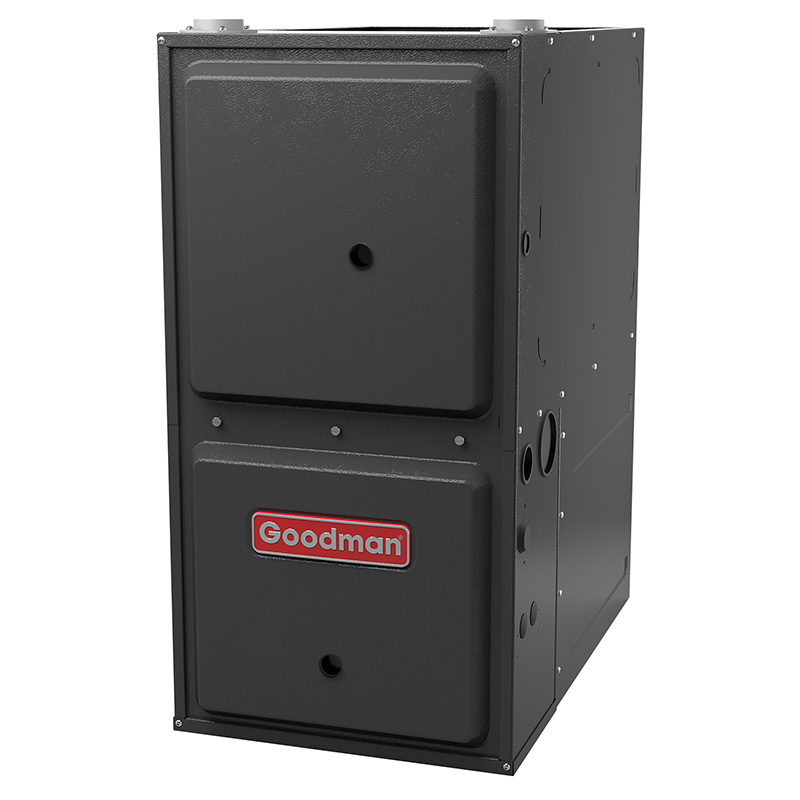
Goodman R32 80000 BTU 80% Two Stage 9-Speed ECM Gas Furnace Low Nox Downflow (GD9T800805CX)
View on AC Direct see your lowest price →Check current price on AC Direct →
Key features
- 80,000 BTU output in a downflow cabinet configuration
- Two-stage burner reduces temperature swings and short-cycling
- 9-speed ECM blower motor for quieter, more even airflow
- 80% AFUE meets federal minimums for most U.S. climate zones
- Low NOx burner design for lower nitrogen oxide emissions
- Compatible with standard split-system cooling coils and thermostats
About this system
The Goodman GD9T800805CX is an 80,000 BTU, 80% AFUE two-stage gas furnace built specifically for downflow installations, meaning warm air exits the bottom of the unit and travels down into the duct system below. That configuration suits homes where the furnace sits in an attic, closet, or above a crawlspace with ductwork running beneath it. The two-stage burner runs at a lower heat output most of the time and fires at full capacity only when temperatures drop sharply, which reduces temperature swings and cuts short-cycling compared with a single-stage unit. The 9-speed ECM blower motor adjusts airflow in small increments to match heating demand, improving comfort distribution and running more quietly than a fixed-speed motor.
At 80% AFUE, this furnace meets federal minimum efficiency standards for most northern climate zones but does not qualify for federal tax credits, which currently require at least 97% AFUE for gas furnaces. Homeowners replacing an older 60% or 70% furnace will still see a meaningful reduction in gas consumption, but buyers who want maximum long-term fuel savings should weigh the cost difference against a 95% or higher condensing unit. The R-32 refrigerant designation in the model specs appears to reflect platform labeling rather than a refrigerant used in the furnace itself, since gas furnaces do not use refrigerant. This is a heating-only appliance. It pairs with a separate cooling coil and condensing unit in a split system.
Goodman positions this furnace as a value option in the two-stage ECM category, and it fits that role well for budget-conscious buyers who are upgrading from basic equipment, have an experienced installer lined up, and do not need high-efficiency condensing performance. It is not the right choice for owners who want top-tier fuel economy or who are in a market where install quality is hard to verify.
The GD9T800805CX delivers genuine two-stage ECM comfort features at a price point well below Carrier, Trane, and Lennox equivalents, making it a reasonable choice when install quality is high and upfront cost is the primary constraint. Its 80% AFUE limits long-term fuel savings compared with condensing alternatives, and Goodman's real-world reliability record shows more mid-life repair costs than premium brands. Buyers who vet their installer carefully and budget for a capacitor replacement or two over the unit's life will likely get fair value here.
Overall score is the average of the five ratings above.
What we like
- Two-stage burner and 9-speed ECM blower improve comfort over single-stage fixed-speed units
- Typically priced 15 to 25 percent below comparable Carrier, Trane, and Lennox models
- Downflow cabinet fills a specific installation need that not all furnace lines address
- Low NOx burner meets stricter regional emissions requirements
- ECM motor reduces blower electricity consumption versus PSC motors
Trade-offs
- 80% AFUE does not qualify for current federal tax credits and leaves fuel savings on the table versus condensing units
- Dual-run capacitors are the most commonly reported failure point across Goodman owner reviews, typically requiring a 300 to 600 dollar repair
- ConsumerAffairs scores average around 2.5 out of 5, with recurring complaints about repair frequency after year 7
- Compressor lifespan on paired cooling equipment averages 10 to 14 years versus 15 to 20 years for premium brands, meaning total system longevity may be shorter
What homeowners and pros say about Goodman
Homeowners who choose Goodman furnaces most often point to the price as the deciding factor, and that holds true for this two-stage ECM unit as well. Google dealer reviews across Goodman installers average around 3.8 out of 5, with affordability and reasonable first-year performance cited regularly by buyers who did their homework and worked with a skilled technician. The picture on ConsumerAffairs is less flattering, averaging around 2.5 out of 5, though that channel skews heavily toward owners who had problems. The consistent theme in negative reviews is repair costs climbing after roughly year 7, which aligns with what independent HVAC technicians say about Goodman equipment in general: it can serve its lifespan well when installed correctly, but it tends to show wear sooner than premium-brand alternatives.
Among HVAC professionals, the recurring advice about Goodman centers on two documented failure patterns. Dual-run capacitors are the most commonly reported part failure across the Goodman line, typically a 300 to 600 dollar repair and rarely catastrophic, but a near-certainty for many owners over the system’s life. Evaporator coil leaks show up in a meaningful share of owner reviews for paired cooling systems, and a minority of owners report refrigerant issues within the first year, most of which trace back to install or charge problems rather than a factory defect. Compressors on paired Goodman cooling equipment average 10 to 14 years in real-world use versus 15 to 20 for premium brands, so buyers planning for a complete system should factor that into the long-term cost picture. None of this makes the GD9T800805CX a bad furnace; it makes it a furnace that rewards careful installer selection and realistic expectations.
Sources: ConsumerAffairs Goodman owner reviews, AHRI Directory of Certified Product Performance, U.S. DOE appliance and equipment efficiency standards, Goodman product specification sheets.
How it compares
| Brand | Comparable model | SEER2 | Stage | Price position |
|---|---|---|---|---|
| Goodman | GD9T800805CX | N/A (furnace only) | Two-stage | Value pick |
| Carrier | Performance 96 (58TP6) | N/A (furnace only) | Two-stage | Moderately higher than Goodman |
| Trane | S9V2 (80% two-stage) | N/A (furnace only) | Two-stage | Moderately to significantly higher than Goodman |
| Lennox | Merit ML196V | N/A (furnace only) | Two-stage | Moderately higher than Goodman |
Competitor rows are comparable single-stage units at similar efficiency; price is relative position, not a quote.
Questions about this system
Why does a gas furnace spec sheet mention R-32 refrigerant?
Gas furnaces do not use refrigerant. The R-32 designation in this model's listing appears to be platform or product-line labeling carried over from the broader Goodman system family. This unit is a heating-only appliance and contains no refrigerant.
What does downflow mean, and how do I know if my home needs it?
Downflow means conditioned air exits through the bottom of the cabinet, so the ductwork must run beneath the unit. This configuration is common in attic installations and some closet setups where the supply plenum drops into a crawlspace or lower floor. If your existing furnace pulls air in from the bottom and blows out the bottom, or if your installer specifies it, downflow is correct. Installing a downflow furnace in an upflow application is not safe and will not work.
Will the 80% AFUE rating qualify for a federal tax credit?
No. Current federal energy efficiency tax credits for gas furnaces require a minimum of 97% AFUE. This unit at 80% AFUE does not qualify. Homeowners seeking a tax credit should look at condensing furnace models rated 97% AFUE or higher.
What repair costs should I budget for over the life of this furnace?
Based on Goodman's documented failure patterns, the dual-run capacitor is the most frequently reported failure point, typically costing 300 to 600 dollars to replace and usually a straightforward fix. After roughly year 7, ConsumerAffairs reviews show an uptick in repair frequency. Setting aside a few hundred dollars annually for potential service calls is a practical approach with any value-tier equipment.
How much does install quality actually affect how this furnace performs?
HVAC technicians consistently cite install quality as the single largest factor in how long a Goodman unit lasts and how well it runs. Proper sizing, correct static pressure, sealed ductwork connections, and accurate gas pressure setup all affect efficiency, comfort, and longevity. Spending extra to use an experienced, licensed installer typically returns more long-term value than any upgrade in equipment tier.
Specifications
| Furnace output | 80000 BTU |
| Configuration | Downflow |
| Refrigerant | R-32 |
| Model | GD9T800805CX |