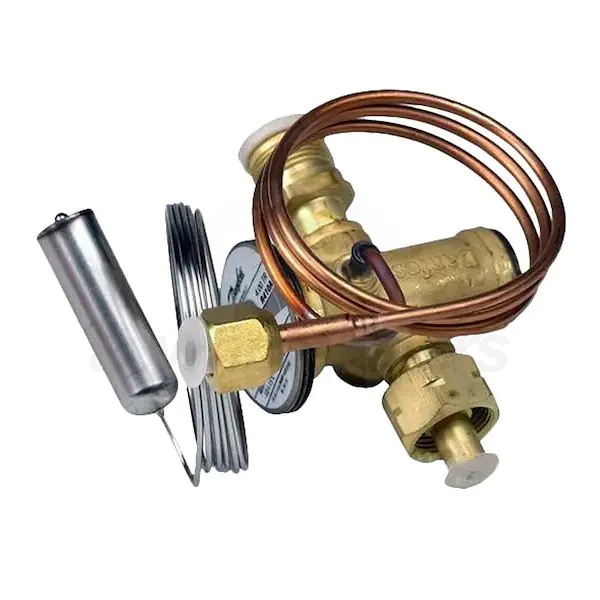
Goodman Thermal Expansion Valve for 3.5 Ton (TXV-42)
View on AC Direct see your lowest price →Check current price on AC Direct →
Key features
- Sized for 3.5-ton Goodman and Amana refrigeration circuits
- Meters refrigerant flow in response to evaporator superheat conditions
- Designed to replace failed or restricted factory metering devices
- Helps restore system capacity and reduce compressor operating stress
- Professional installation required for proper superheat adjustment
- Compatible with systems using the refrigerant type specified in the host unit documentation
About this system
The Goodman TXV-42 is a replacement thermal expansion valve sized for 3.5-ton refrigeration circuits. A TXV meters refrigerant flow into the evaporator coil in response to real-time superheat conditions, keeping the coil operating at peak efficiency across a wide range of load conditions. Swapping a failed or stuck metering device for a properly matched TXV can restore system capacity, lower head pressure, and reduce compressor strain, making this component repair a cost-effective alternative to a full system replacement when the rest of the equipment is in good shape.
This valve is designed for compatibility with Goodman and Amana systems built around 3.5-ton coil assemblies. Because TXV sizing is tied closely to coil design, refrigerant type, and operating pressure range, correct application matters significantly. A mismatched or improperly installed valve can cause hunting, short-cycling, or chronic low superheat, problems that are sometimes mistaken for refrigerant charge issues. Technicians servicing an older Goodman system will want to verify the refrigerant circuit specifications before ordering, and homeowners should treat this as a professional-installation part rather than a DIY repair.
The TXV-42 is a straightforward OEM-matched replacement part that does its job well when installed correctly by a qualified technician. It is a sensible repair choice for a 3.5-ton Goodman system that is otherwise in good working order, but the value of the repair depends entirely on the remaining service life of the surrounding equipment. Goodman's broader track record, including compressor lifespans averaging 10 to 14 years and a documented history of evaporator coil leaks, is worth weighing before committing to a component repair on an older unit.
Overall score is the average of the five ratings above.
What we like
- Cost-effective way to restore capacity without full system replacement
- OEM sizing reduces compatibility guesswork for Goodman and Amana coils
- Correct TXV match can reduce compressor operating stress and extend its remaining life
- Restores precise refrigerant metering lost when a fixed orifice or failed valve is in place
- Lower upfront cost than competitor brand equivalent replacement parts
Trade-offs
- Proper superheat adjustment after installation requires a licensed technician with gauges
- Value of the repair diminishes quickly if the host compressor is already past year 10
- Goodman systems have a documented rate of evaporator coil leaks that a TXV swap will not address
- Incorrect refrigerant type or coil pairing can cause hunting and short-cycling, negating the repair
What homeowners and pros say about Goodman
Goodman sits at roughly 2.5 out of 5 on ConsumerAffairs, a channel that skews toward frustrated owners, where the most consistent complaints center on repair costs climbing after year 7. Google dealer reviews land higher, around 3.8 out of 5 across hundreds of location-level ratings, and affordability is by far the most common reason owners say they chose the brand. For a replacement component like the TXV-42, that price advantage is a real factor: Goodman parts tend to cost meaningfully less than equivalent Carrier, Trane, or Lennox components, which matters when a homeowner is already spending on a service call.
That said, the documented failure landscape for Goodman systems adds important context to any component repair decision. Dual-run capacitors are the brand’s most commonly reported failure, a relatively inexpensive fix. More concerning are the evaporator coil leak reports that appear in a meaningful share of owner reviews, and a compressor lifespan that averages 10 to 14 years compared to 15 to 20 for premium brands. Technicians consistently note that install quality is the single largest factor in how long a Goodman system runs, which means a TXV replacement done carelessly or without proper superheat calibration can create new problems. The repair makes the most sense when a qualified technician has confirmed the diagnosis, inspected the surrounding equipment, and signed off on the remaining service life of the system.
Sources: ConsumerAffairs Goodman owner reviews, AHRI Directory of Certified Product Performance, U.S. DOE appliance and equipment efficiency standards, Goodman product specification sheets.
How it compares
| Brand | Comparable model | SEER2 | Stage | Price position |
|---|---|---|---|---|
| Goodman | TXV-42 | N/A | Replacement component | Value pick |
| Carrier | EXV / TXV series (3.5-ton compatible) | N/A | Replacement component | Typically 20 to 35 percent more than Goodman equivalent |
| Trane | TXV replacement series (3.5-ton compatible) | N/A | Replacement component | Typically 25 to 40 percent more than Goodman equivalent |
| Lennox | TXV / EEV replacement series (3.5-ton compatible) | N/A | Replacement component | Typically 25 to 40 percent more than Goodman equivalent |
Competitor rows are comparable single-stage units at similar efficiency; price is relative position, not a quote.
Questions about this system
How do I know if my 3.5-ton Goodman system actually needs a TXV replacement versus a refrigerant charge or coil cleaning?
A technician will measure superheat and subcooling values with manifold gauges to distinguish a metering device failure from a charge issue or dirty coil. A stuck-open TXV typically shows very low superheat and a flooded evaporator, while a stuck-closed valve shows high superheat and low suction pressure. Diagnosis should always come before parts ordering.
Can I install the TXV-42 myself to save on labor costs?
No. Replacing a TXV involves recovering and recharging refrigerant, which requires an EPA 608 certification. Improper installation or incorrect superheat adjustment after the swap can cause compressor damage, which is a far more expensive problem than the original repair.
My Goodman system is about 9 years old. Is it worth replacing just the TXV, or should I replace the whole system?
At year 9 you are approaching the range where Goodman compressors begin to see higher failure rates, typically averaging 10 to 14 years versus 15 to 20 for premium brands. If your technician confirms the compressor and coil are in good condition and there is no history of refrigerant leaks, a TXV repair can buy meaningful additional service life at low cost. If there are other concerns, get a full system quote for comparison.
What refrigerant type does the TXV-42 support, and does it matter?
TXV valves are calibrated for specific refrigerants, typically R-410A for systems manufactured in the 2010s and early 2020s. Using a valve calibrated for the wrong refrigerant will result in improper flow control and potential system damage. Always cross-reference the model number on your host unit's data plate with the valve specifications before purchasing.
Does replacing the TXV come with any warranty coverage?
Replacement parts like the TXV-42 typically carry a limited parts warranty, but coverage terms and duration should be confirmed at the point of purchase. Note that Goodman's broader warranty on installed systems has historically required registration within a specific window and professional installation to remain valid, so keep documentation of the repair.
Specifications
| Cooling capacity | 3.5 Ton |