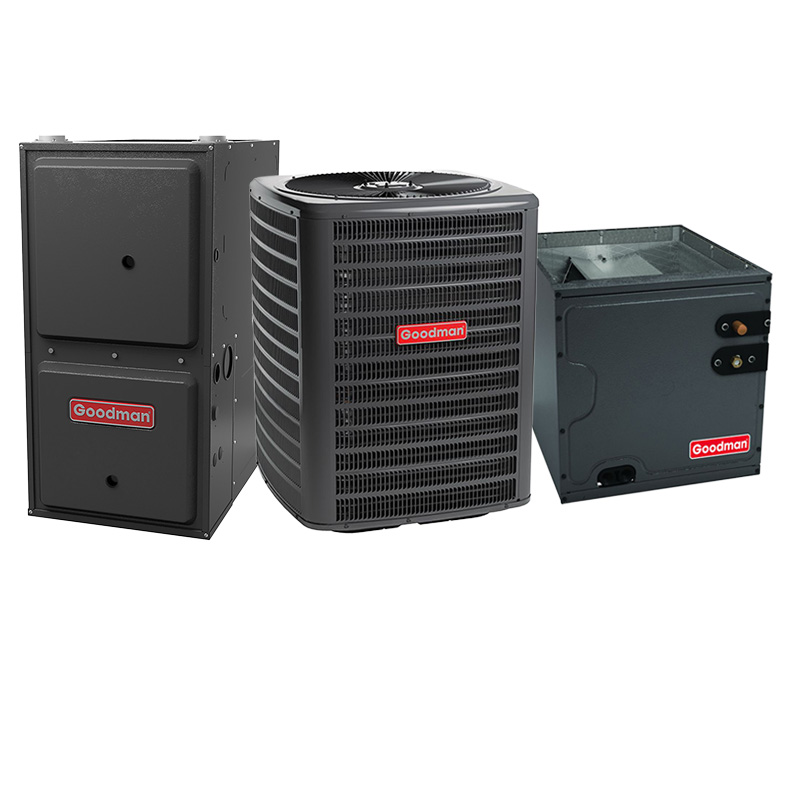
Goodman 2 Ton 14.5 SEER2 R32 AC System with 40,000 BTU 80% AFUE Gas Furnace – California & Colorado Ultra Low NOx, Upflow, Multi-Speed ECM
View on AC Direct see your lowest price →Check current price on AC Direct →
Key features
- 14.5 SEER2 cooling efficiency meets federal and Southwest regional minimums
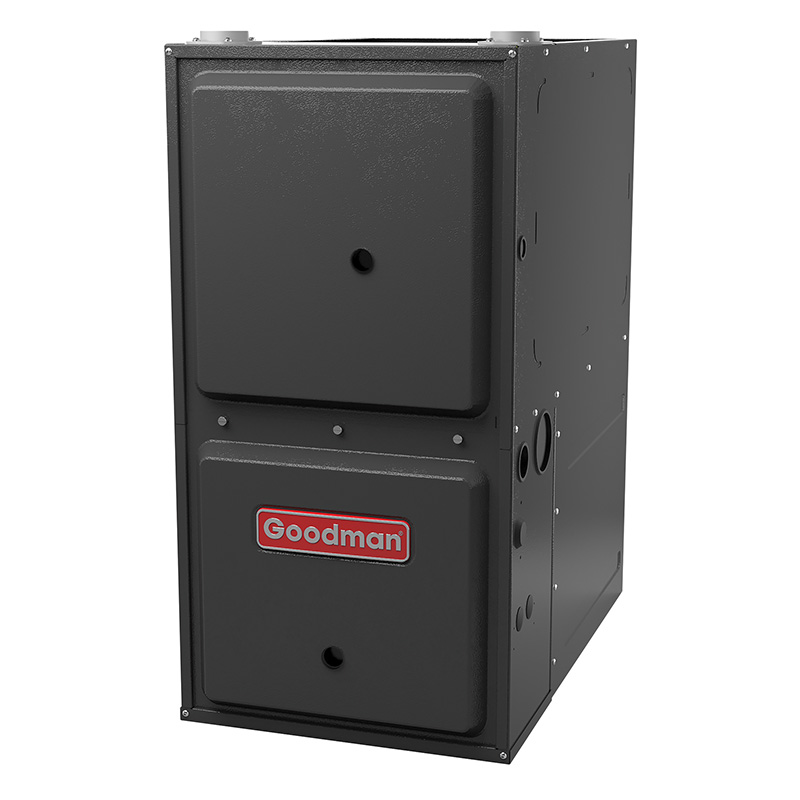
- 40,000 BTU 80% AFUE upflow gas furnace for single-story or basement-to-main-floor installations
- R-32 refrigerant with lower global warming potential than legacy R-410A
- Multi-speed ECM blower motor for quieter operation and reduced fan electricity use
- California and Colorado Ultra Low NOx certified for legal install in those states
- Goodman value pricing, typically 15 to 25 percent below Trane, Lennox, and Carrier equivalents
About this system
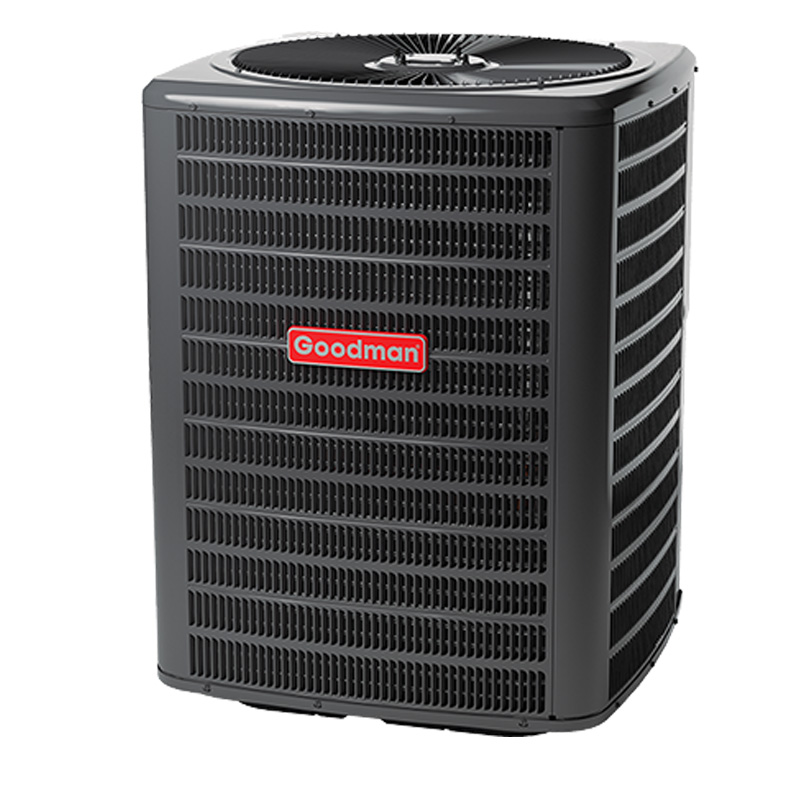
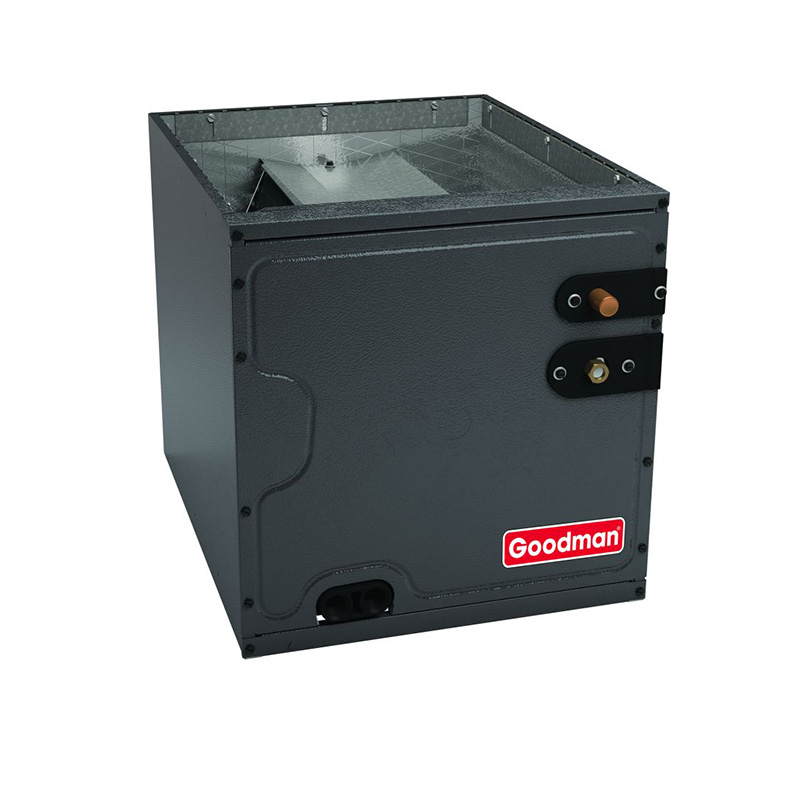
The Goodman 2-ton 14.5 SEER2 system pairs a straightforward single-stage central air conditioner with a 40,000 BTU 80% AFUE upflow gas furnace, making it a practical match for smaller homes or well-insulated spaces in the 800-to-1,100-square-foot range, depending on climate and load. The R-32 refrigerant is a lower-global-warming-potential option that is increasingly standard in new equipment, and the multi-speed ECM blower motor improves airflow consistency and reduces electricity draw compared to a basic single-speed PSC motor. The California and Colorado Ultra Low NOx certification means this system meets the strictest regional nitrogen-oxide emission limits, so it is a legal installation in those states without requiring any additional hardware or variance.
The 80% AFUE furnace converts eight of every ten units of gas into heat, which is the entry-level efficiency tier. In mild climates or homes where gas rates are low, that is an acceptable trade-off for lower upfront cost. In cold-winter regions or areas with high utility rates, a 96% AFUE unit would recover the price difference in operating savings within a few years. The 14.5 SEER2 rating clears the federal minimum for most U.S. climate zones and will satisfy California and Southwest region requirements, though it sits at the lower end of what the market offers. This system suits a budget-conscious buyer who wants code-compliant equipment, accepts periodic maintenance costs, and is working with a skilled installer.
This Goodman bundle is a serviceable, code-compliant system for cost-conscious buyers in smaller homes, delivering adequate efficiency and the ECM blower as a genuine comfort upgrade. Its long-term reliability leans heavily on installation quality and a willingness to budget for maintenance, since Goodman's documented failure modes and shorter average compressor lifespan are real considerations. Buyers who can afford premium brands and prioritize fewer service calls over the life of the equipment should weigh that trade-off carefully.
Overall score is the average of the five ratings above.
What we like
- Price point 15 to 25 percent below comparable Carrier, Trane, and Lennox systems
- Ultra Low NOx certification allows legal installation in California and Colorado without modifications
- Multi-speed ECM blower improves comfort and lowers fan operating costs versus a standard PSC motor
- R-32 refrigerant is the forward-looking standard and widely serviceable by certified technicians
- Upflow configuration fits the most common furnace placement in homes with basements or closet installs
Trade-offs
- 80% AFUE is the lowest efficiency tier; operating costs will be meaningfully higher than a 96% AFUE furnace in cold climates
- Dual-run capacitors are the most frequently reported failure point, typically adding a 300-to-600-dollar service call within the first decade
- Average compressor lifespan of 10 to 14 years runs shorter than the 15-to-20-year expectation from premium brands
- Evaporator coil leaks and first-year refrigerant leaks appear in a notable share of owner reports, often tied to install or charge issues
What homeowners and pros say about Goodman
Homeowners who leave reviews for Goodman equipment tend to split along clear lines. On Google dealer review pages, where the aggregate score sits around 3.8 out of 5, the most consistent praise is for the price: buyers report getting a functional, code-compliant system installed for noticeably less than contractor bids for Trane or Carrier equivalents. HVAC technicians who encounter Goodman in the field frequently echo that the brand’s reputation lives or dies on the quality of the installation, since a poorly commissioned R-32 system or an undercharged coil is where many early problems originate. The first-year refrigerant leak complaints documented in owner reviews are consistently traced back to install or charge errors rather than factory defects.
On ConsumerAffairs, where the brand scores around 2.5 out of 5 on a channel that disproportionately captures frustrated owners, the picture is less encouraging. The recurring theme in that forum is repair costs that accelerate after roughly year seven. The two failure modes that show up most in those accounts are dual-run capacitor failures, which are a relatively inexpensive fix in the 300-to-600-dollar range, and evaporator coil leaks, which are not. Compressor longevity is another realistic concern: Goodman compressors average an estimated 10 to 14 years in the field, compared to 15 to 20 years for premium-tier equipment. For this specific system, that math means a buyer who keeps their home for 15 years should budget mentally for the possibility of a compressor replacement, and should treat an annual maintenance visit as cost of ownership rather than optional.
Sources: ConsumerAffairs Goodman owner reviews, AHRI Directory of Certified Product Performance, U.S. DOE appliance and equipment efficiency standards, Goodman product specification sheets.
What it costs to run
At 14.5 SEER2, cooling this 2-ton system for a typical 1200-hour cooling season at the U.S. average electricity rate of $0.17/kWh works out to roughly $338 per year in cooling, about $27 less per year than a minimum-efficiency 13.4 SEER2 unit of the same size. Your real cost depends on your climate and local rate.
Method: (24,000 BTU/hr ÷ 14.5 SEER2) × 1200 hours ÷ 1000 × $0.17/kWh. Rate source: U.S. EIA average; cooling hours: moderate-climate estimate.
How it compares
| Brand | Comparable model | SEER2 | Stage | Price position |
|---|---|---|---|---|
| Goodman | GSX15/GMVC8 or equivalent 2-ton 14.5 SEER2 R-32 bundle | 14.5 | Single-stage | Value pick |
| Carrier | Comfort 14 Series (CA14NA / 58SB) | 14.5 | Single-stage | Typically 15 to 25 percent more than this Goodman bundle |
| Trane | XR14 Series (4TTR4 / S8B1) | 14.5 | Single-stage | Typically 15 to 25 percent more than this Goodman bundle |
| Lennox | Merit 14 Series (ML14XC1 / ML180UH) | 14.5 | Single-stage | Typically 15 to 25 percent more than this Goodman bundle |
Competitor rows are comparable single-stage units at similar efficiency; price is relative position, not a quote.
Questions about this system
Is this system actually legal to install in California and Colorado?
Yes. The Ultra Low NOx designation means the furnace meets the strictest NOx emission limits required in California Air Quality Management Districts and Colorado, so no additional components or exemptions are needed for a standard residential installation.
Why does the system use R-32 refrigerant instead of R-410A, and does that affect service costs?
R-32 has a significantly lower global warming potential than R-410A and is increasingly the industry standard for new equipment. Most certified HVAC technicians can service it, though you should confirm your local contractor is equipped with R-32 recovery and charging tools before scheduling work.
Will 2 tons and 40,000 BTU be enough for my home?
A proper Manual J load calculation is the only reliable way to answer this. As a rough reference, 2 tons typically handles 800 to 1,200 square feet in moderate climates, but insulation quality, ceiling height, window area, and local temperatures all shift that number significantly. Oversizing is as problematic as undersizing, so do not skip the calculation.
What should I expect to spend on repairs over the first ten years?
The most commonly reported failure on Goodman systems is the dual-run capacitor, a repair that generally runs 300 to 600 dollars and is a quick fix. Evaporator coil leaks are a more expensive possibility. Budgeting for one to two service calls in the first decade is realistic, and keeping an annual maintenance contract in place gives you the best chance of catching capacitor and refrigerant issues early.
How much will I save on gas compared to an 80% AFUE unit versus a higher-efficiency option?
An 80% AFUE furnace means 20 cents of every gas dollar goes up the flue as waste heat. A comparable 96% AFUE furnace wastes only 4 cents per dollar. In a cold climate with high gas rates, the annual savings from the higher-efficiency unit can add up to several hundred dollars, often closing the price gap within five to eight years.
Specifications
| Cooling capacity | 2 Ton |
| Efficiency | 14.5 SEER2 |
| Furnace output | 40,000 BTU |
| Furnace efficiency | 80% AFUE |
| Configuration | Upflow |
| Refrigerant | R-32 |