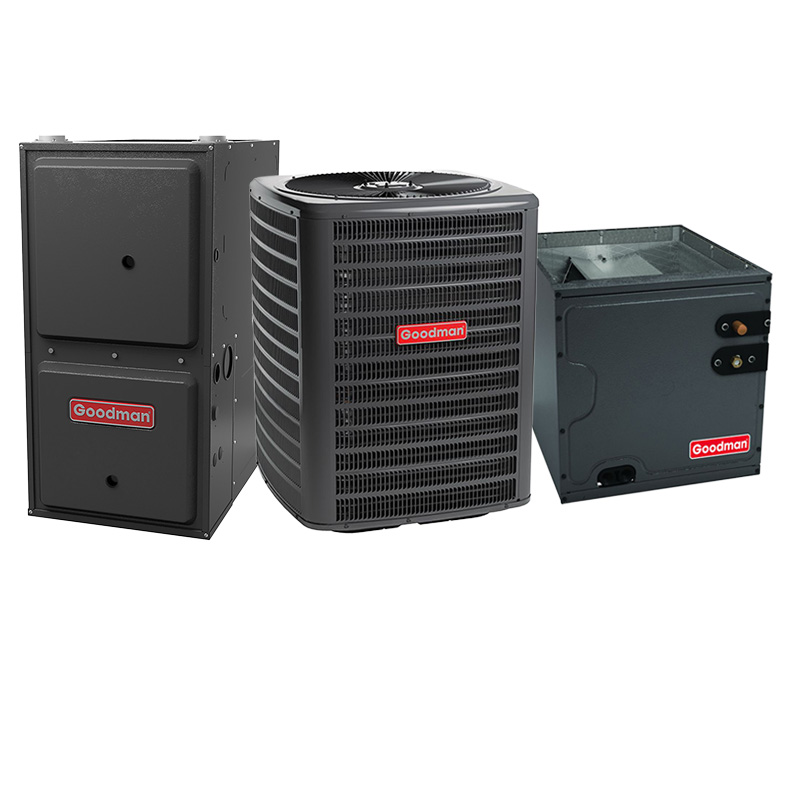
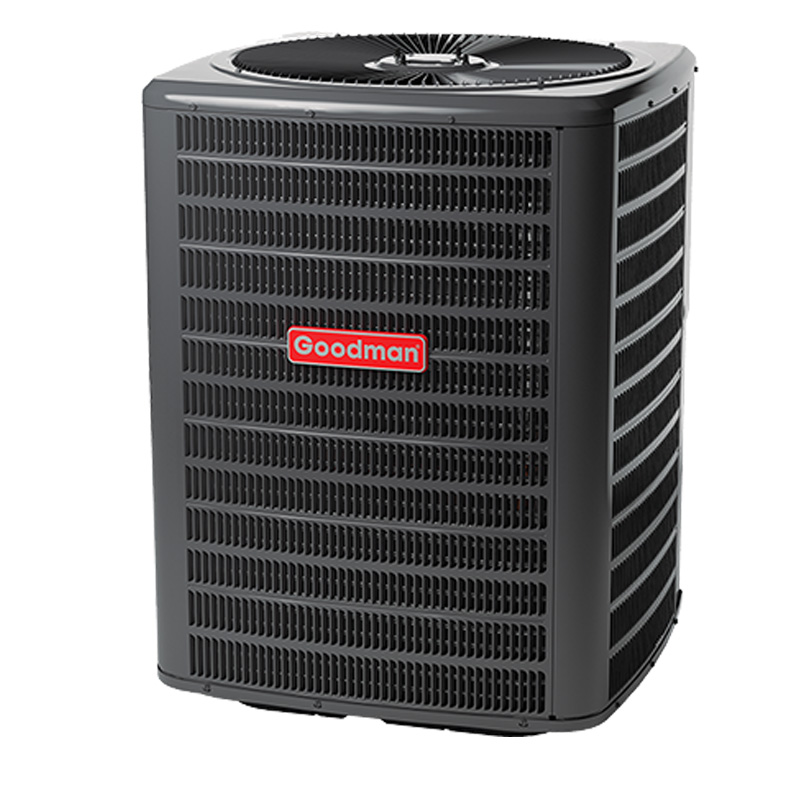
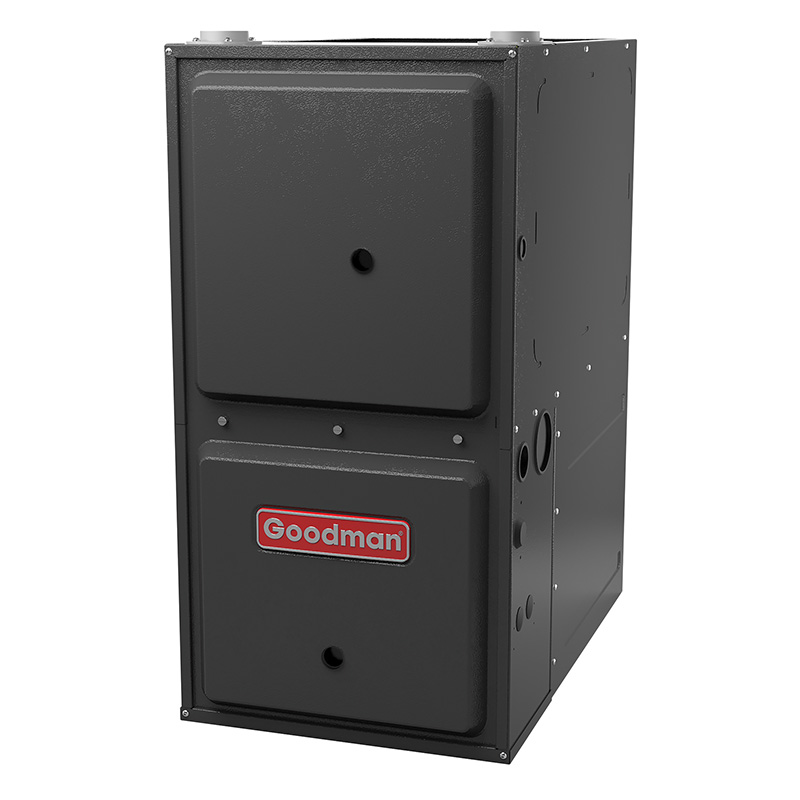
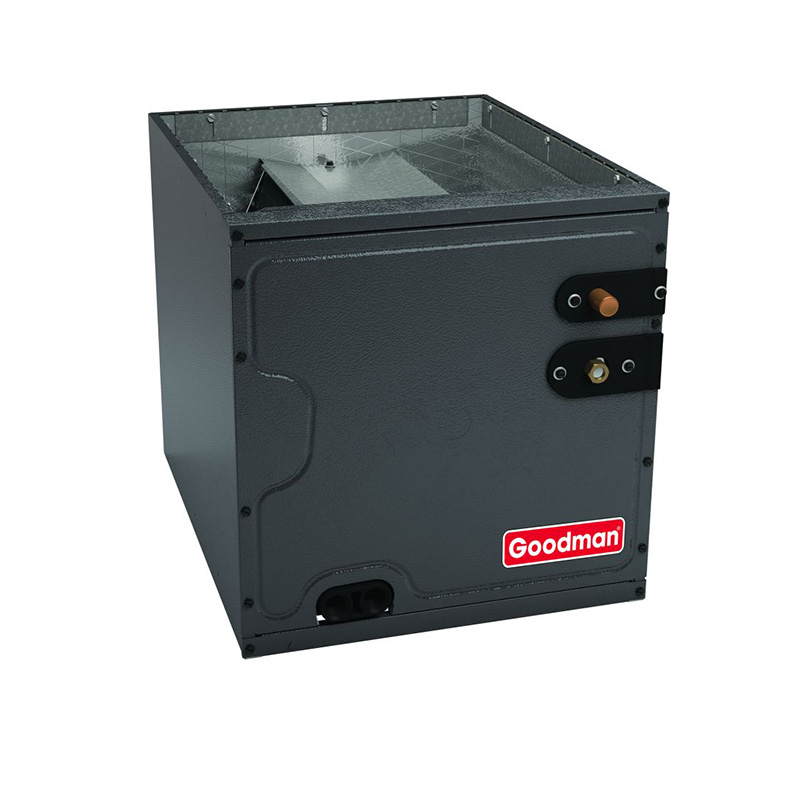
Goodman 4 Ton 14.5 SEER2 R32 AC System with 80,000 BTU 80% AFUE Gas Furnace – California & Colorado Ultra Low NOx, Upflow, Multi-Speed ECM
View on AC Direct see your lowest price →Check current price on AC Direct →
Key features
- 4-ton, 14.5 SEER2 cooling meets western U.S. federal minimum efficiency standard
- R-32 refrigerant complies with California and Colorado environmental regulations
- Ultra Low NOx-certified furnace satisfies CA and CO air quality requirements
- 80,000 BTU, 80% AFUE gas furnace suitable for moderate heating climates
- Multi-speed ECM blower motor reduces temperature swings and operating noise
- Upflow configuration fits standard basement and closet duct layouts
About this system
This Goodman bundle pairs a 4-ton, 14.5 SEER2 air conditioner with an 80,000 BTU, 80% AFUE upflow gas furnace, targeting homes in the 2,000- to 2,600-square-foot range in moderate to warm climates. The system runs on R-32 refrigerant, a lower-GWP alternative to R-410A that is increasingly required in California and Colorado under state environmental rules, making this package a compliant choice for those regulated markets. The furnace carries an Ultra Low NOx certification, satisfying the strict California and Colorado air quality standards that disqualify standard NOx-emission units.
The 14.5 SEER2 rating sits at the federal baseline for the western U.S. region, meaning it meets the minimum efficiency standard but does not exceed it. Buyers prioritizing lower utility bills over time may want to consider a higher SEER2 tier, since the gap between baseline and mid-efficiency (17-18 SEER2) can pay back in warmer climates within several years. The multi-speed ECM furnace blower is a genuine comfort upgrade over single-speed motors: it ramps airflow gradually, reduces hot and cold spots, and moves air more quietly than a direct-drive PSC motor. Upflow configuration suits the most common installation scenario, a basement or closet installation where conditioned air rises into the duct system above.
This system is best understood as an honest entry-level replacement package. It covers the compliance requirements for two of the strictest regulatory states in the country, uses a future-forward refrigerant, and includes a capable blower motor, all at a price point typically 15 to 25 percent below Trane, Lennox, and Carrier equivalents. The trade-off is that Goodman’s long-term reliability record is mixed, and the value equation depends heavily on getting a skilled installation.
This system delivers solid regulatory compliance for California and Colorado buyers and a genuine comfort upgrade via the ECM blower, all at a price that undercuts major premium brands by a meaningful margin. The 14.5 SEER2 and 80% AFUE ratings are entry-level, not standout, so long-term energy savings are limited. Goodman's mixed reliability record means installation quality and a solid warranty on parts are the two most important variables in how this system performs over its lifespan.
Overall score is the average of the five ratings above.
What we like
- R-32 refrigerant and Ultra Low NOx certification satisfy both California and Colorado regulatory requirements out of the box
- Multi-speed ECM blower motor delivers more consistent temperatures and quieter operation than standard single-speed motors
- Purchase price typically 15 to 25 percent below comparable Carrier, Trane, and Lennox systems
- Upflow design is the most universally compatible configuration for existing residential ductwork
- Factory-matched system ships as a tested combination, simplifying permitting and reducing sizing errors
Trade-offs
- 80% AFUE is the low end of available efficiency; homeowners in colder climates or with high gas rates will see noticeably higher heating bills than with a 90-plus AFUE system
- 14.5 SEER2 is the regulatory floor for this region, offering no meaningful energy savings advantage over other baseline systems
- Goodman's documented failure modes, including dual-run capacitor failures, evaporator coil leaks, and compressor lifespans averaging 10 to 14 years versus 15 to 20 for premium brands, represent real long-term cost risk
- A minority of owners have reported refrigerant leaks in year one, typically traced to installation or initial charge quality rather than the equipment itself, underscoring how heavily outcomes depend on installer skill
What homeowners and pros say about Goodman
Homeowners who research Goodman quickly run into a split picture. On ConsumerAffairs, the brand scores around 2.5 out of 5, a figure that reflects the platform’s tendency to attract frustrated owners more than satisfied ones, but the recurring pattern in those complaints is real: repair costs that start climbing after roughly year seven, with capacitor failures and evaporator coil leaks appearing most often in the negative reviews. Google dealer reviews tell a softer story, averaging around 3.8 out of 5 across hundreds of reviews per location, where affordability is the praise that comes up most consistently. That gap between the two scores is itself informative: buyers who get a clean install and budget for eventual maintenance tend to report acceptable results; those who encounter early problems often feel the savings evaporated quickly.
HVAC technicians who work on Goodman equipment regularly tend to describe it as serviceable but maintenance-prone compared to premium brands. The dual-run capacitor is the part most techs expect to replace at some point, a $300 to $600 repair that is not alarming on its own. The more consequential concern is compressor lifespan: Goodman compressors average roughly 10 to 14 years in real-world service versus 15 to 20 years for Carrier, Trane, and Lennox equipment at the same tier. For this specific R-32, Ultra Low NOx system, the regulatory compliance features add genuine value for California and Colorado buyers, but the underlying reliability profile of the brand does not change. Pros who recommend Goodman consistently pair that recommendation with one condition: find the best installer you can afford, because with this brand more than most, the quality of the equipment in year ten is largely a function of the quality of the installation in year one.
Sources: ConsumerAffairs Goodman owner reviews, AHRI Directory of Certified Product Performance, U.S. DOE appliance and equipment efficiency standards, Goodman product specification sheets.
What it costs to run
At 14.5 SEER2, cooling this 4-ton system for a typical 1200-hour cooling season at the U.S. average electricity rate of $0.17/kWh works out to roughly $675 per year in cooling, about $56 less per year than a minimum-efficiency 13.4 SEER2 unit of the same size. Your real cost depends on your climate and local rate.
Method: (48,000 BTU/hr ÷ 14.5 SEER2) × 1200 hours ÷ 1000 × $0.17/kWh. Rate source: U.S. EIA average; cooling hours: moderate-climate estimate.
How it compares
| Brand | Comparable model | SEER2 | Stage | Price position |
|---|---|---|---|---|
| Goodman | GSX-14.5 / GMVC8 Series (this system) | 14.5 | Single-stage / Multi-speed | Value pick |
| Carrier | Comfort 14 Series (24ACC4) | 14.5 | Single-stage | Typically 15 to 25 percent more than this Goodman system |
| Trane | XR14 Series | 14.5 | Single-stage | Typically 15 to 25 percent more than this Goodman system |
| Lennox | Merit 14ACX Series | 14.5 | Single-stage | Typically 15 to 25 percent more than this Goodman system |
Competitor rows are comparable single-stage units at similar efficiency; price is relative position, not a quote.
Questions about this system
Is this system actually legal to install in California and Colorado, or do I need additional components?
The system is designed to comply with both states' requirements: it uses R-32 refrigerant to meet California's low-GWP refrigerant rules and carries Ultra Low NOx certification for the furnace, which is required in California's South Coast AQMD and similar Colorado jurisdictions. You should still verify your specific county's permit requirements with your installer, as local adoption timelines can vary.
Why is the AFUE only 80%? Will that cost me significantly more to operate?
80% AFUE means 80 cents of every dollar of gas becomes usable heat. High-efficiency furnaces run 95 to 98% AFUE, and in colder climates or with high natural gas rates, the gap in annual heating bills can be several hundred dollars. If your home is in a mild-winter area or you heat primarily with the AC side, the lower upfront cost of the 80% unit may be a reasonable trade-off; in cold climates, the higher AFUE tier often pays back within a few years.
What is the warranty on this Goodman system?
Goodman typically offers a 10-year parts warranty on registered systems, which requires online registration within a set window after installation. The compressor often carries a separate limited lifetime replacement warranty on registered residential equipment. Read the registration terms carefully, because failure to register on time can reduce coverage to a shorter base period.
How big a deal are those reported capacitor and coil failures, and what should I budget for repairs?
Dual-run capacitor replacements are the most frequently cited Goodman repair and are relatively inexpensive, typically in the $300 to $600 range including labor, and a straightforward fix for any technician. Evaporator coil leaks are more expensive and disruptive, potentially running $1,000 or more depending on labor and refrigerant costs. Budgeting for a service plan or setting aside a repair fund is a practical move with any entry-level brand.
Does the multi-speed ECM blower motor really make a noticeable difference compared to a standard furnace blower?
Yes, in practice ECM motors ramp up and down gradually rather than switching on at full speed, which reduces the temperature swings and the rush of air that many people notice with single-speed systems. They also draw significantly less electricity during lower-demand operation. The main trade-off is that ECM motors cost more to replace if they fail, though failures are less frequent than in older PSC motors.
Specifications
| Cooling capacity | 4 Ton |
| Efficiency | 14.5 SEER2 |
| Furnace output | 80,000 BTU |
| Furnace efficiency | 80% AFUE |
| Configuration | Upflow |
| Refrigerant | R-32 |