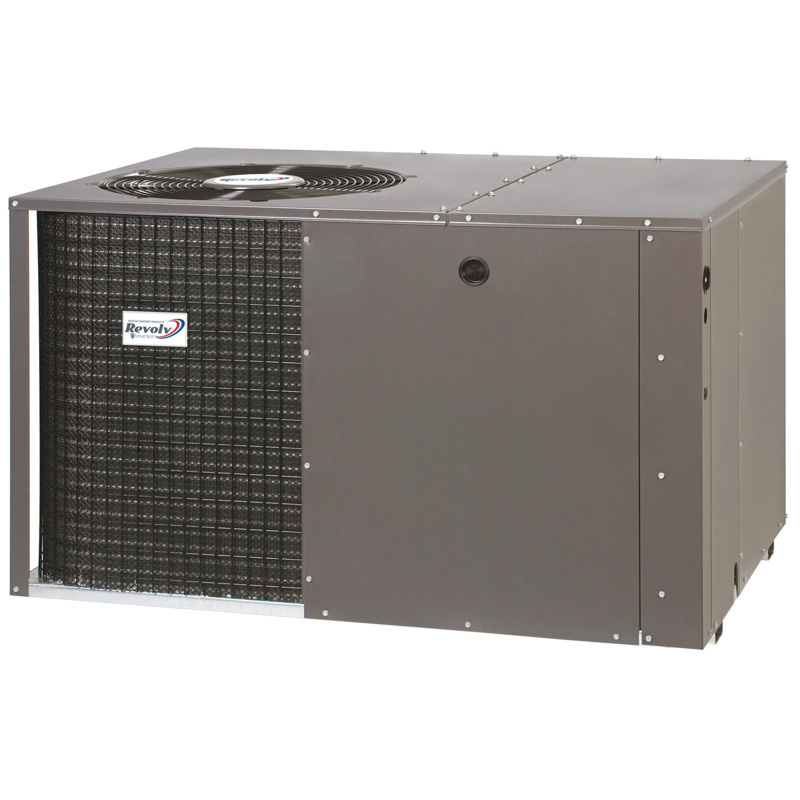
Revolv 3.5 Ton Package Unit Cooling Only AC For Mobile Homes | 13.4 SEER2 Horizontal Discharge | R454B (P95RD-042K)
View on AC Direct see your lowest price →Check current price on AC Direct →
Key features
- 3.5-ton capacity sized for manufactured homes up to roughly 2,000 sq ft
- 13.4 SEER2 efficiency rating meets current federal minimum for packaged units
- Horizontal discharge configuration designed for ground-mount installation on manufactured homes
- R-454B refrigerant complies with current EPA low-GWP requirements
- Cooling-only design pairs with existing electric heat strips or separate heating equipment
- All-in-one packaged cabinet simplifies installation compared to a split system on a mobile home
About this system
The Revolv P95RD-042K is a 3.5-ton, cooling-only packaged unit built specifically for HUD-code mobile and manufactured homes. Unlike a split system, everything sits in one cabinet mounted horizontally outside the home, which matters because most manufactured homes lack the attic or crawl space clearance needed for vertical installation. At 13.4 SEER2, it meets the current federal minimum efficiency threshold for packaged equipment, so you’re not paying a premium for efficiency you don’t need if your priority is getting reliable cooling at a manageable upfront cost.
The unit ships with R-454B refrigerant, the low-global-warming-potential replacement for R-410A that became the industry standard under updated EPA rules. That future-proofs the refrigerant side of the system for the foreseeable regulatory horizon. Revolv is a brand distributed through Menards and certain HVAC supply chains; the equipment itself is manufactured by Goodman, so real-world performance and longevity track closely with Goodman’s documented record. For a 1,600 to 2,000 square foot manufactured home in a climate with moderate cooling loads, 3.5 tons is typically the right capacity.
Because this is a cooling-only configuration, homeowners still need a separate heat source, whether electric heat strips, a gas furnace, or a heat pump. That is a deliberate trade-off: in mild-winter climates where heating demand is low, a cooling-only package unit keeps the total system cost down versus a heat pump package unit. Buyers in regions with cold winters should weigh whether a heat pump package would make more economic sense over the system’s life.
The Revolv P95RD-042K is a straightforward, budget-accessible way to replace or install cooling in a manufactured home when you already have a separate heat source and do not want to pay for heat pump capability you may rarely use. Efficiency sits at the federal minimum, so operating costs will be higher than a higher-SEER2 alternative over time, but the upfront price advantage can offset that gap in moderate climates. Long-term reliability hinges heavily on installation quality and on whether you budget for capacitor and coil maintenance after year seven.
Overall score is the average of the five ratings above.
What we like
- Purpose-built horizontal discharge design is genuinely compatible with manufactured home setups without field modifications
- R-454B refrigerant is current-generation and avoids the regulatory uncertainty that now surrounds R-410A equipment
- All-in-one packaged cabinet reduces the number of refrigerant connections a technician must make compared to a split system
- Goodman-manufactured equipment has a wide national service network and readily available replacement parts
- Cooling-only configuration keeps the purchase price lower than a comparable heat pump package unit
Trade-offs
- 13.4 SEER2 is the minimum efficiency tier, meaning monthly cooling costs will run higher than a 15+ SEER2 alternative over the system's life
- Goodman's documented compressor lifespan of 10 to 14 years runs shorter than premium-brand equipment averaging 15 to 20 years
- Dual-run capacitor failures are a common Goodman failure mode, and evaporator coil leaks appear in a meaningful share of owner reports after several years
- Cooling-only means you must already have or separately purchase a compatible heating system, adding planning complexity
What homeowners and pros say about Goodman
Homeowners and technicians discussing Goodman equipment online tend to land in two camps that mirror the brand’s actual ratings: Google dealer reviews cluster around 3.8 out of 5, with affordability and parts availability as the most repeated positives, while ConsumerAffairs scores sit closer to 2.5 out of 5, a channel that skews toward owners motivated enough by frustration to write a review. For a cooling-only packaged unit like this one, the feedback pattern that emerges is predictable: the system works as expected for the first several years with minimal drama, then repair frequency picks up after roughly year seven, which aligns with Goodman’s documented compressor lifespan of 10 to 14 years versus the 15 to 20 years owners of premium-brand equipment report.
The failure modes that appear most consistently in Goodman owner accounts are dual-run capacitor failures, which are common across the industry but show up frequently in Goodman reviews, and evaporator coil leaks, which a meaningful share of owners report in the mid-life years of the unit. A smaller subset of owners describe refrigerant leaks within the first year, and experienced technicians generally attribute those to installation or charge issues rather than a factory defect. The professionals who speak most positively about Goodman equipment tend to be those who emphasize installation quality as the single biggest variable in how long any unit lasts, a point that applies with particular force to a package unit where the initial refrigerant charge and ductwork connection both live or die on the care taken during the first few hours of the job.
Sources: ConsumerAffairs Goodman owner reviews, AHRI Directory of Certified Product Performance, U.S. DOE appliance and equipment efficiency standards, Goodman product specification sheets.
What it costs to run
At 13.4 SEER2, cooling this 3.5-ton system for a typical 1200-hour cooling season at the U.S. average electricity rate of $0.17/kWh works out to roughly $639 per year in cooling, about $0 less per year than a minimum-efficiency 13.4 SEER2 unit of the same size. Your real cost depends on your climate and local rate.
Method: (42,000 BTU/hr ÷ 13.4 SEER2) × 1200 hours ÷ 1000 × $0.17/kWh. Rate source: U.S. EIA average; cooling hours: moderate-climate estimate.
How it compares
| Brand | Comparable model | SEER2 | Stage | Price position |
|---|---|---|---|---|
| Revolv (Goodman) | P95RD-042K | 13.4 | Single-stage | Value pick |
| Carrier | WeatherMaster 50XC Series Package Unit | 14.0-16.0 | Single-stage | Moderately higher than Revolv |
| Trane | Precedent XR Series Packaged Unit | 14.0-15.0 | Single-stage | Moderately higher than Revolv |
| Lennox | LRP16 Packaged Cooling Unit | 16.0 | Single-stage | Notably higher than Revolv |
Competitor rows are comparable single-stage units at similar efficiency; price is relative position, not a quote.
Questions about this system
Will this unit actually fit my mobile home's existing ductwork and curb opening?
The P95RD-042K uses a horizontal discharge configuration that matches the standard exterior-mount setup on most HUD-code manufactured homes, but you should verify the cabinet dimensions and duct collar size against your existing opening before ordering. Connection sizes and cabinet footprints can vary slightly between homes built in different decades, so a quick measurement before purchase avoids surprises on installation day.
Since this is cooling only, what heating options can I pair it with?
The most common pairings for manufactured homes are electric heat strips installed inside the duct system, an existing propane or natural gas furnace, or a separate electric wall heater. If you want a single-system solution that handles both heating and cooling, you would need to look at a heat pump package unit instead of this cooling-only model.
Is R-454B refrigerant something I need to worry about for future service calls?
R-454B is the current-generation low-GWP refrigerant replacing R-410A, and it is now the standard for new equipment, so technicians and supply houses are stocking it more broadly each year. It does require different handling procedures and compatible equipment compared to R-410A, so confirm that your service contractor has R-454B certified technicians before scheduling maintenance.
What is the realistic service life of this unit, and what maintenance should I plan for?
Based on Goodman's documented track record, compressors on this platform tend to average 10 to 14 years versus 15 to 20 years for premium brands. The single most common service call on Goodman equipment is a dual-run capacitor replacement, which typically runs 300 to 600 dollars and is a straightforward fix. Budgeting for a capacitor check at each annual tune-up and watching for evaporator coil condition after year five will help you catch the most frequently reported failure modes early.
Does 3.5 tons cover my manufactured home, and how do I know if it is the right size?
A general rule of thumb puts 3.5 tons in the range for roughly 1,600 to 2,100 square feet in a moderate climate, but manufactured homes vary widely in insulation quality, window area, and ceiling height, all of which affect actual load. An HVAC contractor performing a Manual J load calculation for your specific home is the only reliable way to confirm whether 3.5 tons is correct before you buy.
Specifications
| Cooling capacity | 3.5 Ton |
| Efficiency | 13.4 SEER2 |
| Configuration | Horizontal |
| Refrigerant | R-454B |