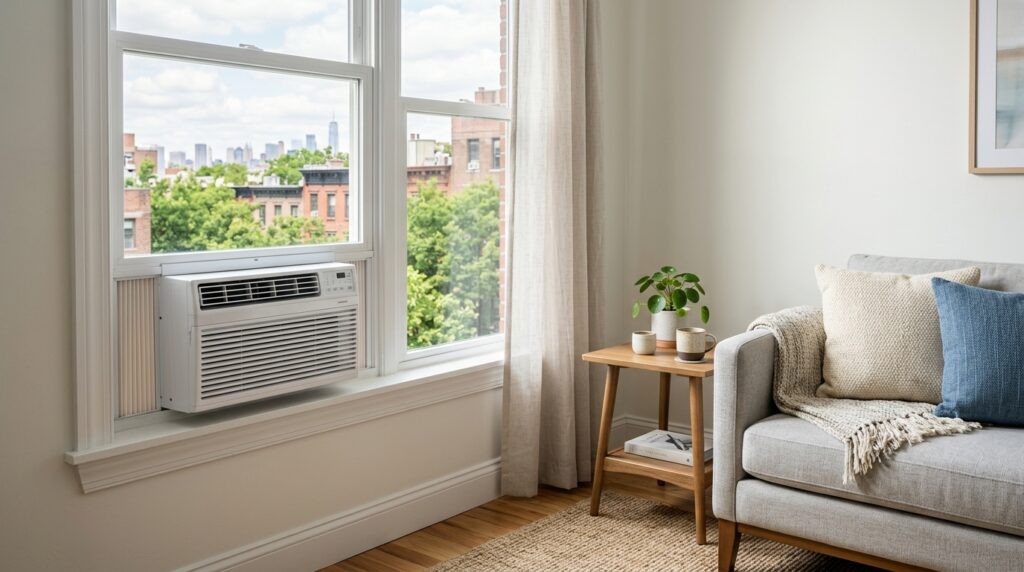
A window AC unit remains one of the most practical and affordable ways to cool a single room or small living space. With prices typically ranging from $150 to $600 and installation that often takes less than an hour, these compact cooling systems continue to serve millions of households across the United States. But the landscape is shifting. New federal efficiency standards, refrigerant regulations, and the rise of inverter technology are reshaping what buyers should look for in 2025 and beyond.
This guide covers everything you need to know before purchasing a window AC unit, from proper sizing and energy efficiency ratings to the regulatory changes that will affect pricing and availability in the coming years.
How Does a Window AC Unit Work?
A window air conditioner operates on the same refrigeration cycle used by central air systems and heat pumps. Warm indoor air is drawn over an evaporator coil containing cold refrigerant, which absorbs heat and moisture from the air. The now-cooled air is blown back into the room, while the absorbed heat is expelled outside through a condenser coil and exhaust fan mounted on the exterior side of the unit.
All of the essential components, including the compressor, expansion valve, evaporator, condenser, and fans, are housed in a single chassis that sits in a window opening. This self-contained design is what makes window AC units so straightforward to install compared to split systems or central air. If you are exploring other cooling and heating technologies, our guide on types of heat pumps covers options that can both heat and cool your home.
What Size Window AC Unit Do I Need?
Choosing the correct size is the single most important decision when buying a window AC unit. An undersized unit will run constantly without adequately cooling the room, while an oversized unit will cycle on and off too frequently, wasting energy and failing to properly dehumidify the air.
BTU Sizing Guidelines
Window AC units are rated in BTUs (British Thermal Units), which measure cooling capacity. Units are available in sizes ranging from 5,000 to 12,000 BTU, with most residential models designed to cool rooms between 100 and 300 square feet. Use the following table as a starting point:
| Room Size (sq ft) | Recommended BTU |
|---|---|
| 100 to 150 | 5,000 |
| 150 to 250 | 6,000 to 7,000 |
| 250 to 350 | 8,000 |
| 350 to 450 | 9,000 to 10,000 |
| 450 to 550 | 12,000 |
Factors That Affect Sizing
Square footage alone does not tell the whole story. You should also consider:
- Sun exposure: Rooms that receive heavy direct sunlight may need 10% more BTU capacity.
- Ceiling height: Standard sizing assumes 8-foot ceilings. Taller ceilings increase the volume of air to cool.
- Occupancy: Rooms regularly used by more than two people generate additional body heat.
- Kitchen use: If the unit cools a kitchen, add roughly 4,000 BTU to account for cooking heat.
- Insulation quality: Poorly insulated rooms or those with many windows lose cool air faster.
Understanding Energy Efficiency Ratings
Energy efficiency determines how much cooling you get per watt of electricity consumed. For window AC units, the key metric is the Combined Energy Efficiency Ratio (CEER). A higher CEER means the unit converts more electricity into cooling and less into waste heat.
ENERGY STAR certified window AC units use about 10% less energy than conventional models, which can translate into meaningful savings over a summer season. The ENERGY STAR program, jointly administered by the EPA and DOE, provides a searchable database of certified models.
Operating Costs
Window air conditioners typically draw between 500 and 1,500 watts of power, with most standard units using around 900 watts during normal operation. In practical terms:
- Daily cost: $1 to $2.50, depending on unit size, efficiency, and local electricity rates.
- Monthly cost: Approximately $30 to $75 when used regularly throughout the summer.
Inverter technology, which adjusts compressor speed continuously rather than cycling on and off, can reduce electricity consumption by 15% to 40% compared to traditional fixed-speed models. As of 2024, inverter-based systems held approximately 65% of the US room AC market share, favored for their lower running costs and compliance with federal energy standards.
New Regulations Affecting Window AC Units in 2025 and 2026
Two major regulatory changes are reshaping the window AC unit market. Buyers should understand both to make informed purchasing decisions.
Refrigerant Transition
Beginning January 1, 2025, new residential and light commercial air conditioners manufactured in the United States must use refrigerants with lower Global Warming Potential (GWP), such as R-32 and R-454B. The widely used R-410A refrigerant can no longer be used in new AC systems manufactured after that date.
For window AC units specifically, which do not require field assembly, the final date of sale for units manufactured before January 1, 2025, that still use higher-GWP refrigerants is January 1, 2028. This means you may still find R-410A window units on store shelves for a few more years, but the industry is clearly moving toward lower-GWP alternatives. The U.S. Department of Energy has published guidance on these transitions for both consumers and manufacturers.
Updated Efficiency Standards
New energy efficiency standards finalized by the DOE in 2023 will take effect in 2026. These standards will:
- Increase the minimum CEER from 11.0 to 12.8 for smaller window AC units with cooling capacity under 8,000 BTU/h.
- Effectively require variable-speed (inverter) compressors for larger units above 8,000 BTU/h.
The practical impact for consumers is that units manufactured after 2026 will be more efficient out of the box, but they may also carry slightly higher purchase prices due to the more advanced compressor technology required.
Key Features to Look For
The modern window AC unit has evolved well beyond a simple on/off cooling box. Here are the features worth prioritizing.
Inverter Compressor
As noted above, inverter compressors modulate speed to match cooling demand rather than running at full blast and shutting off repeatedly. This results in quieter operation, more consistent temperatures, and significantly lower energy bills.
Smart Connectivity
Many current models from brands like Midea, LG, GE Profile, and Windmill offer Wi-Fi connectivity, smartphone app control, and voice assistant integration with Amazon Alexa or Google Assistant. Scheduling features let you pre-cool a room before you arrive home, and some units include motion sensors that adjust output based on room occupancy.
Air Quality Features
Some window AC units now include enhanced filtration or UV-C technology to help reduce airborne particles and biological contaminants. While a window unit is not a substitute for a whole-home air quality strategy, these features can provide incremental benefits. For a broader look at keeping your indoor air clean, see our article on how to improve home air quality with your HVAC system.
Noise Level
Noise is a common concern with window AC units. Look for models that advertise decibel ratings in the low-to-mid 40 dB range for indoor operation. Inverter models tend to be quieter because the compressor runs at lower speeds most of the time rather than cycling between full power and off.
Installation Tips and Best Practices
Proper installation affects both performance and safety. Follow these guidelines:
- Measure your window: Confirm that the unit fits your window opening. Most window AC units are designed for double-hung (vertical sliding) windows, but models for casement (side-opening) windows also exist.
- Ensure structural support: Larger units can weigh 50 to 80 pounds. Use a support bracket if the window sill cannot bear the weight.
- Tilt slightly outward: A slight backward tilt allows condensation to drain outside rather than pooling inside the unit or dripping into the room.
- Seal gaps: Use the foam insulation strips and side panels included with the unit to seal the space around the chassis. Gaps allow hot air infiltration and reduce efficiency.
- Check your electrical circuit: Most window AC units plug into a standard 115-volt outlet, but larger units (10,000+ BTU) may require a dedicated 230-volt circuit. Never use an extension cord.
Maintenance for Longevity
With proper maintenance, a window air conditioner can last between 10 and 15 years. A few routine tasks will keep your unit running efficiently:
- Clean or replace the filter: Check the filter every two weeks during heavy use. Most window units have reusable mesh filters that can be rinsed with water and air-dried.
- Clear the condensate drain: A clogged drain causes water to back up and leak into the room or freeze on the evaporator coil.
- Clean the coils: At least once per season, gently vacuum or brush dust and debris from the evaporator and condenser coils.
- Inspect the window seal: Over time, foam insulation strips can compress or deteriorate, allowing air leaks. Replace them as needed.
- Off-season storage: If you remove the unit for winter, store it upright in a dry location and cover it to prevent dust accumulation.
Top Window AC Unit Brands in 2025
Several manufacturers consistently receive strong reviews from consumers and industry publications:
- Midea: Known for offering strong value and inverter models at competitive price points.
- LG: Offers a wide range of sizes with smart connectivity and quiet operation.
- Frigidaire: A long-standing name in room air conditioning with reliable, budget-friendly options.
- GE Profile: Features premium smart models with sleek designs.
- Friedrich: Targets the higher end of the market with commercial-grade build quality and advanced filtration.
- Windmill: A newer brand focused on modern design, quiet operation, and app-based controls.
If you are also considering systems that provide both cooling and heating, you may want to explore heat pump options for homeowners, as some window-style heat pumps can serve dual purposes.
Frequently Asked Questions
Will window AC units be banned in 2025 or 2026?
No. Window AC units are not being banned. However, new federal regulations require units manufactured after January 1, 2025, to use lower-GWP refrigerants instead of R-410A. Additionally, stricter minimum efficiency standards take effect in 2026. These changes affect what manufacturers produce, not whether consumers can buy or use window AC units.
How much electricity does a window AC unit use per month?
Most window AC units draw between 500 and 1,500 watts during operation. For a standard unit using around 900 watts, expect monthly electricity costs of approximately $30 to $75 when running regularly throughout the summer, depending on your local utility rates and usage patterns.
How long does a window air conditioner typically last?
With proper maintenance, including regular filter cleaning, coil care, and drain clearing, a window AC unit can last between 10 and 15 years. Units that run in harsh conditions or receive little maintenance may have shorter lifespans.
Why is my window AC unit leaking water inside?
Indoor water leaks are usually caused by a clogged condensate drain, improper installation angle (the unit should tilt slightly outward), or a dirty filter restricting airflow and causing the evaporator coil to freeze and then thaw. Check all three before calling for service.
Are inverter window AC units worth the extra cost?
In most cases, yes. Inverter models can reduce electricity consumption by 15% to 40% compared to traditional fixed-speed compressors. They also run more quietly and maintain more consistent room temperatures. Given that the 2026 efficiency standards will effectively require variable-speed compressors for larger units, inverter technology is becoming the industry standard.
Can a window AC unit also heat a room?
Some window AC units include a heat pump mode or electric resistance heating element that allows them to provide warmth during cooler months. These models cost more upfront but offer year-round climate control from a single unit. For a deeper comparison of heating technologies, the U.S. Department of Energy provides resources on heat pump efficiency and selection.
What is the best way to improve air quality with a window AC unit?
Start by cleaning or replacing the unit’s filter regularly. Some models offer enhanced filtration or UV-C features that can help reduce airborne particles. For a more comprehensive approach, consider pairing your window unit with standalone air purifiers or exploring whole-home solutions. Our guide on how to improve home air quality with your HVAC system covers additional strategies.