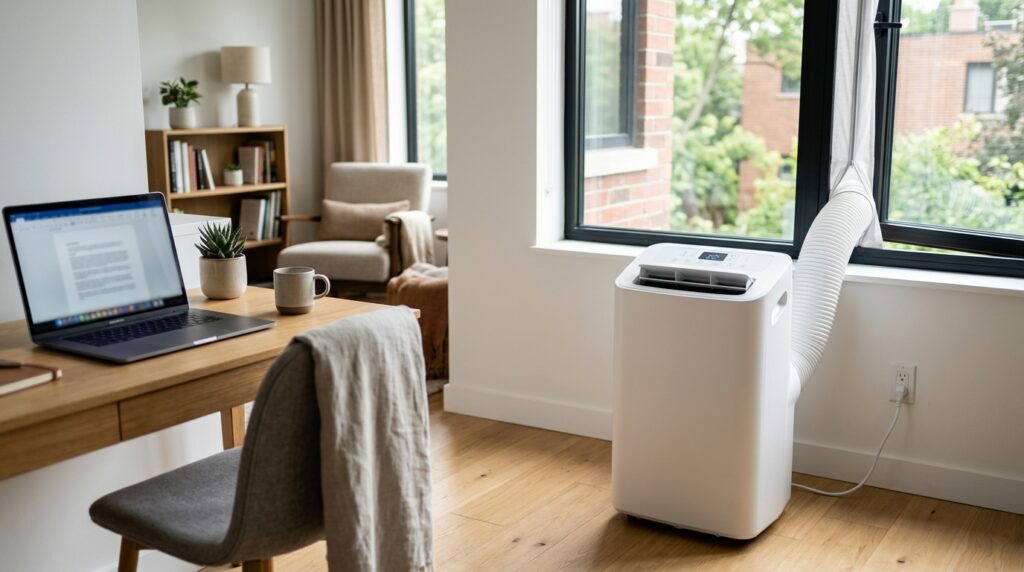
What Is a Portable Air Conditioner?
A portable air conditioner is a compact, self-contained cooling device designed to lower the temperature in a single room. Unlike window units or central HVAC systems, a portable AC sits on the floor, draws warm air from the room, passes it over refrigerant-cooled coils, and sends cooled air back into the space. The heat it extracts is expelled outdoors through an exhaust hose that typically vents through a window kit included with the unit.
Because these units require no permanent installation and no professional help to set up, they have become a popular solution for renters, homeowners without ductwork, and anyone who needs flexible, room-by-room cooling. The global portable air conditioner market was valued at USD 3.24 billion in 2024 and is projected to reach USD 4.3 billion by 2032, growing at a compound annual growth rate of 3.6%.
How Does a Portable Air Conditioner Work?
Every portable AC relies on the same vapor-compression refrigeration cycle used in larger systems. A compressor pressurizes refrigerant, which absorbs heat from indoor air as it evaporates inside the unit. The now-warm refrigerant is compressed again, releasing that heat into the exhaust airstream, which is pushed outdoors through the hose. Condensate, the moisture pulled from the air, is either collected in an internal tank, drained through a hose, or partially evaporated and expelled with the exhaust air.
Single-Hose vs. Dual-Hose Systems
The most important design distinction in portable air conditioners is the number of hoses:
- Single-hose units use one hose to vent hot air outside. Because they pull room air to cool the condenser and then exhaust it, they create negative pressure inside the room. This draws warm outside air in through gaps around doors and windows, reducing net cooling. Single-hose models dominated the global market in 2024 due to their lower price point.
- Dual-hose units use a second hose to draw outside air specifically for condenser cooling, so they do not depressurize the room. Dual-hose systems can be up to 20% more efficient than single-hose systems and are expected to grow at the highest rate in the coming years thanks to their superior performance in larger spaces.
Sizing: What BTU Rating Do You Need?
Cooling capacity is measured in BTUs (British Thermal Units). Choosing the right size is critical: an undersized unit will run constantly without reaching a comfortable temperature, while an oversized unit may short-cycle and fail to dehumidify properly.
| Room Size (sq ft) | Recommended BTU (SACC-adjusted) |
|---|---|
| Up to 200 | 8,000 BTU |
| 200 to 350 | 10,000 BTU |
| 350 to 500 | 12,000 BTU |
| 500+ | 14,000 BTU or consider a split system |
Note that traditional ASHRAE BTU ratings can overstate real-world performance. The SACC (Seasonally Adjusted Cooling Capacity) metric, which accounts for heat leakage back through the exhaust hose, gives a more realistic picture. When comparing models, always check the SACC rating rather than the headline BTU number. If you are exploring whole-home solutions beyond portable units, our guide to types of heat pumps covers systems that can both heat and cool an entire house.
Energy Efficiency: What the Numbers Mean
Portable air conditioners are convenient, but they are not the most efficient cooling option. A typical portable AC uses 30 to 50 percent more electricity than a comparable window unit for the same cooling output. Understanding efficiency ratings helps you minimize that gap.
Key Efficiency Metrics
- EER (Energy Efficiency Ratio): Cooling output in BTUs divided by watts consumed at a single test condition.
- CEER (Combined EER): Includes standby power consumption, giving a more complete efficiency picture.
- SACC: Factors in the heat that re-enters the room through the exhaust hose, making it the most accurate metric for portable units.
The U.S. Department of Energy (DOE) sets minimum efficiency standards for portable ACs. New federal efficiency standards that took effect on January 10, 2025, require all single-duct and dual-duct portable air conditioners manufactured on or after that date to meet updated minimum efficiency ratios and certification requirements through the DOE’s Compliance Certification Management System (CCMS). Products sold in California must also be certified to the California Energy Commission’s Modernized Appliance Efficiency Database System (MAEDbS). Look for the Energy Star label as a quick way to identify models that exceed baseline efficiency requirements.
2025 and 2026 Regulatory Changes
Several regulatory shifts are reshaping the portable air conditioner landscape right now.
Refrigerant Transition
Beginning January 1, 2025, the U.S. EPA, under the American Innovation and Manufacturing (AIM) Act, restricts the use of high global warming potential (GWP) hydrofluorocarbons (HFCs) in residential and light commercial air conditioning, including portable room ACs. Older refrigerants like R-22 are long gone; even R-410A is being phased down. Manufacturers are transitioning to lower-GWP alternatives such as R-32, R-454B, and hydrofluoroolefins (HFOs). When shopping, check the refrigerant type listed on the spec sheet to ensure you are buying a future-proof unit.
Rental Housing Cooling Mandates
New laws are making portable ACs more relevant for renters:
- Los Angeles County (August 12, 2025): An indoor air temperature mandate requires rental housing providers to maintain habitable rooms at 82 degrees Fahrenheit or cooler, with enforcement starting January 1, 2027, or when a cost study is finalized.
- Washington State (Effective June 11, 2026): A new law (ESSB 6200) generally prohibits landlords from restricting tenants from installing portable cooling devices, including window-mounted and floor-standing units.
These regulations are likely to drive further adoption of portable air conditioners in rental markets across the country.
Noise Levels: How Loud Are Portable Air Conditioners?
Because the compressor sits inside the room with you, noise is the most common complaint about portable ACs. Most units operate between 40 and 60 decibels (dB), which is roughly comparable to a normal conversation at the low end and a running dishwasher at the high end. Higher fan speeds increase noise noticeably.
If noise is a concern, look for models with inverter compressors, which ramp up and down gradually rather than cycling on and off at full power. The emerging category of portable split ACs, expected to gain traction in 2026, places the compressor in a small outdoor unit, dramatically reducing indoor noise while retaining the mobility advantage. For broader strategies on keeping your indoor environment comfortable and healthy, see our article on how to improve home air quality with your HVAC system.
Pros and Cons of a Portable Air Conditioner
Advantages
- No permanent installation: Set up in minutes with the included window venting kit. No drilling, no brackets, no landlord approval in most cases.
- Mobility: Roll the unit from room to room on built-in casters.
- Lower upfront cost: Generally more affordable than mini-split or central systems.
- Dehumidification: Most models double as dehumidifiers, useful in humid climates.
- Smart features: Wi-Fi connectivity, app control, and IoT integration are becoming standard rather than premium add-ons in 2025 and beyond.
Disadvantages
- Lower efficiency: Uses 30 to 50 percent more electricity than a window unit of comparable capacity.
- Noise: Indoor compressor means 40 to 60 dB during operation.
- Exhaust hose requirement: Must vent to the outdoors, limiting placement to rooms with a suitable window or opening.
- Floor space: The unit itself occupies several square feet of living area.
- Limited cooling range: Designed for single rooms, not whole-home cooling.
Maintenance and Lifespan
The lifespan of a portable air conditioner typically ranges from 5 to 10 years with proper care. Routine maintenance is straightforward:
- Clean or replace the air filter every two to four weeks during heavy use. A clogged filter forces the compressor to work harder and reduces cooling output.
- Drain the condensate tank regularly, or set up a continuous drain hose if your model supports one. Standing water can promote mold growth.
- Inspect the exhaust hose for kinks, cracks, or loose connections. A compromised hose leaks heat back into the room.
- Wipe down the exterior and vents to prevent dust buildup.
- Store properly during the off-season: drain all water, clean the filter, and keep the unit upright in a dry location.
If you are interested in adding UV-based air purification to your HVAC setup for additional indoor air quality benefits, our guide on UV light HVAC systems explains how the technology works.
What to Look for When Buying a Portable Air Conditioner
With dozens of models on the market, here is a practical checklist:
- SACC rating: Match it to your room size using the table above.
- Hose type: Dual-hose for larger rooms or hot climates; single-hose for smaller spaces on a budget.
- Noise rating: Check the dB level at the fan speed you plan to use most.
- Refrigerant type: Prefer R-32 or R-454B for regulatory compliance and lower environmental impact.
- Smart features: Wi-Fi, voice assistant compatibility, and programmable timers add convenience.
- Drain method: Auto-evaporative models require less manual draining.
- Window kit compatibility: Measure your window before purchasing. Sliding and casement windows may need different kits.
Notable models frequently cited in 2025 and 2026 recommendations include the Midea Duo MAP14S1TBL (a dual-hose inverter unit), the Whynter ARC-14S (a long-standing dual-hose favorite), the LG Dual Inverter LP1419IVSM, and the battery-powered EcoFlow WAVE 3 for off-grid use.
Can a Portable Air Conditioner Cool an Entire House?
In short, no. A single portable AC is designed to cool one room at a time. Even the largest residential portable units top out around 14,000 BTU, which is suitable for roughly 500 to 600 square feet under ideal conditions. Whole-home cooling requires a central air system, a ductless mini-split setup, or multiple units strategically placed throughout the home. Our overview of heat pump types for homeowners covers whole-home alternatives in detail.
Frequently Asked Questions
Do portable air conditioners need to be vented outside?
Yes. Every portable AC must exhaust hot air through a hose to the outdoors. Without proper venting, the unit recirculates heat back into the room and provides no net cooling. The included window kit makes this easy in most cases, but you can also vent through a drop ceiling, a dryer vent opening, or a purpose-cut wall panel.
Are portable air conditioners energy efficient?
They are less efficient than window units or mini-splits. A typical portable AC uses 30 to 50 percent more electricity than a window unit of comparable capacity. Dual-hose models and those with inverter compressors narrow the gap. Always compare SACC ratings and look for the Energy Star label.
How loud are portable air conditioners?
Most operate between 40 and 60 dB. At the low end, that is similar to a quiet library; at the high end, it is comparable to a running dishwasher. Inverter models and the newer portable split ACs tend to be quieter.
Can I lengthen the exhaust hose on a portable air conditioner?
Manufacturers generally advise against extending the exhaust hose beyond its original length. A longer hose increases airflow resistance, forces the compressor to work harder, and can cause the unit to overheat or shut down. If the included hose does not reach your window, reposition the unit rather than extending the hose.
What size portable air conditioner do I need?
Use the SACC rating, not the traditional BTU number, to match the unit to your room. As a general guide: 8,000 BTU for rooms up to 200 square feet, 10,000 BTU for 200 to 350 square feet, and 12,000 BTU for 350 to 500 square feet. Rooms with high ceilings, direct sun exposure, or heavy heat-generating equipment may need a step up.
How long do portable air conditioners last?
With proper maintenance, including regular filter cleaning, condensate draining, and careful storage, a portable air conditioner typically lasts 5 to 10 years.
What refrigerant do modern portable air conditioners use?
Older models used R-22 or R-410A, but EPA regulations under the AIM Act are phasing down high-GWP HFCs starting in 2025. Current and upcoming models increasingly use R-32, R-454B, or HFO-based refrigerants with significantly lower global warming potential.